






Buying guides
Best Chicken Runs: What Actually Matters
The best chicken run gives each bird enough ground to scratch, is covered on top, is wrapped in welded mesh with the bottom edge protected against digging, and is easy to walk into for cleaning. Work out your flock's space first, then check the wire, roof and base. Start with our chicken runs and use the checks below.

By Matt GarnettUpdated November 13, 20264 min read2 sources
How much run does a flock need?
Penn State Extension's housing table puts outdoor run space at 4 square feet per bantam, 8 square feet per laying hen and 10 square feet per large chicken. That is a floor for birds that go back into a coop at night, not a generous allowance, and a run that holds its birds all day should lean toward the top of those numbers or beyond.
In practice that means six laying hens want about 48 square feet at minimum, which is roughly a 6 by 8 foot enclosure, and six large birds want 60 square feet. Small runs wear down to bare dirt fast, so more space also means less mud and less parasite buildup. Remember the coop counts separately: see our guide to chicken coop size for the indoor figures.
Mesh, roof and the top of the run
A run is only as safe as its weakest panel. Oregon State Extension recommends enclosing the run in 1 by 2 inch mesh and covering the top with netting or wire, and Penn State says runs should be covered against hawks and owls. A roof also stops climbing predators from dropping in, and keeps wild birds from landing on feed.
When you compare runs, look at what the roof is made from and how it attaches to the frame. A solid or shaded roof section helps with rain and sun; a mesh-only roof helps with predators. Many owners want both: a mesh roof over most of the run and a solid panel over the feeding and watering area.
Protecting the base against diggers
Penn State suggests burying run wire at least 12 inches deep and bending the bottom edge outward about 6 inches, since animals tend to dig straight down at the fence line. Oregon State gives a range of 6 inches to 1 foot. Coarse gravel along the base also discourages digging, and so does starting walls with one or two concrete blocks.
Most ready-made runs sit on the surface with no buried wire, which is fine for a daytime enclosure when the birds sleep in a secure coop but not for a run that holds birds overnight. If you buy one that sits on the ground, plan to add a skirt of mesh laid flat and pegged outward, or pavers around the edge. Our guide to a predator proof chicken coop covers adding these to an existing setup.
Run types compared
A large walk-in run, such as a 17 by 15 foot run with a cover, suits a bigger flock and lets you stand up to clean, fill feeders and chase down a hen when needed. The trade-off is the footprint and the effort of fixing it down in wind.
Smaller modular runs, like a combinable wooden run with perches of about 4.6 by 2.8 feet, let you expand in sections, but each unit is tiny, so check the total square footage against the per-bird figures above. An all-in-one coop with an extra large run is the simplest purchase for a small flock, provided the run area alone still works out to the space you need.
Shade, drainage and the ground itself
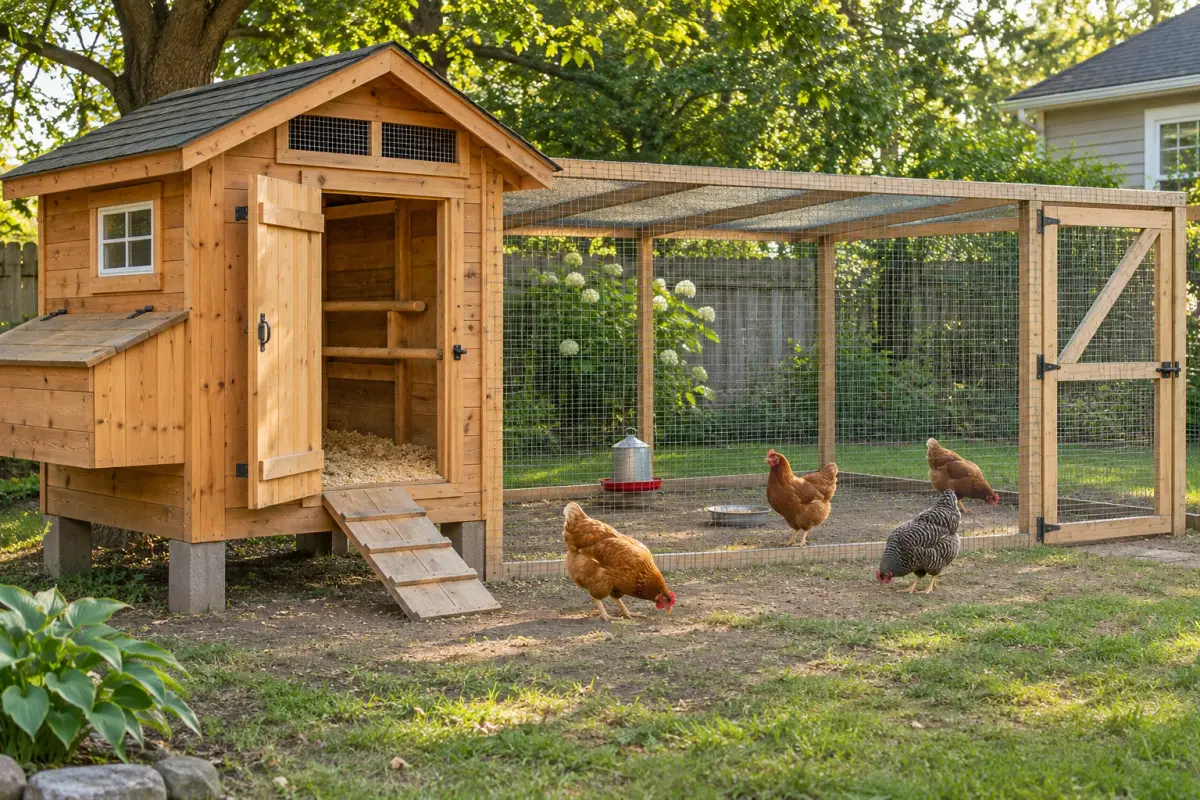
Chickens cope with cold better than with heat, so part of every run should be shaded all day, whether by a solid roof panel, a tarp, or a planted shrub outside the wire. Penn State also notes building on well-drained ground; a run on low soil turns to mud, which spreads disease and rots wooden frames.
Rotating or resting sections of ground helps grass recover. Where it cannot, use deep litter, such as wood chips, to keep the surface dry and absorb droppings. Add a dust bath area, which chickens use to keep clean; our guide to chicken dust baths covers how to build one.
Which run suits which owner
With two to four hens, a compact run attached to the coop is workable if the birds can also free range under supervision, and our guide to chickens and gardens explains how to keep them off the vegetable beds. With six or more birds, the walk-in design earns its footprint, because daily maintenance is faster when you can step inside.
Anyone with dogs should read chickens and dogs before choosing a run, since a dog that fixates on the birds will test every latch. Whatever you pick, pair it with a coop sized for the same flock from our chicken coops, and a feeder and waterer set from chicken feeders and waterers. When you are ready to compare, browse chicken runs again with your square-foot figure in hand.
Poultry-run structures and measured areas
| Structure | Physical arrangement | What to measure separately |
|---|---|---|
| Walk-in | A taller covered enclosure | Ground footprint and usable headroom |
| Modular | Several units join together | Combined space and every connection |
| Coop-and-run | Shelter attached to an exercise section | Run area separately from the coop |
| Covered frame | Frame supports mesh or fabric | Deployed cover and fixing points |
Common questions
How big should a chicken run be?
Penn State Extension lists 8 square feet per laying hen, 10 for large chickens and 4 for bantams in an outdoor run. Treat those as minimums and add space if the birds are confined to the run all day.
Does a chicken run need a roof?
Yes. Oregon State Extension advises covering the top of the run with netting or wire, and Penn State recommends covering runs against hawks and owls. A roof also stops climbing predators from dropping in.
How deep should chicken run fencing be buried?
Penn State suggests burying run wire at least 12 inches deep with the bottom edge bent outward about 6 inches. Oregon State gives a range of 6 inches to 1 foot, so deeper is safer.
Can I use a run without a coop?
A run is an outdoor yard, not a shelter. Chickens still need a coop with a roost and nest boxes for night and bad weather, and it is safest to lock them inside it before dark.
What size mesh is best for a chicken run?
Oregon State Extension recommends 1 by 2 inch mesh for run fencing, and Penn State advises heavy-gauge mesh on windows and doors. Smaller openings keep out small predators but thin wire can still be torn.
Sources we checked
This guide is general information, not veterinary advice. If your pet is unwell or injured, contact your veterinarian.


