






Buying guides
Best Chicken Coops: What Actually Matters
The best chicken coop is the one with enough floor space for your flock, a roost and nest boxes sized to it, ventilation that doesn't blow on sleeping birds, and a build that predators cannot open or chew through. Size by flock first, check latches and wire second, and look at style last. Start with our chicken coops and use the checks below.
By Matt GarnettUpdated November 13, 20265 min read2 sources
Size the coop to the flock, not the label
Sellers often rate a coop by how many chickens it holds, and those ratings tend to be generous. Do the arithmetic yourself. Extension sources do not agree on one number: Penn State Extension's housing table gives laying hens about 1.5 square feet inside and 2 square feet for large breeds, with 8 to 10 square feet each in an outdoor run, while Oregon State Extension suggests at least 3 square feet per bird when there is a run and 8 to 10 square feet per bird when there is not.
The practical reading is that the Penn State figures are a bare minimum for birds that spend the day outside, and 3 square feet per bird is a comfortable target. Four standard hens therefore want roughly 12 square feet of coop floor, and six want about 18. Bantams need less, large breeds more. If you might add birds later, buy for the bigger flock now; our guide to chicken coop size walks through the math in more detail.
Roosts and nest boxes decide whether the coop works every day
Chickens sleep on a roost, not on the floor, so a coop needs one. Penn State suggests about 6 inches of roost per standard bird (4 inches for bantams), set roughly 18 to 24 inches off the floor and kept away from the nest boxes so droppings don't foul eggs. Oregon State allows 5 to 10 inches per bird. Check that the roost in any coop you are considering is long enough for your whole flock to perch at once, and that it is a flat-ish bar a hen can grip, not a thin dowel. See chicken roosts for shapes and heights.
Nest boxes should be about 12 inches wide, deep and tall, with Oregon State recommending one box for every four hens and Penn State two for the first four. A box built into the side of a coop saves floor space, but make sure it has an outside lid so eggs can be collected without stepping in. Boxes should sit higher than the floor and not below the roost, otherwise hens end up sleeping in them. If a coop lacks enough boxes you can add some separately; our chicken nesting boxes cover that.
Ventilation without drafts
Chickens produce a lot of moisture and ammonia, so a closed-up coop is a problem even in winter. Oregon State says passive ventilation, meaning windows, wall or gable vents, and eave or roof vents, is enough for most backyard coops. Penn State adds that openings should stay out of the direct line of the perching area so sleeping birds are not in a draft, and that the side away from prevailing wind is usually best.
When you look at a coop, ask where the air goes. Vents high on the walls, above bird height, let moist air leave without blowing across the roost. A coop with one small window and a solid door is likely to feel stuffy by midsummer. Every vent also becomes a way in for predators, which is why the covering matters as much as the opening.
Predator-proofing: what to check on any coop
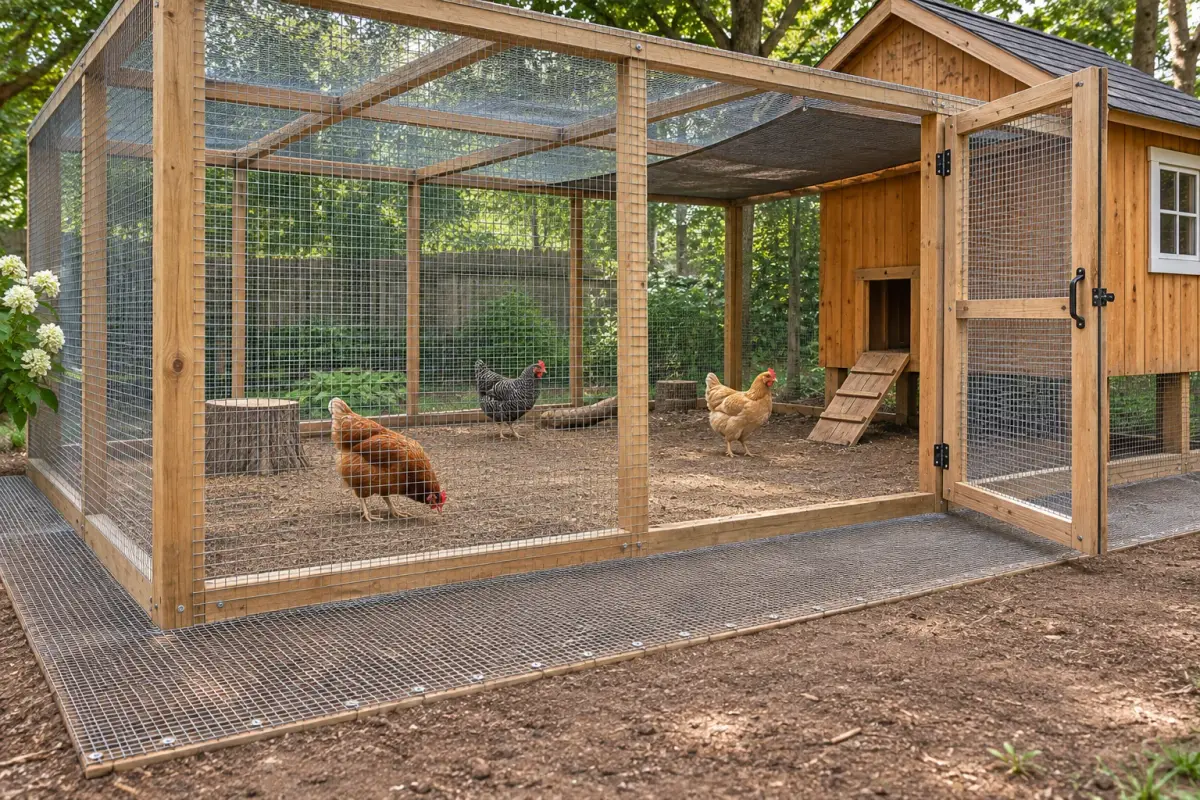
The usual failure is not a dramatic break-in; it is a latch a raccoon can work or a thin mesh it can tear. Oregon State says to close the flock inside at night, raise the coop at least a foot off the ground on a solid floor, and cover run fencing as well. Penn State advises screening windows and doors with heavy-gauge mesh. Light poultry netting keeps chickens in but is a weak barrier against anything with teeth or hands, so look for welded mesh on every vent and window.
Check the doors next. Look for latches that need two movements, such as a slide bolt with a clip, and for pop doors that close fully at night. A coop that sits flat on soil invites digging, so a raised floor or a skirt of buried wire helps. Our page on a predator proof chicken coop lists what to add if the coop you buy falls short.
Enclosed houses and mesh runs serve different purposes
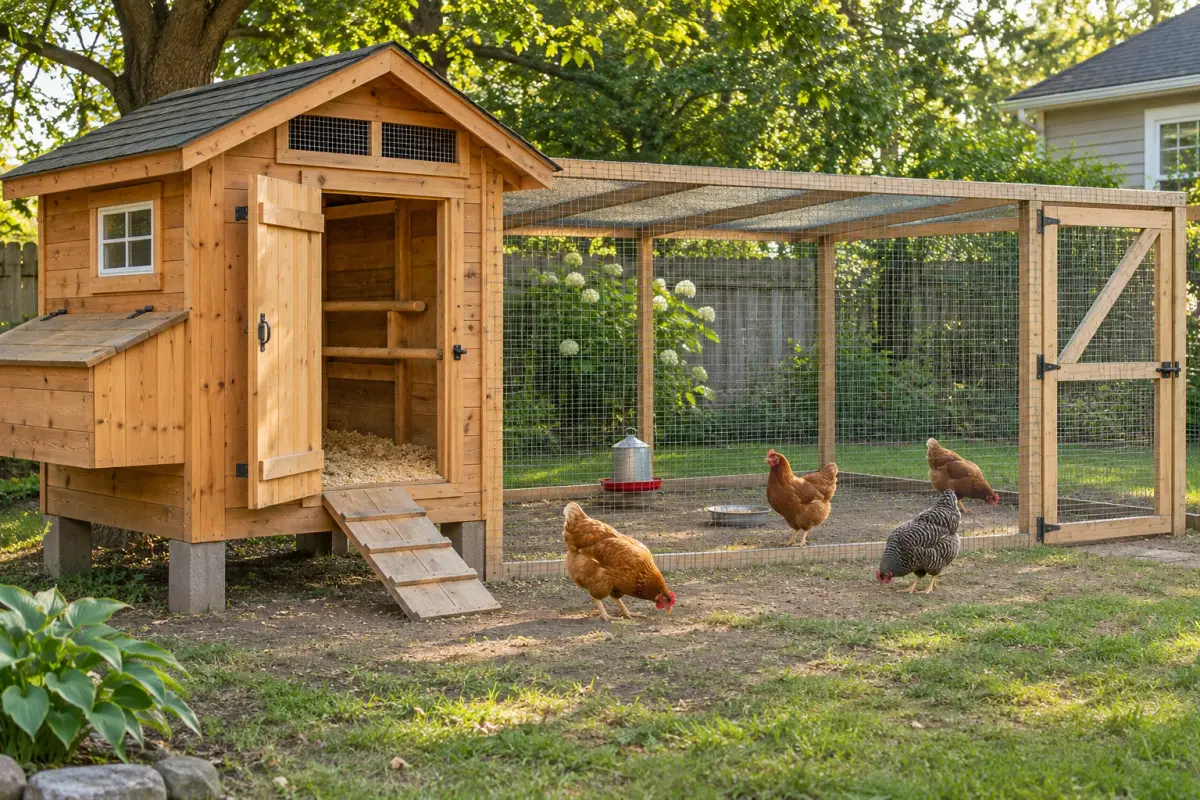
A wooden enclosed house provides an interior for roosting and laying. Check its usable inside floor, roosts, nest access, roof and ventilation separately from any attached outdoor section. Timber walls and a roof describe the structure; they do not establish the flock capacity or the condition of the finish.
The 31-foot domed poultry run with fabric shade covers is a mesh outdoor enclosure, with fabric covering sections of its curved roof. The pitched-roof chicken run with a tall lockable door is also a mesh run, with a cover panel over part of its roof. Their walk-in space can help with tending the birds, but neither should be described as an enclosed overnight house. Plan a separate suitable enclosed roosting area and assess its dimensions independently.
Which coop suits which flock
For a small flock, compare the enclosed house’s usable inside floor with the space guidance above, then measure the run separately. An attached run does not add indoor roosting floor. With a larger flock, check whether you can stand inside the enclosed house or reach its roosts, nest boxes and floor from the access doors. A human-height mesh run helps with outdoor access, but it does not by itself make indoor cleaning or egg collection a standing task.
If your winters are cold, prioritize a draft-free roost and good ventilation over thick insulation, and see chickens in winter. For deep bedding and cleaning routines, read our guide to chicken coop bedding and cleaning. When you are ready to compare designs, browse chicken coops, and consider pairing one with a chicken run and chicken feeders and waterers sized for the same flock.
Poultry shelter and run structures
| Structure | Physical arrangement | Verify before choosing |
|---|---|---|
| Wooden enclosed house | Timber walls and a roof around an interior | Inside dimensions,floor and cleaning access |
| Metal run | Mesh or wire enclosure over a ground area | Panel dimensions,roof or cover and fixings |
| Walk-in run | Enclosure with human-height entry | Door opening and footprint |
| House with attached run | An enclosed house joined to an outdoor section | House and run dimensions separately |
Common questions
How big should a chicken coop be for four chickens?
Extension guidance ranges from about 1.5 to 3 square feet per bird inside the coop when there is a run. Planning on 12 square feet for four standard hens gives comfortable room, and more if the birds will be shut in during bad weather.
How many nest boxes do six hens need?
Oregon State Extension recommends one box for about every four hens, which gives two for six birds. Penn State starts with two boxes for the first four hens, so two or three boxes is a safe plan.
Is a raised coop better than one on the ground?
Oregon State Extension advises raising the coop at least a foot off the ground with a concrete or solid wood floor. Raising it limits digging, keeps the floor drier and gives birds shade underneath, though a ramp is then needed.
Do chickens need a roost in the coop?
Yes. Chickens prefer to sleep off the floor, and Penn State suggests about 6 inches of roost per standard bird at 18 to 24 inches high, positioned away from the nest boxes so eggs stay clean.
Should a chicken coop have windows?
Openings are useful for airflow, but Penn State advises keeping them out of the direct path of the roost to avoid drafts, and screening windows and doors with heavy-gauge mesh so predators cannot get in.
Sources we checked
This guide is general information, not veterinary advice. If your pet is unwell or injured, contact your veterinarian.


