






Care & how-to
How to Build a Chicken Coop: Size, Layout and Predator Protection
To build a chicken coop, start with the flock size, then plan floor space, roosts, nest boxes, ventilation and predator protection around it. University extension guidance gives laying hens 1.5 to 3 square feet inside and about 8 to 10 in a run, a nest box for every four hens, and fencing buried at least a foot deep. Get these right and the rest, from siding to paint, is a matter of taste. A ready-made coop is the other route.
By Matt GarnettUpdated November 13, 20265 min read3 sources
Step 1: Decide how many birds and check local rules
Every other measurement in the build comes from the number of birds, so settle that first. Add a few birds to your count rather than building for exactly what you have, because flocks tend to grow, and a crowded coop is harder to keep clean and dry.
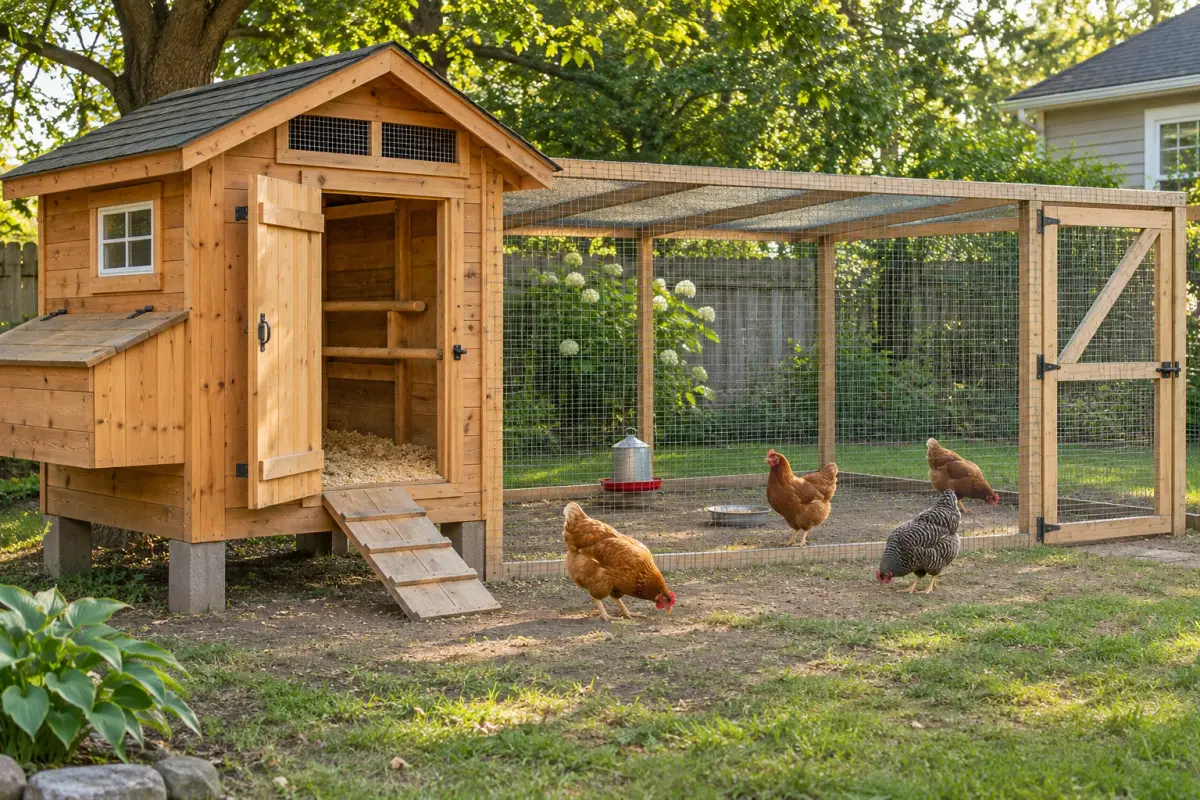
Before you buy materials, check your city or county rules and any homeowners association limits. Many places cap the number of hens, ban roosters and require the coop to sit a set distance from property lines. Penn State Extension also advises building on high, well-drained ground, with the front and run facing south so sun warms and dries the coop and soil.
Step 2: Work out floor and run space
Extension sources give a range rather than one number. Penn State Extension's minimums are 1 square foot inside and 4 in the run for bantams, 1.5 inside and 8 in the run for laying hens, and 2 inside and 10 in the run for large chickens. Oregon State University Extension recommends at least 3 square feet per bird if they have run access, and 8 to 10 square feet per bird inside if they have none.
The sensible way to read that is as a floor, not a target. If birds spend most of the day shut in, such as through a long winter, build toward the larger figures. For six standard hens, that means anywhere from 9 to 18 square feet inside, plus a covered run. Extension.org also lists sample plans from universities, including an 8 ft by 12 ft family-size laying house, if you want a worked example to follow.
Step 3: Add roosts and nest boxes
Chickens sleep on roosts, so give every bird room. Penn State Extension recommends 6 inches of roost per standard chicken, with roosts about 1 foot apart and 18 to 24 inches above the floor, and never more than 4 feet high. Oregon State suggests 5 to 10 inches per bird, on 1- to 2-inch lumber with rounded top edges, about 2 feet off the floor for most breeds. Keep roosts away from the nest boxes so eggs stay clean.
For nest boxes, both universities agree on about 12 by 12 inches. Penn State suggests two boxes for the first four hens and one more for every four after that, with a 3 to 4 inch front lip, 2 inches of clean dry bedding, and boxes placed in a dim, quiet corner at least 2 feet off the ground. Oregon State suggests a sloped roof on the boxes so birds cannot sleep on top.
Step 4: Plan ventilation without drafts
Chickens need fresh air even in winter, because damp air and ammonia from droppings cause trouble. Penn State Extension says dampness or an ammonia smell means ventilation is not adequate. Windows or vents on one side are usually enough for a small coop, and openings should not sit directly over the perching area, so cold air does not blow on sleeping birds.
Oregon State adds that passive ventilation, through wall windows or gable, eave or roof vents, is adequate for most coops, and that fans are only needed in hot, humid weather and should not blow directly on the birds. Sliding windows are better than swinging ones, since birds cannot perch on them. Cover every opening with heavy-gauge mesh.
Step 5: Protect against predators
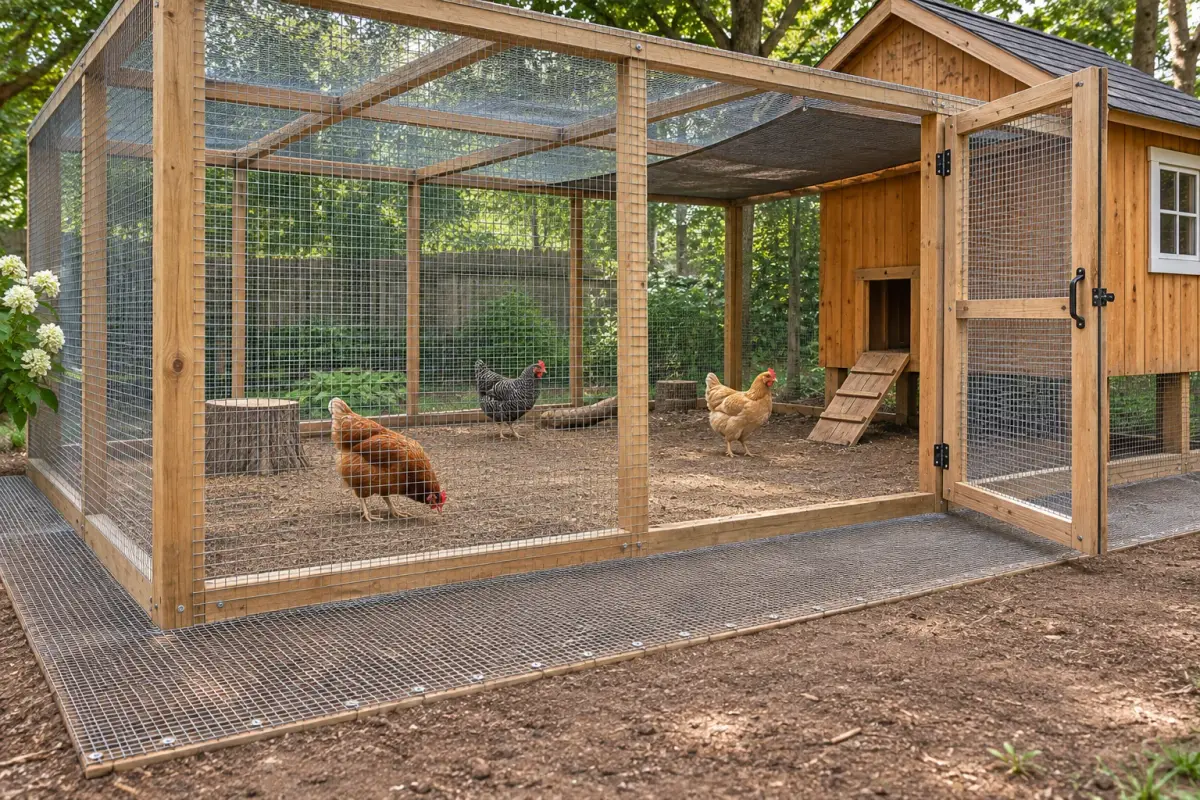
This is the step that decides whether the flock survives. Penn State Extension says fully confined birds with a fenced, covered run have the best protection. It advises burying fence wire at least 12 inches deep around the pen and turning it outward about 6 inches, covering runs with mesh or netting against hawks and owls, and using heavy-gauge mesh on windows and doors. Oregon State suggests a run of 1 by 2 inch mesh, raising the coop at least 1 foot off the ground, and a motion-detector light outside.
Shut the birds into the coop every night, since predators are most active in the dark. Keep large plants away from the coop, because they can shelter predators, and keep the coop close to the house, where human activity discourages wildlife.
Step 6: Floors, cleaning access and buying instead of building
Plan for cleaning from the beginning. Both universities recommend a floor that is easy to clean and slopes slightly so it drains when hosed, with Penn State favoring concrete in a new build and a block or two at the base of the wall to stop digging. Oregon State suggests weekly cleaning and doors that open outward so every corner is reachable. A roof high enough to work under comfortably saves your back.
If you would rather not build, a ready-made coop skips the cutting and framing, though the same space, roost, nest and predator rules apply to it. Browse our chicken coops and check each against the numbers above, such as a wooden chicken coop or a metal chicken coop, and compare the run with our chicken runs. Before you finish, return to our chicken coops to check dimensions against your flock size.
If a bird looks ill, talk to a veterinarian who treats poultry. This page is general information, not veterinary advice, and it cannot replace advice from a veterinarian who treats poultry.
Common questions
How big should a chicken coop be?
Extension guidance varies. Penn State suggests 1.5 square feet inside and 8 in the run per laying hen, while Oregon State suggests at least 3 square feet per bird with run access. More space is easier to keep dry and clean.
How many nest boxes do chickens need?
Penn State Extension suggests two boxes for the first four hens and one more for every four additional hens. Oregon State suggests one per four birds. Boxes should be about 12 by 12 inches.
How high should chicken roosts be?
Penn State suggests roosts 18 to 24 inches above the floor and never above 4 feet. Oregon State suggests about 2 feet for most breeds and about 1 foot for silkies, with 5 to 10 inches of roost per bird.
How deep should I bury fencing to keep predators out?
Penn State Extension advises burying fence wire at least 12 inches deep and turning it outward about 6 inches. Oregon State suggests 6 inches to 1 foot. Choose the deeper end where digging predators are common.
Does a chicken coop need ventilation in winter?
Yes. Penn State Extension says dampness or an ammonia smell means ventilation is inadequate. Provide openings that move air without blowing drafts directly on the birds while they roost.
Sources we checked
This guide is general information, not veterinary advice. If your pet is unwell or injured, contact your veterinarian.


