






Buying guides
Best Dog Collars: How to Choose the Right Collar and Fit
The best dog collar for most dogs is a flat buckle or clip collar in nylon or leather, fitted so two fingers slide underneath, carrying an ID tag. For dogs whose heads are narrow enough to back out of a flat collar, such as sighthounds, a martingale is safer. For long or sensitive coats, a rolled collar rubs less. Fit and hardware matter far more than looks.
By Matt GarnettUpdated November 9, 20264 min read2 sources
What matters most: fit, type and hardware
A dog collar has two jobs: carrying identification every day and, for some dogs, attaching a leash. Fit comes first. The AKC's guidance is to slide two fingers under the collar; if two will not fit it is too tight, and if more than two fit it is too loose. Measure your dog's neck rather than guessing from a size label, then add the two-finger allowance.
Type comes second, and it should match your dog's head and neck shape. Hardware comes third. A sturdy buckle or a quality side-release clip, a welded D-ring that will not open under load, and even stitching are what separate a collar that lasts from one that fails at the worst moment, such as when a dog lunges at a squirrel near a road.
The main collar types compared
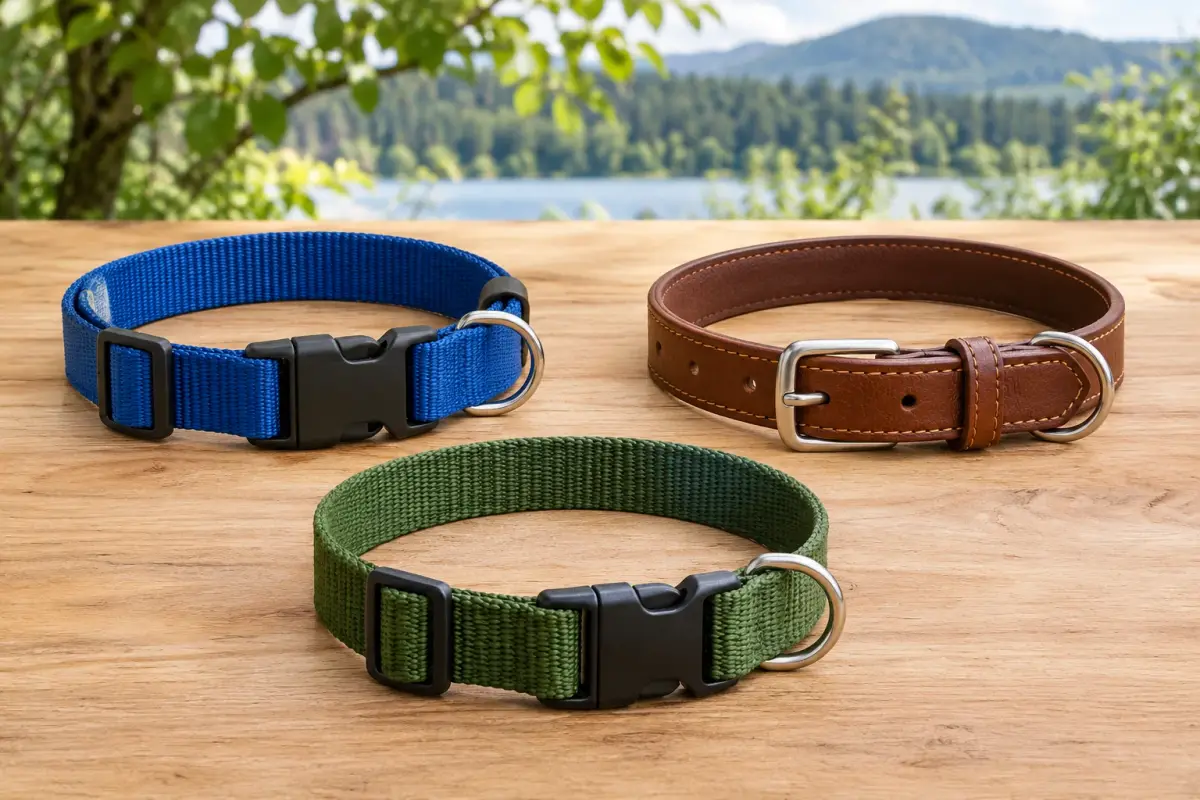
Flat collars with a buckle or a plastic clip are the standard. They are simple, hold an ID tag well and suit most dogs. Martingale collars have a second loop that tightens slightly when the dog pulls, which the AKC describes as stopping a dog slipping out without blocking the airway. They suit dogs with narrow heads, such as Greyhounds and Whippets, and dogs that back out of flat collars.
Rolled collars are round rather than flat, so they part the fur instead of flattening it, which reduces matting on long coats and rubbing on thin skin. Breakaway collars release under strong pressure, which can prevent a strangling accident if a collar catches on something, but a breakaway collar should not be used to attach a leash. Personalized collars with your phone number stitched on are a good backup to a tag.
Best collar for each dog
For a large dog, choose a wider collar, at least an inch, in thick nylon or leather with metal hardware, because wider webbing spreads pressure. For a small dog, a narrow, light collar is kinder, and for walks most small breeds do better on a harness, since their necks and windpipes are delicate. For a puppy, the AKC suggests an inexpensive nylon collar, because puppies outgrow collars quickly in their first year.
For a dog that pulls, a collar alone is not the answer; use a harness for walks and keep the collar for ID. For dogs that swim, biothane or coated webbing dries fast and does not smell. For walks before sunrise or after dark, reflective stitching or a light-up collar makes your dog visible to drivers.
Materials compared
Nylon is affordable, comes in many colors and is machine washable, but it can fray and hold odor if it stays wet. Leather is durable, softens with age and is comfortable on many coats, but it needs drying and conditioning after rain. Biothane and other coated webbings are waterproof, wipe clean and do not absorb smells, which makes them good for swimmers and muddy hikers.
Neoprene padding helps dogs with sensitive skin, and the AKC notes neoprene can help long-haired dogs whose coats mat easily. Whatever the material, check that edges are smooth and that no decorations, rhinestones or studs can snag or irritate the skin. Choose safety over style; a collar that catches on a crate wire is a real risk.
What to avoid
Avoid leaving a collar so loose that it slips over the ears, and avoid one so tight that it leaves a mark in the fur. Avoid dangling charms that can catch on a crate or fence, and remove collars in the crate or during rough play between dogs, since jaws and paws can get caught in a collar. Avoid relying on a collar to stop a dog that pulls hard; pressure on the throat can cause coughing.
Check the skin under the collar every week, especially on dogs with thick coats where problems hide. Redness, hair loss, a sore or a smell are signs the collar is too tight or staying wet. If your dog coughs or gags when the leash tightens, switch to a harness for walks and ask your vet whether the neck or windpipe needs checking.
How to measure, and when to replace it
Wrap a soft tape around the middle of your dog's neck, where the collar will sit, and note the number. Add about two inches for small and medium dogs and a little more for large dogs, then choose a collar whose adjustable range puts that number near the middle. Recheck fit monthly on puppies and after weight changes in adults.
Replace a collar when webbing frays, stitching loosens, a buckle cracks or the D-ring shows wear. Update the ID tag whenever your phone number or address changes. The AKC recommends ID on the collar even for microchipped dogs, because anyone who finds your dog can read a tag without a scanner.
Collar body and closure arrangements
| Construction | Physical distinction | Check on the selected collar |
|---|---|---|
| Flat | A flat strap closes with buckle or clip | Neck-fitting range and closure |
| Martingale | A second loop changes under pressure | Adjustment and exact instructions |
| Rolled | A round rather than flat collar body | Diameter,edges and coat contact |
| Breakaway | A release mechanism is part of the closure | Release instructions and separate leash arrangement |
| Personalized | Contact details added to a collar | The actual personalization and order-input process |
Common questions
What is the best collar for a puppy?
A light, adjustable nylon flat collar with an ID tag. Puppies grow fast, so check the two-finger fit every week or two and expect to buy several sizes in the first year.
What is the best dog collar for large dogs?
A wide collar, about an inch or more, in thick nylon, leather or biothane, with a metal buckle and welded D-ring. For walks, many large dogs that pull do better on a harness.
What is the best collar for small dogs?
A narrow, lightweight flat collar for ID, paired with a harness for walks. Small breeds have delicate necks, so avoid attaching a leash to the collar if your dog pulls.
Should my dog wear a collar all the time?
Most dogs should wear a collar with ID whenever they could slip out of the house. Take it off in the crate and during rough play, where a collar can catch on wire or another dog's jaw.
Sources we checked
This guide is general information, not veterinary advice. If your pet is unwell or injured, contact your veterinarian.


