






Buying guides
Best Martingale Collar: What Actually Matters
The best martingale collar suits a dog whose neck is about the size of its head, fits so the loop tightens only a little under tension, and has smooth hardware and strong stitching. Measure the neck first, check the fit with a finger or two, and use it for walks only, not as a training tool.
By Matt GarnettUpdated November 14, 20265 min read3 sources
What a martingale collar is for
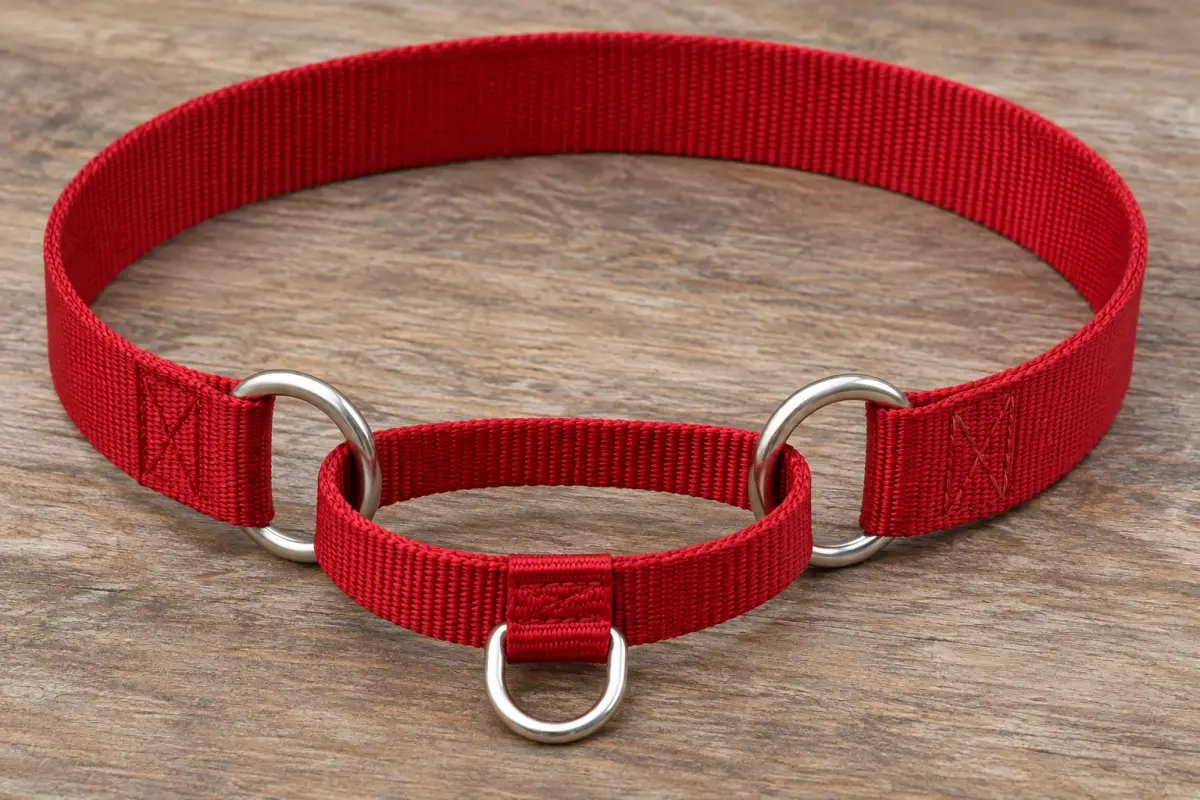
A martingale, also called a limited-slip collar, tightens slightly when the leash is pulled so a dog cannot back out of it. The American Kennel Club describes martingales as great for dogs whose necks are about the same size as their heads and who can slip out of flat collars, which is why they are common for sighthound-type and narrow-headed dogs. If your dog does not slip a flat collar, you may not need one at all. Browse our full martingale collars to see the styles.
It is a safety tool for walks, not a training aid. VCA Animal Hospitals notes that a martingale tightens when the leash is pulled but is not recommended as a training tool, and says the leash should never be snapped or jerked. A martingale's job is to stay on, not to correct behavior, and pulling is better handled with a well-fitted harness and positive training. See our dog harnesses if pulling is the main problem.
What matters most when choosing one
Fit is the first test. The AKC says clothing and gear fit starts with measuring, and that for a collar the measurement is neck girth only, taken around the base of the neck where the collar sits. For a martingale, the collar should sit high on the neck when tightened and still be loose enough to rest comfortably when the leash is slack. Choose the size whose adjustment range includes your dog's neck measurement near the middle, so you can fine-tune it, and check each brand's chart because sizing varies.
Construction is the second test. Look for a strong, wide webbing or leather band, a sturdy D-ring where the leash attaches, and stitching that is reinforced where the loop meets the band. A narrow, thin loop can bite into the neck, while a wide, smooth one spreads pressure. Hardware should be smooth, with no sharp edges that rub, and the loop should slide freely without catching on the fur.
Types and styles compared
A plain nylon martingale is the everyday choice: lightweight, easy to wash and available in many widths. A leather one is more durable and softer once broken in but needs care when wet. Chain-loop martingales are sold for strong dogs, but a smooth fabric loop is gentler and is the better start for most owners. A basic dog collar with a fixed buckle suits dogs that do not slip out, and a rivet-style pet collar is a heavier look for dogs that do not need limited-slip action.
For identification and style, an engraved or personalized dog collar keeps contact details readable, and for walks at night a glowing light-up dog collar helps drivers see your dog. Keep your dog's ID tags on a flat collar or a martingale with a tag ring; our dog collars collection has the full range.
Best type for each situation
For a narrow-headed dog that backs out of collars, a martingale with a wide band is the usual solution, with a separate ID tag attached. For a dog that pulls hard, use a harness for walks and keep the martingale as a backup attachment, since the AKC notes a loose collar lets a dog wiggle out and a harness spreads the load. For a nervous or newly adopted dog that might bolt, a martingale plus a secure leash adds a margin of safety.
For small or flat-faced dogs, check carefully: VCA says a well-fitted body harness puts minimal pressure on delicate tissue and is an excellent choice for dogs with neck pain or tracheal disease, so a dog with those problems may be better off in a harness than in any collar. Ask your vet if you are unsure about neck sensitivity or breathing problems.
What to avoid
Avoid prong, choke and shock collars. VCA lists these as designed to cause discomfort and advises against them, and a martingale is not a milder version of any of them. Avoid a loop so long that it tightens fully around the neck, and avoid leaving a martingale on in a crate, when playing with other dogs or when your dog is unattended, because the loop can catch on objects.
Avoid snapping or jerking the leash. VCA says the leash should never be snapped or jerked, and that applies to every collar. And avoid assuming one size fits all: a loose martingale can slip over the head, and a tight one rubs, so re-check the fit after grooming, weight change or growth.
How to size and check the fit
Measure the neck with a soft tape at the base of the neck where a collar normally sits, snug but not tight, and add room as the maker's chart directs. The AKC says that for collars you should be able to slide two fingers under a fitted collar, and its general rule is one finger for small dogs and two for large-breed dogs. For a martingale, check this with the collar in its resting position, then pull the leash gently to see how far the loop closes.
The loop should tighten enough to stop the collar from slipping over the head but not so much that it grips the neck. Walk your dog around the house with treats and watch for coughing, pawing at the neck or a stiff posture. If you see any of those, loosen it and try again. Re-check the fit every few weeks, especially on a growing dog.
Care, checking and when to call your vet
Wash the collar when it is dirty and let it dry fully. Inspect the stitching, D-ring and slider before each walk, and replace it at the first sign of fraying or a bent ring. Look at the fur and skin under the band for rubbing, redness or hair loss. When you need a replacement, our martingale collars are the place to start.
Call your vet if you see raw skin, persistent coughing or gagging on walks, or any sign of neck pain after wearing a collar. This page is general information, not veterinary advice, and it cannot replace an examination by the vet who knows your pet.
Martingale materials and loop construction
| Construction | Physical distinction | Inspection point |
|---|---|---|
| Nylon martingale | Webbing strap with a limited-slip loop | Loop travel and adjustment |
| Leather martingale | Leather used in the collar body | Wet-care instructions and inside edges |
| Chain-loop design | Metal chain in the loop arrangement | Connections and the exact operating instructions |
| Flat fixed-buckle collar | A buckle closes a single collar body | Actual neck range and buckle |
Common questions
What is a martingale collar used for?
It keeps dogs with narrow heads or slippery necks from backing out of a collar by tightening slightly under leash tension. It is meant for walks and safety, not for correcting behavior.
Is a martingale collar better than a harness?
Not necessarily. A martingale helps a dog that slips out of flat collars, while a harness spreads pressure across the body and is often kinder for dogs that pull or have neck or breathing problems.
How tight should a martingale collar be?
It should rest comfortably with about two fingers of room for a large dog and one for a small dog when slack, and tighten just enough under leash tension to stop it slipping over the head.
Can a dog wear a martingale collar all the time?
It is better not to. The loop can catch on crates, furniture or other dogs, so take it off when your dog is unsupervised and keep ID tags on a separate flat collar or a tag ring.
Sources we checked
This guide is general information, not veterinary advice. If your pet is unwell or injured, contact your veterinarian.


