






Buying guides
Best Chicken Feeders: What Actually Matters
The best chicken feeder gives every bird room to eat at once, hangs with its lip at back height, keeps rain and droppings out, and wastes little feed. Count inches of feeder space for your flock first, then choose between a hanging, gravity or automatic design. Start with our chicken feeders and waterers and use the checks below.
By Matt GarnettUpdated November 13, 20264 min read2 sources
Feeder space per bird
Penn State Extension says laying birds need at least 3 inches of feeder space each, and 3 to 4 inches for large breeds, while small birds such as bantams can manage with about 1 inch. Penn State also advises that with more than 25 birds, feeders should go in separate spots so lower-ranking birds are not pushed away. Extension.org gives chicks 2 inches each for the first two weeks, rising to 4 inches after.
Do the sum before you buy. Six standard hens need about 18 inches of feeder lip, and a feeder with three small holes may provide less than that. Count the usable feeding length, including both sides of a trough, not the capacity printed on the box. A flock that cannot all eat at once will bully its lowest members.
Height and placement
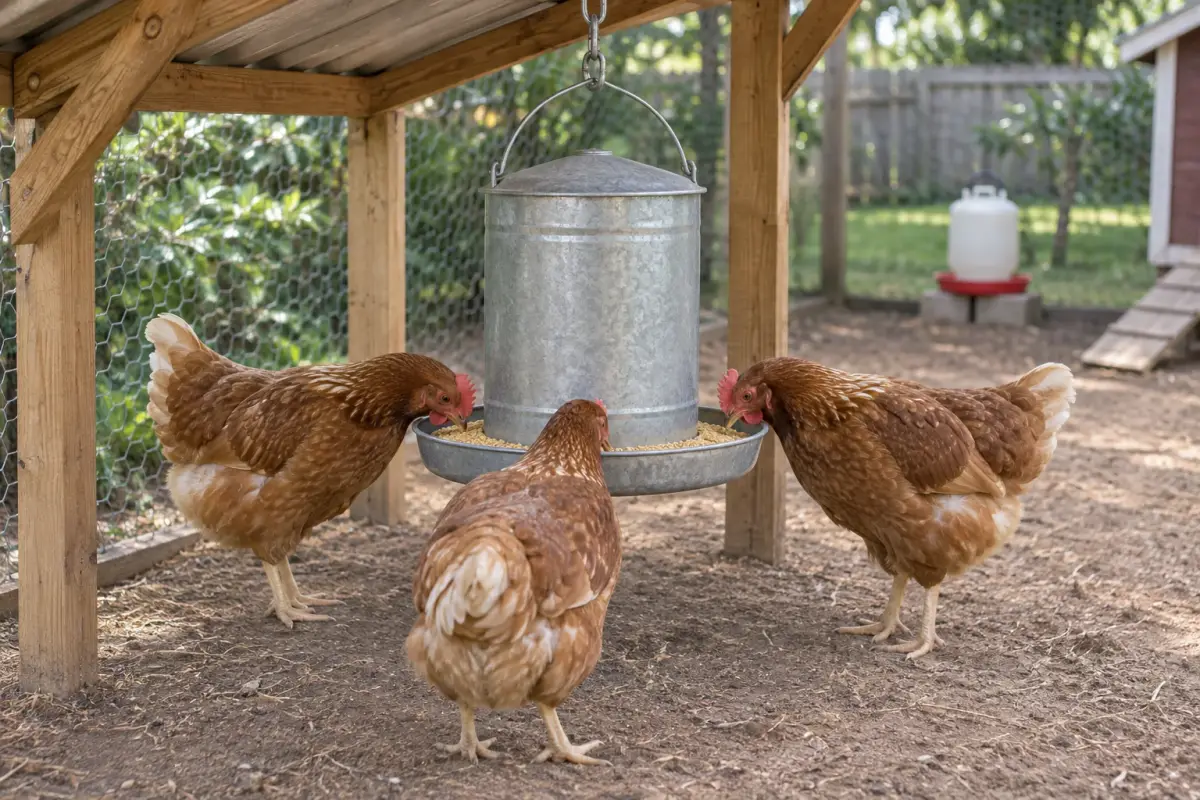
Both extension sources give the same rule: set the top lip of the feeder at the birds' back height. Penn State says this reduces waste and keeps feed clean, and Extension.org adds that feeders should be raised as chicks grow. A feeder on the floor gets scratched into the bedding and fouled with droppings, while one hung too high is hard for smaller or lower-ranking birds to reach.
Choose a feeder you can adjust. A hanging feeder on a chain or rope lets you change height as the flock changes, and a stand-alone one can sit on a block. Place it under cover if the run is open, away from the roost so droppings do not fall in, and away from the waterer so spills do not wet the feed.
Hanging, gravity and automatic feeders compared
A hanging tube or hopper feeder is the common starting point. It holds a few pounds, is simple to refill and cheap to replace. Its weakness is capacity: a small tube empties quickly with a larger flock, and rain can get in through an open top, so check for a lid or a roof over the feed.
A larger automatic design, such as a 25 lb capacity automatic poultry feeder with a galvanized steel and aluminum build, suits owners who want to refill less often, though a bigger hopper still needs checking so feed does not clump or mold. A gravity feed kit that fits buckets and barrels turns a bucket you already own into a feeder with several ports, which suits owners who like to adapt; check the port size and that the bucket lid seals.
Keeping feed dry, clean and lasting
Extension.org advises filling feeders only halfway to reduce spillage and raising them off the floor so litter and manure stay out. Feed that gets wet can mold, so look for covered hoppers, rain guards and ports that are sheltered from the weather. Metal is easy to clean and does not absorb moisture, while thin plastic can crack in sun or cold.
Plan the cleaning routine when you buy. A feeder you cannot take apart is hard to scrub, and a base with crevices will hold old feed. Brush out any leftovers before refilling, and avoid topping up on top of stale feed. Pair the feeder with fresh water daily, as Extension.org notes chickens do not eat as much if they cannot drink.
Feeders and waterers work as a pair
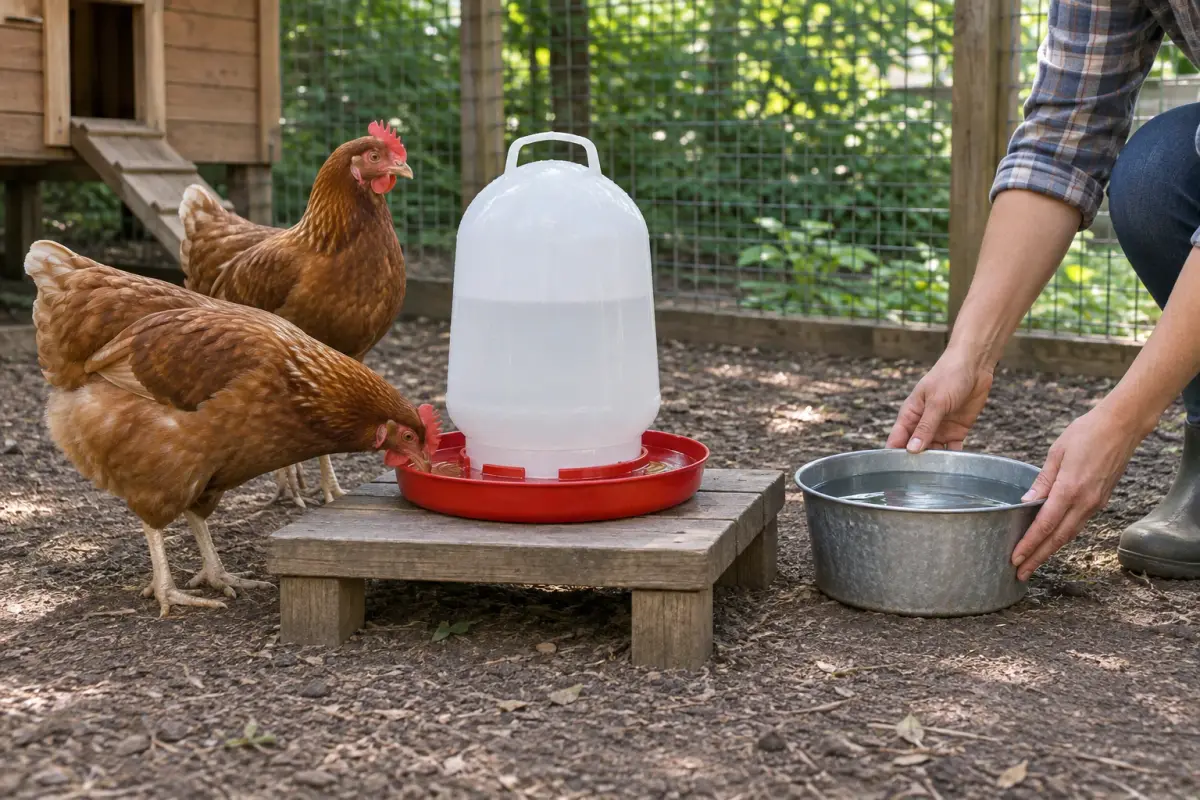
Penn State sets waterers at back height, like feeders, and recommends putting waterers in outdoor runs when possible to keep coop humidity down. Nipple waterers should be set just above eye level, at one nipple for every 6 to 8 birds. Keep the water away from the feed so splashing does not wet it, and away from any heat source.
If you are buying a feeder and a waterer together, size them for the same flock and put them in the same covered area of the run, not in the coop where moisture builds. For a cleaner floor, our guide to chicken coop bedding and cleaning explains how to manage spilled feed and litter.
Which feeder suits which flock
For two to four hens, a simple hanging feeder with a lid and a sturdy base is usually enough. For six to ten birds, move to a larger hopper or a bucket-style gravity feeder with several ports. For flocks that approach 25 birds or more, use more than one feeder in different places, as Penn State advises, so every bird can eat.
Feeding questions often lead to other topics, such as grit and oyster shell for chickens and fermented chicken feed, which have their own feeding setups. Once you know your flock size, browse chicken feeders and waterers, and see chicken coops and chicken runs for housing that fits the same birds.
Poultry feeder bodies and refill access
| Design | Food storage or delivery | Check before choosing |
|---|---|---|
| Hanging tube or hopper | A reservoir above a feeding area | Lid,roof and refill opening |
| Larger automatic design | A larger hopper with an operating mechanism | Mechanism instructions and access to inspect stored feed |
| Bucket or barrel port kit | Ports fitted into a separate container | Port size,container compatibility and lid seal |
Common questions
How much feeder space does each chicken need?
Penn State Extension says at least 3 inches per bird, with 3 to 4 inches for large breeds and about 1 inch for bantams. Chicks need around 2 inches each for the first two weeks, according to Extension.org.
How high should a chicken feeder be hung?
Both Penn State and Extension.org say to set the lip of the feeder at the birds' back height. This reduces spilled feed and keeps droppings out, and the feeder should be raised as young birds grow.
How many feeders do I need for my flock?
One feeder with enough total lip length is fine for a small flock. Penn State advises placing feeders in separate areas once you have more than 25 birds, so lower-ranking birds can still reach feed.
Should I fill the feeder all the way?
Extension.org advises filling feeders only halfway to reduce spillage. A fuller hopper wastes more feed when birds scratch at it, so top up more often rather than overfilling.
Should feeders go inside the coop or in the run?
Either works if feed stays dry. Penn State suggests keeping waterers in the run where possible to reduce coop humidity, so a covered area of the run is a good spot for both feeder and waterer.
Sources we checked
This guide is general information, not veterinary advice. If your pet is unwell or injured, contact your veterinarian.


