






Buying guides
What Size Crate Does My Dog Need?
Your dog crate should let your dog stand up without ducking, turn around and lie flat on its side, and not much more. Measure your dog standing, from nose to the base of the tail and from the top of the head to the floor, then add 3 to 4 inches to each. For a puppy, buy for adult size and use a divider.
By Matt GarnettUpdated November 14, 20264 min read3 sources
How to measure your dog for a crate
Measure with your dog standing on all four feet. For length, run a soft tape from the tip of the nose to the base of the tail, not the tip of the tail. For height, measure from the floor to the top of the head, or to the tips of the ears if they stand upright. The AKC recommends adding 3 to 4 inches to each measurement to get the inside dimensions you need.
Compare those numbers with the internal size of the crate, not the outside measurements on the box, which include bars and handles. A dog that has to duck its head or curl tightly to fit is in a crate that is too small. If your dog sits tall, also check that it can sit up without its head touching the roof.
Why bigger is not better
It is tempting to buy the roomiest crate you can fit, but extra space works against you, especially with a puppy. Dogs prefer not to soil the area where they sleep, and a crate with lots of spare room lets a puppy sleep at one end and potty at the other. A snug, den-sized space also feels more secure to many dogs than a large open cage.
The exception is a dog that will spend longer stretches confined, a dog with joint problems, or a very large breed that needs room to stretch out flat. For those dogs, it is better to err slightly larger and pair the crate with an exercise pen if you need more space during the day. Our guide to crate training a puppy covers how to introduce the crate.
Sizing a crate for a growing puppy
Buying a new crate every few months is expensive. The usual approach is to buy a crate that will fit your puppy as an adult and use a divider panel to block off the extra space. Move the divider back as your puppy grows so it always has just enough room to stand, turn and lie down. Many wire crates are sold with a divider included; see our crates with dividers.
To estimate adult size, look at the breed standard, ask your breeder about the parents' size, or ask your vet at a puppy visit. Mixed-breed puppies are harder to predict, so a crate with a generous divider range gives you more margin.
Common crate sizes as a starting point
Crates are usually sold by length. As a rough guide, 18 to 22 inch crates suit toy breeds up to about 10 to 15 lb, 24 inch crates small dogs up to about 25 lb, 30 inch crates dogs around 25 to 40 lb, 36 inch crates medium dogs around 40 to 70 lb, 42 inch crates larger dogs around 70 to 90 lb, and 48 inch crates and up suit large and giant breeds.
Weight is only a proxy, because two dogs of the same weight can be very different shapes. A long, low Basset Hound and a tall, lean sighthound need different crates. Always confirm with your own measurements plus 3 to 4 inches, and check the manufacturer's size chart for that model.
Which type of crate to choose
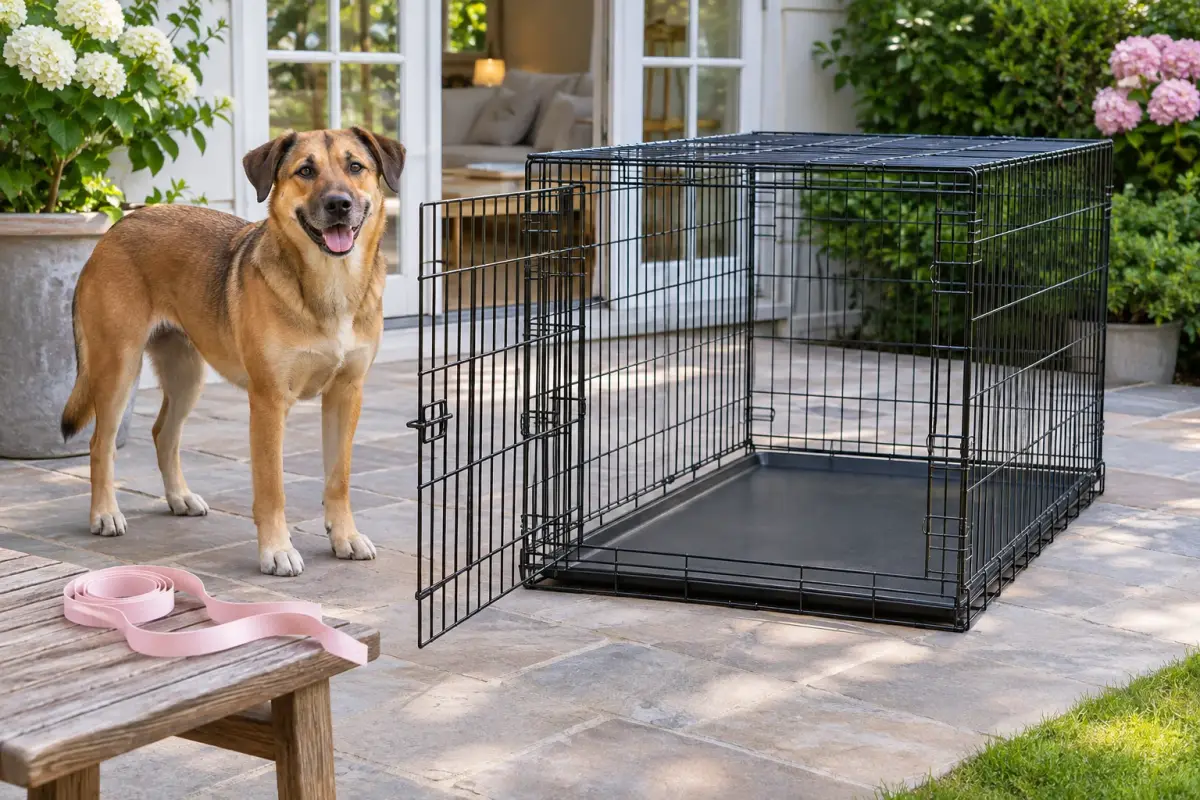
Wire crates are sturdy, airy and easy to see through, fold flat, and are the best choice for chewers. A single-door wire cage and a double-door wire cage show the two common layouts, and our guide to the best dog crates compares the types in more detail. Plastic crates are more enclosed and often airline-approved for travel. Soft fabric crates are light and good for calm small dogs on trips but are no match for a determined chewer. Furniture-style wooden crates look good in a living room but are heavier and harder to clean.
Whatever you choose, make sure there is good ventilation and that a washable mat fits the floor. If your dog likes a den feel, a cover over the top and sides of a wire crate can help, as long as the front stays open and the crate does not get too warm (see should you cover a dog crate). Ask your vet if your dog has a health condition that affects how it lies or moves.
This page is general information, not veterinary advice, and it cannot replace an examination by the vet who knows your pet.
Common questions
Is it better to get a bigger or smaller crate?
Get the crate that fits your dog's measurements plus 3 to 4 inches. Too small is uncomfortable and too big can undermine potty training. For a puppy, buy adult size and use a divider.
How do I know if my dog's crate is too small?
If your dog cannot stand without ducking, cannot turn around easily, or cannot lie stretched out on its side, the crate is too small. Measure again and size up.
What size crate does a 50 lb dog need?
Many 50 lb dogs fit a 36 inch crate, but shape matters more than weight. Measure nose to base of tail and floor to top of head, add 3 to 4 inches, and compare with internal dimensions.
Sources we checked
This guide is general information, not veterinary advice. If your pet is unwell or injured, contact your veterinarian.


