






Training & behavior
How to Crate Train a Puppy
Crate training a puppy works best when the crate becomes the place good things happen: meals, chews and naps. Start with the door open, reward every visit, then close it for seconds, then minutes. Keep sessions short, match crate time to your puppy's bladder, and never use it as a time-out. Most puppies settle within a few days to a few weeks.
By Matt GarnettUpdated November 14, 20265 min read4 sources
Why crate training helps a puppy
A puppy crate gives a young puppy a small, predictable space of its own. Dogs naturally avoid soiling where they sleep, so a correctly sized crate supports potty training: your puppy learns to hold it for short stretches and you learn its rhythm. It also keeps a curious puppy away from electrical cords, shoes and anything it might swallow while you shower or cook.
The longer-term payoff is a dog that is calm in a crate at the vet, in the car, when guests visit, during fireworks or if you ever need to evacuate. The AKC lists travel, recovery after surgery and storm anxiety among the reasons a crate-trained dog has an easier life. None of that requires long hours inside; it requires the crate to feel safe.
Choose the right crate and set it up
The crate should let your puppy stand up, turn around and lie down comfortably, and not much more. Too much room and a puppy may use one end as a bathroom. Many owners buy a wire crate sized for the expected adult dog (our puppy crate buying guide covers the types) and use a divider panel, moving it back as the puppy grows. Measure your puppy from nose to the base of the tail and from the top of the head to the floor, then add 3 to 4 inches.
Put the crate where the family spends time, such as the living room by day and beside your bed at night, so your puppy is not shut away. Add a washable crate mat, a safe chew toy and access to water for longer stretches. Take the collar off before crating, because tags can catch on wire. Skip thick bedding until your puppy stops shredding fabric or having accidents on it.
Step 1 to step 3: make the crate a good place
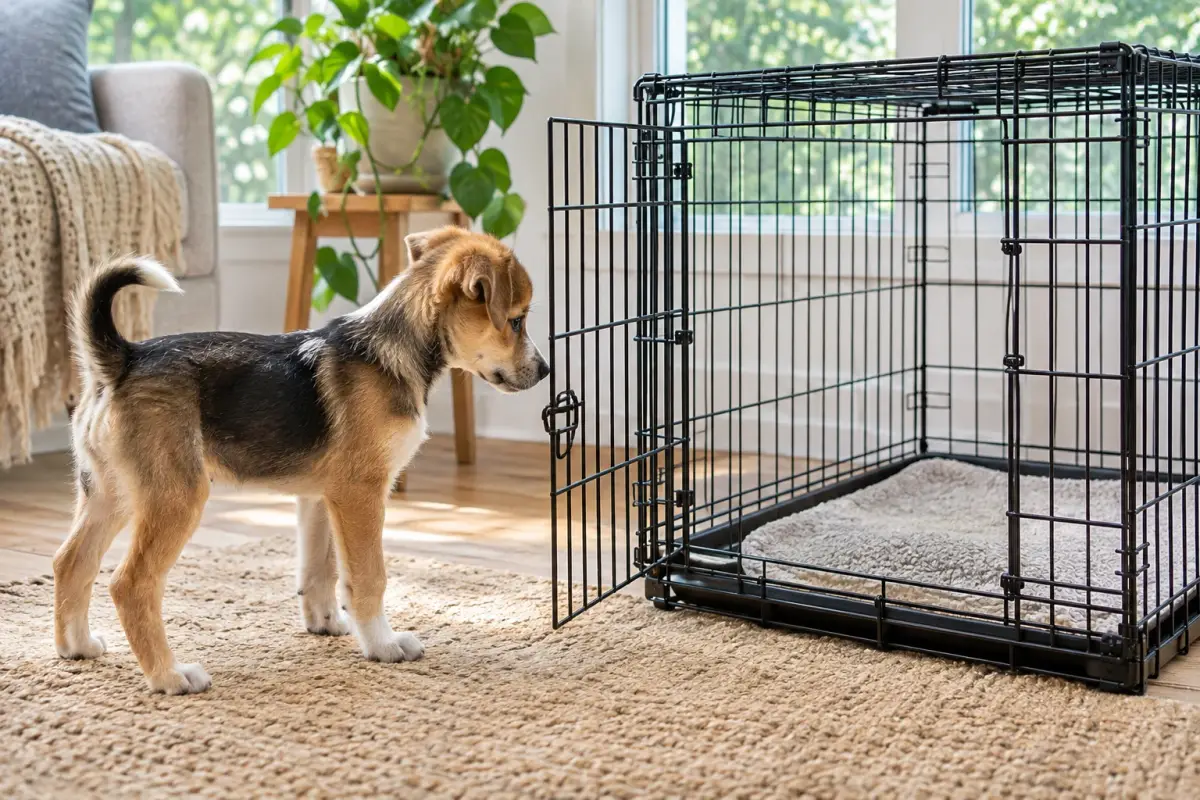
Step 1: Leave the door open and let your puppy explore. Toss a few small treats just inside, then deeper inside, and praise any visit. Keep rewards in a training treat pouch so you can pay the moment your puppy steps in. Do not push or carry your puppy in. Step 2: Feed meals in the crate. Start with the bowl at the doorway and move it farther back at each meal until your puppy is eating fully inside.
Step 3: Once your puppy walks in happily for food, close the door while it eats and open it the moment the bowl is empty. Over the next meals, leave the door shut for a minute or two after eating. If your puppy whines as soon as the door closes, you moved too fast; go back a step and keep the door closed for a shorter time. Our guide to a puppy crying in the crate covers what to do when the whining continues.
Step 4 to step 6: build time and add a cue
Step 4: Add a cue word such as crate or kennel. Say it, wait for your puppy to step inside, then reward with a treat from your dog treat pouch. Step 5: Give a stuffed chew toy inside, close the door and sit nearby for five to ten minutes. Then leave the room for a few minutes and come back calmly. Lengthen these absences gradually over several days.
Step 6: Mix short and long sessions so your puppy cannot predict how long you will be. Let your puppy out only after a few seconds of quiet. If you open the door during whining, your puppy learns that noise works. Practice while you are home, not just when you leave, so the crate does not become a signal that you are going away.
How long a puppy can stay in the crate
A puppy can only hold its bladder for so long. VCA Animal Hospitals gives a rough daytime guide of about 3 hours at 2 months, 4 hours at 3 months and 5 hours at 4 months after a potty break, and many trainers use the age in months plus one as a ceiling. Very young or toy-breed puppies may need a break every hour or two. These are maximums, not targets.
Build the crate training schedule around potty trips: out first thing in the morning, after every meal, after play and naps, and right before bed. If your workday is longer than your puppy can manage, arrange a midday visit from a family member, neighbor or dog walker. A puppy that is crated past its limit learns to soil the crate, which undoes potty training.
Common crate training mistakes to avoid
The biggest mistake is using the crate as punishment. If your puppy is sent there after chewing a shoe, it starts to see the crate as a bad place. The second is going too fast: closing the door for an hour on day one. The third is crating for most of the day. A puppy needs play, training, exercise and company, and the puppy crate is only one part of the day.
Watch for panic rather than ordinary protest. Frantic scratching, drooling, bending bars, injuring paws or eliminating in a panic are signs of real distress, not stubbornness. Stop and talk to your vet or a qualified positive-reinforcement trainer, because a puppy in that state needs a different plan, and forcing it can make anxiety worse.
This page is general information, not veterinary advice, and it cannot replace an examination by the vet who knows your pet.
Common questions
How long does it take to crate train a puppy?
Some puppies accept the crate in a few days, while others take several weeks. Progress depends on age, temperament and how gradually you build time, so go at your puppy's pace rather than a calendar.
Can you crate train a puppy in 3 days?
You can make big progress in a long weekend by feeding every meal in the crate and practicing short sessions, but reliable comfort alone for hours usually takes longer. Rushing tends to create crying and setbacks.
Should I put a puppy pad in the crate?
Usually no. A pad invites your puppy to toilet in the crate, which works against potty training. Keep crate time within your puppy's bladder limit and take it outside regularly instead.
Should my puppy sleep in a crate in my bedroom?
Many trainers suggest it for the first weeks. Your puppy feels less alone, and you will hear when it needs a nighttime potty trip. You can move the crate gradually once nights are settled.
Is it OK to let my puppy out when it cries in the crate?
If your puppy might need to potty, take it straight outside and back without play. Otherwise wait for a few seconds of quiet before opening the door, so silence, not crying, is what earns release.
Sources we checked
This guide is general information, not veterinary advice. If your pet is unwell or injured, contact your veterinarian.


