






Training & behavior
Puppy Crate Training Tips: A Step-by-Step Guide
The best puppy crate training tips are simple: choose a crate your puppy can stand, turn and lie down in, make it a place where good things happen, and build up time slowly. Never use it as punishment, and never leave a puppy longer than it can hold its bladder. Veterinary and kennel club guidance both stress short sessions, exercise and a potty break before every crating.
By Matt GarnettUpdated November 14, 20265 min read2 sources
Choose the right crate and place it well
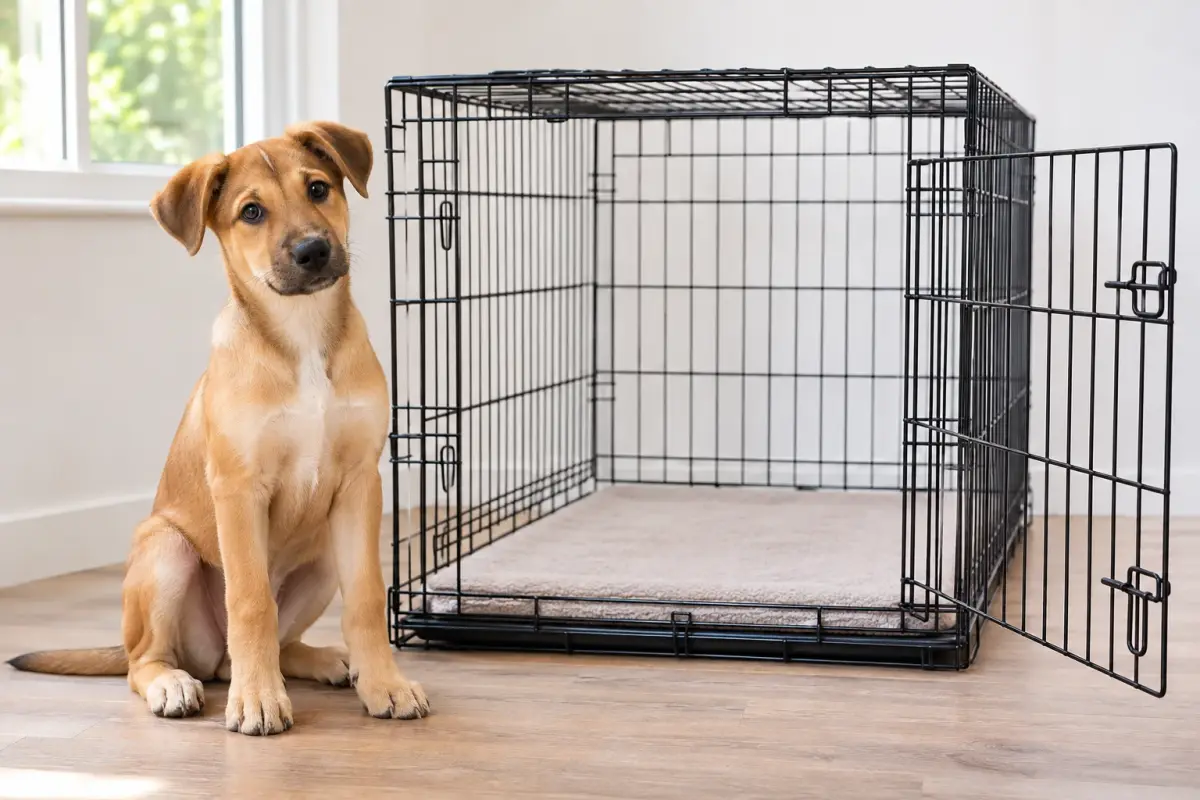
VCA Animal Hospitals advises a crate large enough for the dog to stand, turn around and stretch out, and the American Kennel Club adds that it should be well ventilated. If your puppy will grow a lot, buy a larger crate and block off half with a divider, so there is no spare corner to use as a bathroom. VCA notes that a puppy who sleeps at one end and eliminates at the other needs less space.
Put the crate where the family spends time, such as the kitchen or a den, or in the bedroom where the puppy sleeps, so it does not feel shut away. VCA says metal collapsible crates with a tray floor work well, and sturdy plastic travel crates can too. Browse our puppy crates for sizes that suit a growing dog, such as a heavy-duty metal dog crate with a double door.
Make the crate cozy and positive
The goal is for your puppy to walk in on their own. VCA suggests putting treats, bedding, toys and water in the open crate so the puppy goes in to explore. The AKC suggests lining the crate with blankets and even covering the top to give it a den-like feel, and using it for naps, bedtime and quiet breaks.
Soft bedding helps, as long as your puppy does not chew it. A washable padded crate mat or plush crate bed is easy to clean after accidents, and you can remove it if your puppy shreds it. Feeding meals in the crate is another way to build a happy association.
Step by step: the first days
Step 1: Introduce the crate as soon as your puppy comes home, early in the day if you can, with the door open. Step 2: Take your puppy to the outdoor potty spot and reward them straight away when they go. Step 3: After play, when your puppy is tired or starting to settle for a nap, place them in the crate with water, a toy and a treat, then close the door.
Step 4: Stay close enough to hear your puppy. VCA says to ignore brief, mild crying and to release your puppy only once they are quiet, either after a few minutes or after a short nap, otherwise they learn that crying opens the door. Step 5: Repeat at every nap and play session, gradually lengthening the time before you let them out. Every time you take your puppy out, walk them straight to the potty spot.
How long can a puppy stay in the crate?
VCA gives daytime limits for puppies who have just eliminated: up to about 3 hours at 2 months old, 4 hours at 3 months, and 5 hours at 4 months. These are ceilings, not targets, and individual puppies vary. Many puppies can sleep through the night by 3 months, though some need a middle-of-the-night potty break.
The AKC is clear that a puppy should never be left in the crate all day. Puppies need several bathroom breaks, plus time for play and meals, and a puppy left longer than they can control their bladder or bowels may be forced to go in the crate. That is a failure of the schedule, not bad behavior on the puppy's part.
Bedtime and the first nights
At bedtime, play with your puppy, take them out to eliminate, and then settle them in the crate for the night. VCA advises not going to your puppy when they cry once you have checked they have no need, since responding teaches them that crying works. Placing the crate in your bedroom lets you hear if your puppy genuinely needs to go out.
Expect the first nights to be noisy. If crying escalates or does not settle, treat it as information: your puppy may need a potty break, or the crate may be too far from you. Persistent panic, escape attempts or destruction can be signs of separation anxiety, and your vet can point you to a trainer or behaviorist.
Mistakes to avoid
Never use the crate as punishment. Both VCA and the AKC stress that the crate should be a safe retreat, not a place to be sent when your puppy has misbehaved. Do not crate a puppy without first giving exercise and a chance to eliminate, do not release a puppy while they are crying, and do not use the crate as a reason to ignore your dog. VCA puts it plainly: a crate is not an excuse to ignore the dog.
Some dogs do not tolerate crates at all, and forcing it makes things worse. VCA notes that a pen, a small room or a gated area can work better for them. If you want a contained space that is bigger than a crate, see our puppy playpens, and come back to our puppy crates if a crate suits your puppy after all.
If your puppy seems very distressed, is injuring themselves or refuses to eat in the crate, call your vet. This page is general information, not veterinary advice, and it cannot replace an examination by the vet who knows your pet.
Common questions
How long does it take to crate train a puppy?
It varies with your consistency and your puppy. Some settle within a few days, while others take several weeks. Short, regular sessions with plenty of rewards and potty breaks before crating usually work best.
Should I ignore my puppy crying in the crate?
Ignore brief, mild fussing, and release your puppy only when they are quiet. But check that they do not need a potty break, and seek help if the distress is intense or continues for a long time.
How big should a puppy crate be?
The crate should be big enough for your puppy to stand, turn around and lie down comfortably. For a growing puppy, buy a larger crate and use a divider to block off the extra space.
Should I put a bed or blanket in my puppy's crate?
Soft bedding makes a crate cozier, and the AKC suggests lining it with blankets. Remove it if your puppy chews or swallows it, and choose washable bedding so accidents are easy to clean.
Can I use the crate as punishment?
No. Both VCA and the AKC say the crate should be a safe, comfortable retreat. Using it as punishment makes puppies fear it and makes crate training harder.
Sources we checked
This guide is general information, not veterinary advice. If your pet is unwell or injured, contact your veterinarian.


