






Buying guides
Best Crate for a Puppy: Size, Type and Divider Explained
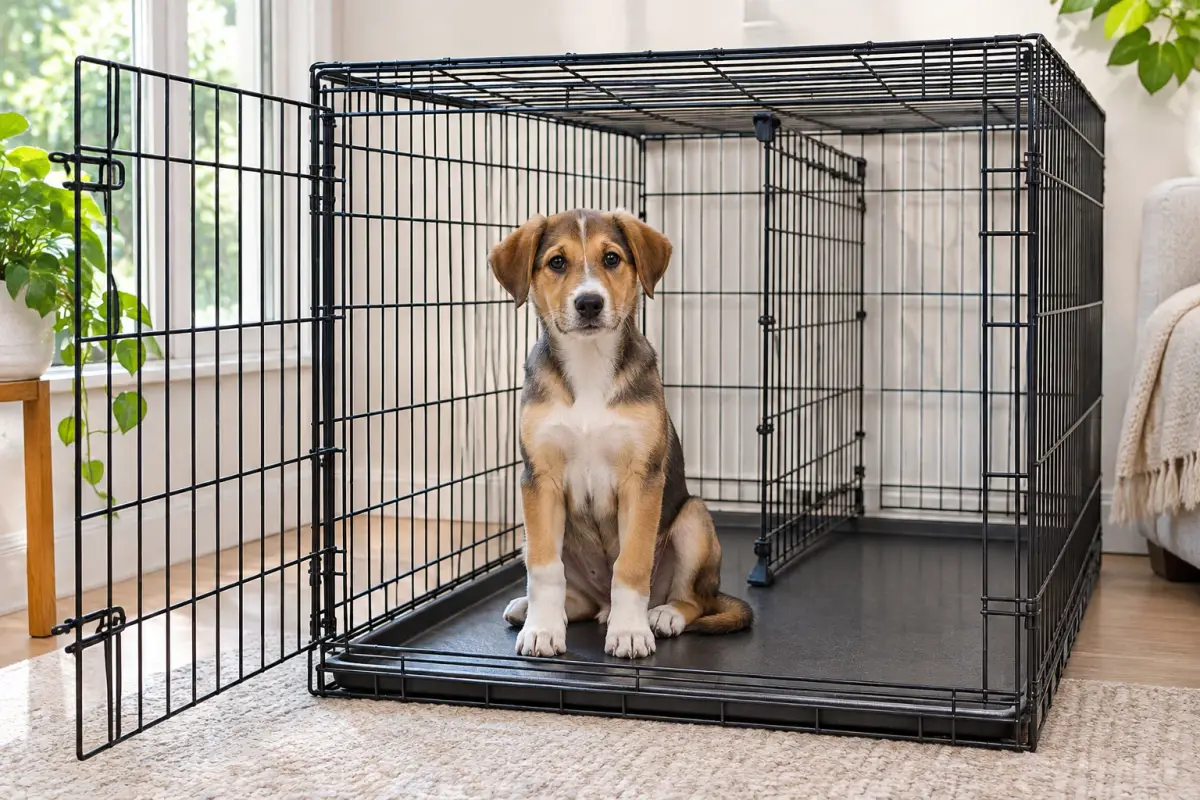
The best crate for a puppy is usually a sturdy wire crate sized for your puppy's expected adult size, with a divider panel that shrinks the space while it is small. A crate that is too big lets a puppy toilet at one end and sleep at the other, which undoes house training. Wire gives airflow and a view, plastic suits car and air travel, and soft crates are for later.
By Matt GarnettUpdated November 14, 20264 min read2 sources
What matters most: size now, size later, and a divider
A puppy crate should be just big enough for the puppy to stand up, turn around and lie down comfortably, and no bigger. That small space is what makes a crate useful for house training, because most puppies avoid soiling the place where they sleep. The AKC's advice is to buy a crate sized for your breed's typical adult size and use an adjustable divider to make it smaller at first, moving it back as your puppy grows.
Buying one puppy crate with a divider saves you buying three crates in a year. Check that the divider is solid, fits snugly and cannot be pushed aside, because a determined puppy will find a gap. Two doors, one at the end and one on the side, make the crate easier to place in a room and easier to use as your puppy grows.
Wire, plastic and soft crates compared
Wire crates are the most common choice for puppies. The AKC calls metal crates the sturdiest you can buy and the best for chewers, with good airflow and visibility. Most fold flat, many include a divider, and a removable tray makes cleaning up accidents easy. A cover over the top and sides gives a den feel for puppies that settle better in the dark.
Plastic crates are enclosed on most sides, which some puppies find calming, and they double as travel crates; if you plan to fly, the AKC suggests an airline-approved plastic model. They rarely come with dividers, so they suit puppies that are already close to adult size. Soft fabric crates are light and portable but easy to chew and hard to clean, so they are better kept for adult dogs that are already crate trained.
Best crate for each puppy
For a small-breed puppy, a compact wire crate or a small plastic crate works, and you may not need a divider at all. For a medium or large breed, choose a wire crate in the adult size with a divider. For a giant breed, check the crate's height carefully, since some extra-large crates are still too short for a grown Great Dane or Mastiff, and the divider may not shrink the space enough for a young puppy.
For a golden retriever puppy, which the AKC lists at roughly 55 to 75 pounds grown, a 42-inch wire crate with a divider is a common fit, but measure rather than assuming. For apartments, a crate with a cover or a furniture-style crate fits better in a living room. For puppies that chew everything, avoid soft crates and fabric pads until the chewing phase passes.
What to avoid
Avoid a crate so large that the puppy can sleep in one corner and toilet in another. Avoid crates with sharp wire ends, wide gaps a jaw or paw could catch in, or flimsy latches a puppy can push open. Avoid soft-sided crates for unsupervised puppies, and never leave a collar or harness on a puppy in a wire crate, since it can catch.
Do not use the crate as punishment or for longer than a puppy can hold its bladder. A young puppy needs frequent toilet breaks, including at night. If your puppy screams, drools heavily or injures itself trying to escape, slow down the crate training, and if the distress continues, talk to your vet or a qualified trainer about separation-related anxiety.
How to measure for a crate
The AKC's method is to measure your dog standing, from the tip of the nose to the base of the tail for length and from the floor to the top of the head for height, then add 3 to 4 inches to each. For a puppy, use the breed's adult size instead, and remember males are often larger than females in the same breed.
Common wire crate lengths run from about 24 inches for toy breeds to 30, 36, 42 and 48 inches for larger breeds. Set the divider so the puppy has room to stand, turn and lie flat, and move it back every few weeks. If your puppy starts soiling the back of the crate, the space is probably too big.
Care, bedding and lifespan
Use a washable crate mat or a folded towel, and remove bedding if your puppy chews it, because swallowed fabric can cause a blockage. Clean the tray and wipe the wire with pet-safe cleaner after accidents. An enzyme cleaner removes the smell that otherwise draws a puppy back to the same spot.
A good wire or plastic crate lasts the life of the dog and often longer. Check latches and welds every few months, replace a cracked plastic tray, and tighten any loose clips. Many adult dogs keep using their puppy crate as a den with the door open, which is a sign the crate was introduced well.
Puppy crate bodies and adjustable space
| Construction | Body arrangement | What to verify |
|---|---|---|
| Wire | Open metal panels,often folding | Divider,removable tray and locks |
| Plastic | Rigid shell with fewer open sides | Usable interior,door and ventilation |
| Soft fabric | Fabric around a folding support | Frame,zippers and fabric condition |
Common questions
Is a wire or plastic crate better for a puppy?
A wire crate with a divider is the more flexible choice because it grows with your puppy and gives good airflow. A plastic crate suits puppies that settle better in an enclosed space and doubles as a travel crate.
What size crate should I get for a puppy?
Buy for your breed's adult size: nose to tail base plus 3 to 4 inches, and floor to head height plus 3 to 4 inches. Use a divider so your puppy only has room to stand, turn and lie down.
What is the best crate for a golden retriever puppy?
Usually a 42-inch wire crate with a divider, since adult goldens typically weigh about 55 to 75 pounds. Measure your dog as it grows and size up if its head touches the roof.
Should a puppy crate have a bed in it?
Yes, a washable mat or towel, as long as your puppy does not chew it. Remove soft bedding during a chewing phase and put it back once the puppy leaves it alone.
Sources we checked
This guide is general information, not veterinary advice. If your pet is unwell or injured, contact your veterinarian.


