Care & how-to
How to Keep a Puppy Entertained
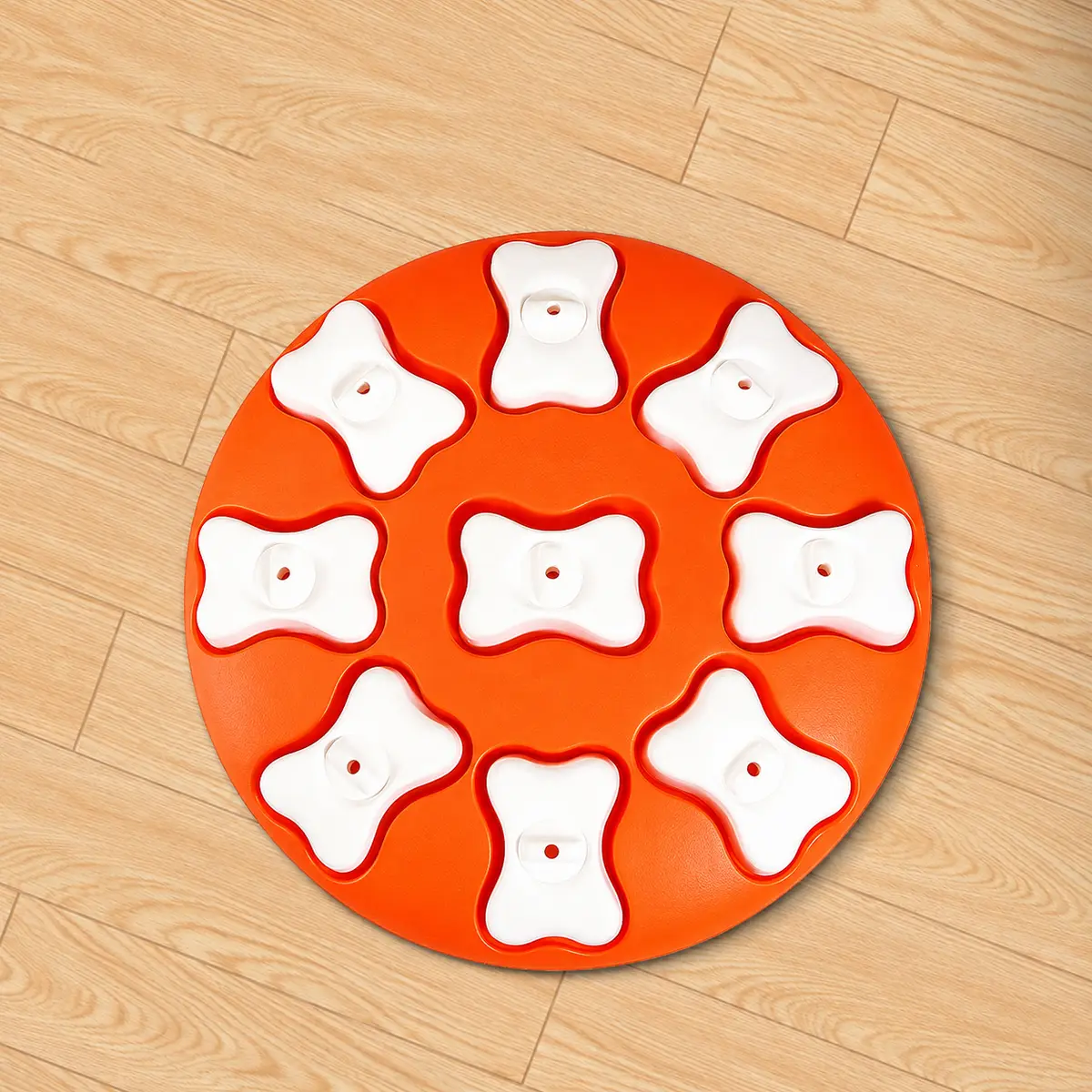
To keep a puppy entertained, mix short bursts of play, sniffing games, food puzzles and quick training sessions through the day, then let your puppy nap. Mental work tires a puppy as much as running does. Rotate a few toys, let treats be found rather than handed over, and supervise anything that can be chewed apart. Our dog enrichment toys cover the puzzle side.
By Matt GarnettUpdated November 13, 20265 min read2 sources
Short bursts, then sleep
Puppies run on a simple cycle: play hard for a few minutes, then crash. Entertaining one all day is neither possible nor healthy, because a young puppy needs far more sleep than an adult dog. Plan several short activities spread across the day and expect a nap after each one. A puppy that gets cranky, mouthy or wild is often overtired rather than bored.
For walks, the AKC cites a rough guide of about five minutes per month of age, once or twice a day, so a three-month-old gets roughly 15 minutes per outing. It also advises letting the puppy set the pace and watching for tiring, such as sitting down mid-walk. Free play in a fenced, safe space is better for young joints than running beside you on a leash, so fill the rest of the day with games that use the nose and brain instead.
Food games that make a puppy work
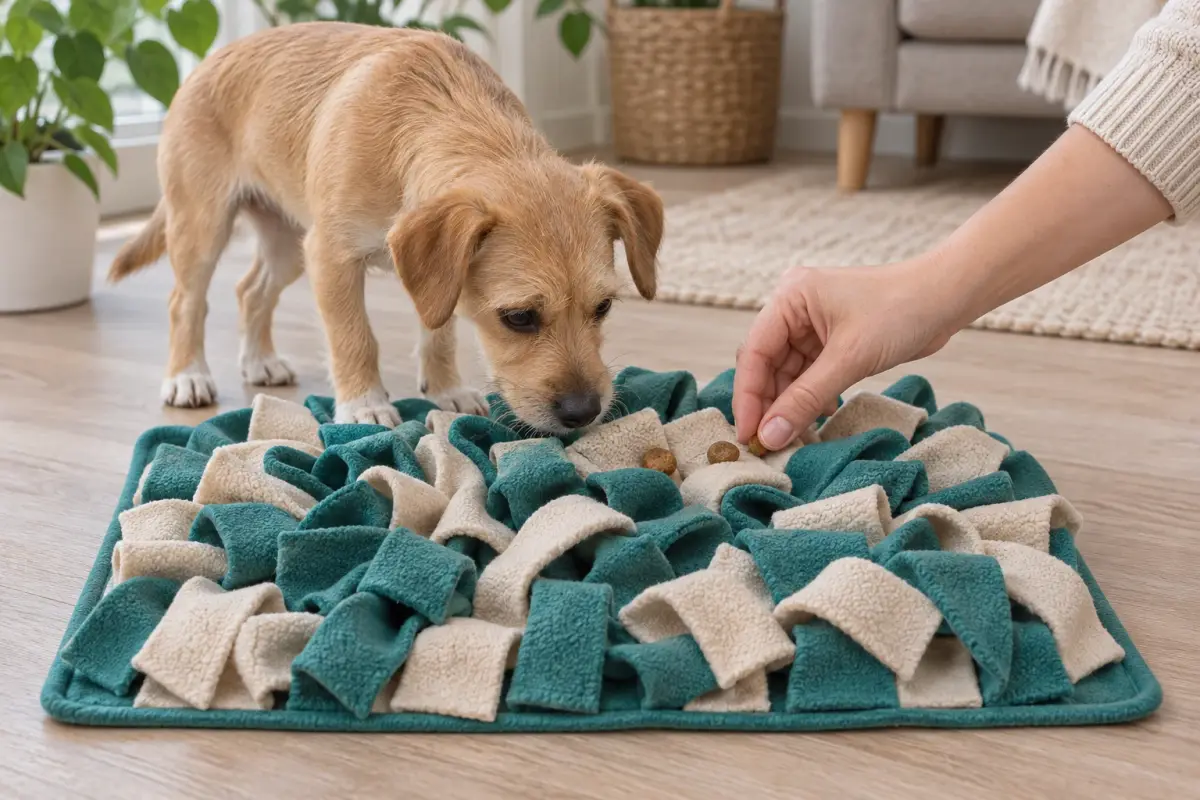
The easiest entertainment is to turn part of a meal into a game. The AKC suggests a scavenger box: hide treats or kibble in an egg carton, a rolled-up dish towel or crumpled paper and let the puppy dig them out. You can also scatter kibble across the lawn or a room for a sniffing walk around the yard. Measure the food out of the daily ration so the games do not add extra calories.
A snuffle mat does the same job indoors. Treats hide in the fabric strips and the puppy has to sniff and nose them out, which can take far longer than eating from a bowl. A snuffle feeding mat or a nosework snuffle mat suits small to medium puppies, and you can browse more puzzle options in our dog enrichment toys. Start with easy rounds where the treats sit on top, and always supervise so fabric strips are not chewed off and swallowed.
Sniffing games and hide-and-seek
Scent games tire a puppy quickly and cost nothing. Start by showing your puppy a treat, hide it behind a chair leg while the puppy watches, and say a find-it cue as it searches. Once that is easy, hide treats where the puppy cannot see you place them: under a cup, behind a door, in another room. Hide-and-seek works the same way with you as the prize: duck behind a door, call once and reward the puppy generously when it finds you.
Vary the walk too. The AKC recommends letting a dog stop and sniff instead of marching to a schedule, and a slow ten minutes of sniffing can be more satisfying than a brisk lap of the block. If your puppy has not finished its vaccinations, ask your vet where it can safely walk, and use the yard, a balcony or a hallway for scent games in the meantime.
Chewing, tugging and toy rotation
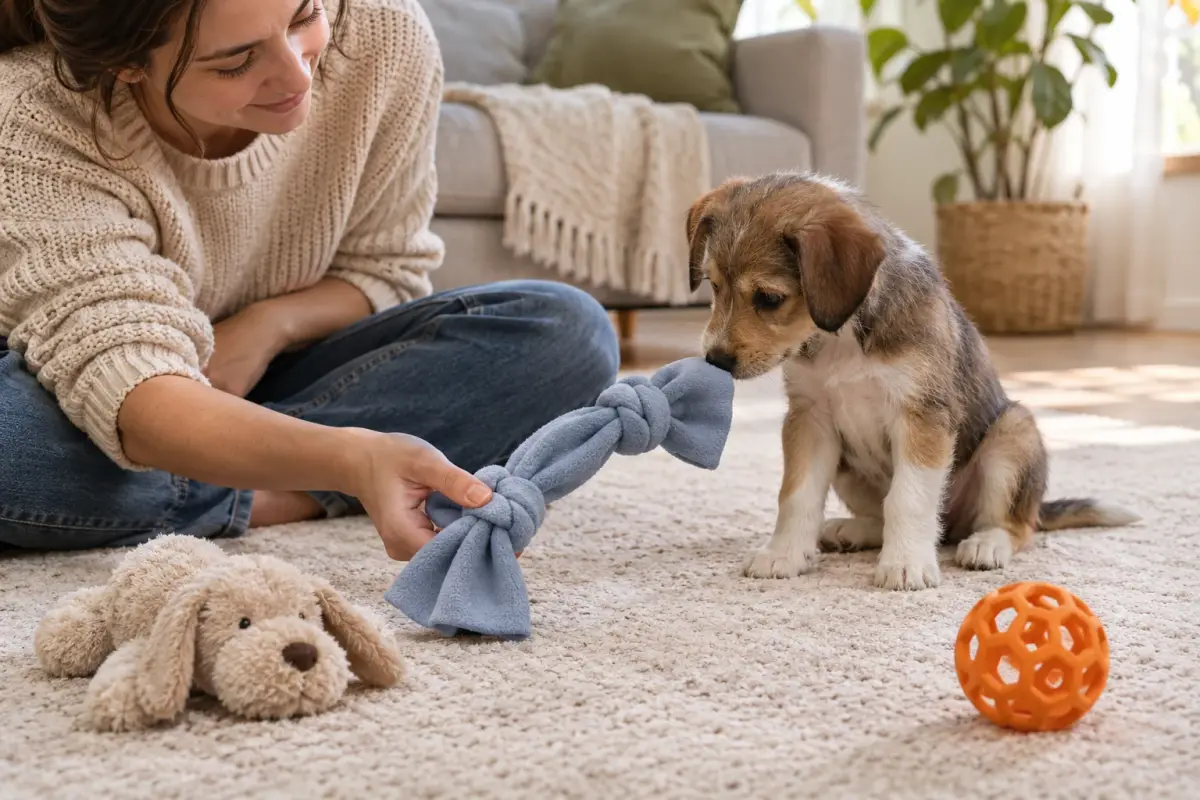
Puppies explore with their mouths, so give them acceptable things to chew. Keep a handful of toys of different textures within reach, such as a soft toy, a rubber chew and a rope, and put the rest away. The AKC suggests rotating toys often, because a toy that disappears for a few days feels new when it returns. Three or four out at a time is plenty. If your puppy is teething, our puppy teething toys are the next stop.
Play tug and fetch in short rounds, and stop while your puppy still wants more. Teach a drop cue so the toy comes back without a fight. Avoid repeated jumping, such as tossing a ball straight up, until your puppy is fully grown. Check toys every day for loose threads, cracks or pieces that could be swallowed, and throw out anything that is breaking apart. For a closer look at what to look for, read our guide to choosing dog enrichment toys.
Training counts as entertainment
A five-minute training session is one of the best games a puppy can play. Teach sit, down, touch or a spin using small treats and a happy voice, and end on a success. The AKC suggests keeping leash practice to about five to ten minutes at first and keeping it positive. New tricks make the puppy think, and thinking is tiring in a good way.
Try three or four mini sessions a day rather than one long one. Mix them with a short play break so the puppy stays eager. Puppies who learn that calm behavior earns attention are also easier to live with when you need them to settle. If you want a full plan for the first months, our puppy training guide covers the basics.
When you are busy, away or the puppy is still bored
The AKC lists chewing furniture, digging, constant attention-seeking, restlessness and barking among the signs of boredom. Before you leave a puppy for a stretch, give it a walk or play session, then something to do: a stuffed chew toy, a snuffle mat or a scattered handful of kibble. Keep the puppy in a safe, puppy-proofed area and arrange a visit from a walker, sitter or friend if you will be gone for long.
If the destructive behavior comes with panic, drooling, constant howling or clinginess whenever you move, it may be separation anxiety rather than boredom, and a vet or trainer should look at it; see our puppy separation anxiety guide. Call your vet if your puppy suddenly seems lethargic, stops eating or acts out of character, since a change in behavior can be a sign of illness.
This page is general information, not veterinary advice, and it cannot replace an examination by the vet who knows your pet.
Common questions
How do I keep a puppy entertained while I work from home?
Give your puppy a walk or play session first, then set up a calm activity such as a snuffle mat, a stuffed chew toy or a scatter of kibble in a safe space. Repeat short sessions through the day and let the puppy nap in between.
How long can a puppy play before it needs a rest?
Short bursts of a few minutes are enough for young puppies, followed by a nap. Watch for signs of tiring such as sitting down, slowing or getting mouthy, and let the puppy set the pace rather than pushing on.
What can a puppy play with when left alone?
Stick to puppy-safe items you have checked and supervise at first: a durable chew, a food-stuffed toy or a snuffle mat with a small amount of food. Remove anything that is coming apart, and do not leave paper or fabric toys that can be eaten.
Is my puppy bored or just tired?
Boredom shows up as chewing, digging, restlessness and attention-seeking despite plenty of activity. Overtired puppies get frantic and nippy, then crash. If a nap fixes it, it was tiredness; if a game or chew toy fixes it, it was boredom.
Sources we checked
This guide is general information, not veterinary advice. If your pet is unwell or injured, contact your veterinarian.