






Buying guides
Best Slow Feeders for Puppies: What Actually Matters
The best slow feeder for a puppy is a shallow, wide bowl or puzzle with low, rounded ridges, made from food-safe material that washes easily and sized to your puppy's muzzle. Deep, tight mazes frustrate young puppies, and a bowl they outgrow in weeks is wasted money. Here is how to pick one, and where to start in our slow feeder bowls for puppies.
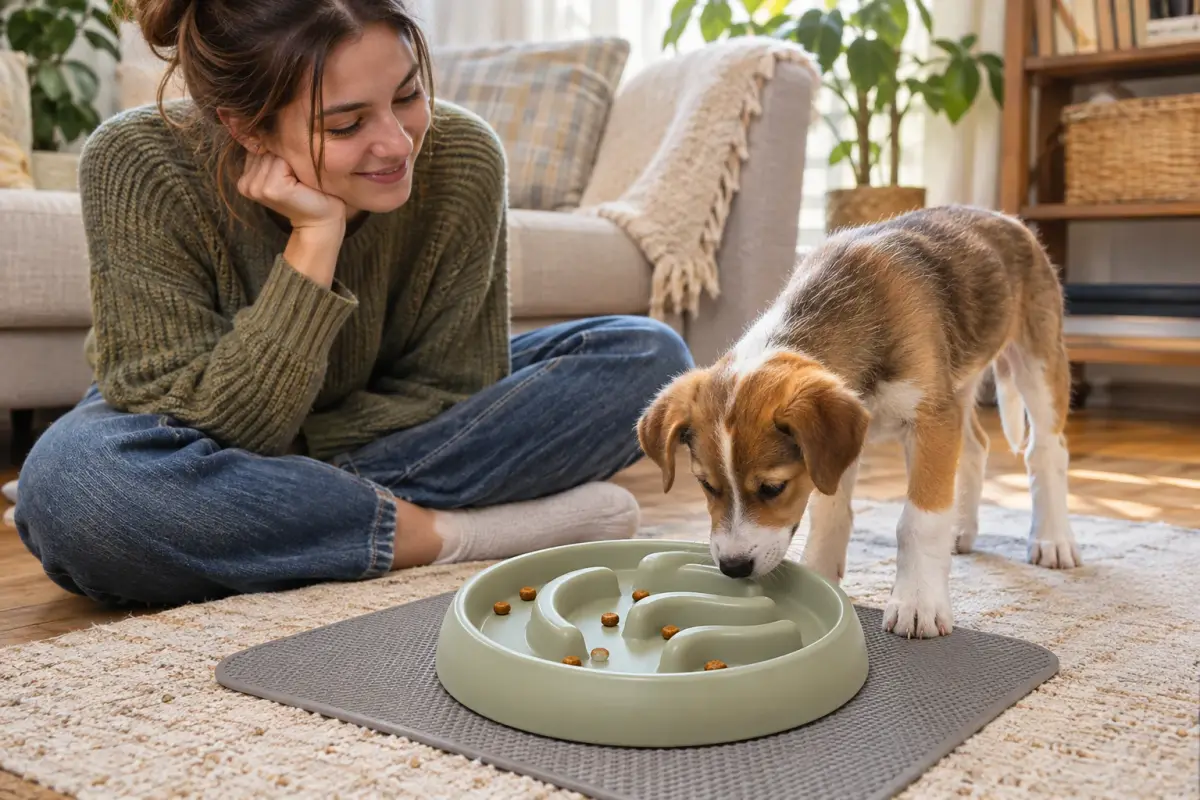
By Matt GarnettUpdated November 13, 20265 min read2 sources
What matters most in a puppy slow feeder
Puppies gulp for ordinary reasons: they are eager, they are competing with littermates in memory if not in fact, and they have not learned to pace themselves. VCA Hospitals notes that fast eating can lead to stomach upset and, in more serious cases, aspiration and bloat. A slow feeder works by making each mouthful take a little more effort, so the design details decide whether it helps or just annoys.
Three things matter more than anything else. First, the obstacles should be low and rounded, so a puppy can still reach the food with its tongue. Second, the bowl should be wide enough that your puppy is not wedged into a corner. Third, it should be easy to wash, because puppies are messy and food residue sits in every groove. Everything else is secondary.
Pattern and depth: gentler is better for young puppies
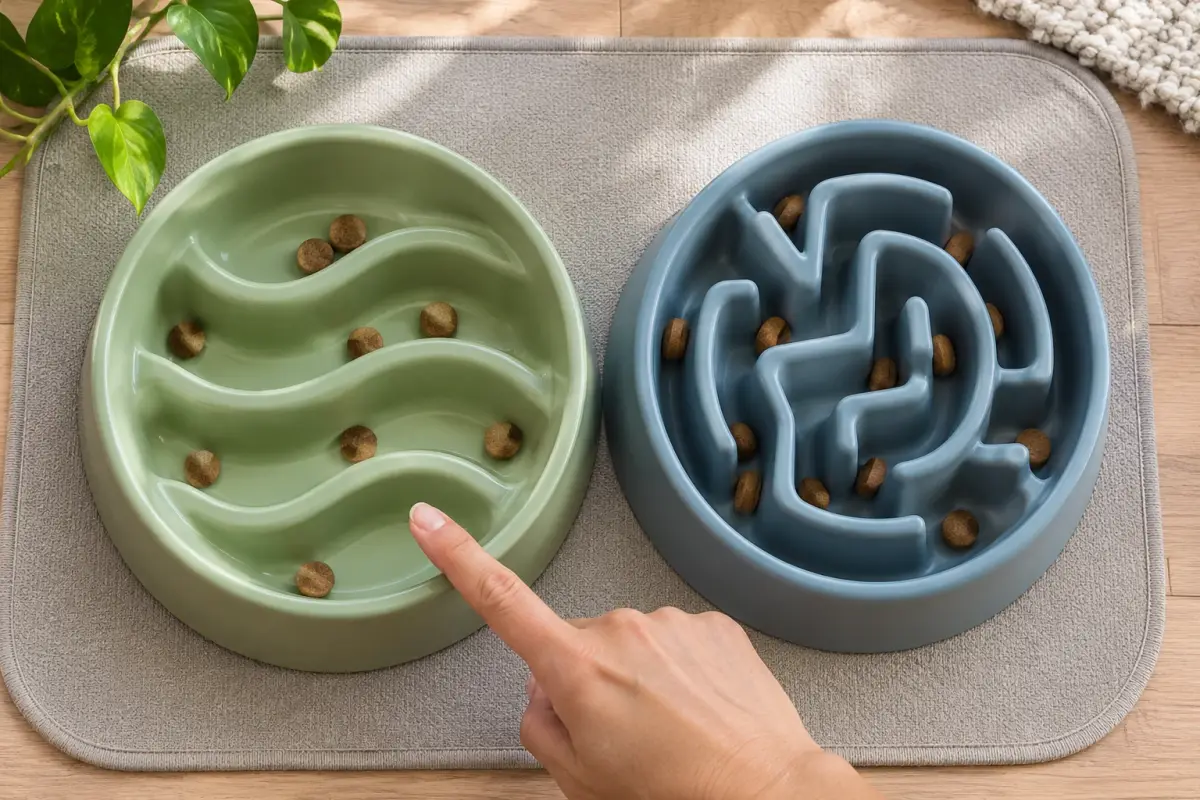
A bowl with tall, close-set posts or a tight maze is designed for an adult dog with a long snout and plenty of patience. A young puppy often gives up, flips the bowl, or learns to tip kibble out of it. Look for wide channels, shallow ridges and a few large obstacles rather than dozens of small ones. If your puppy can reach most of the food within a few seconds of effort, the pattern is in the right range.
You can raise the challenge as your puppy grows. Many owners start with a simple ridged bowl and move to a more intricate puzzle feeder at four or five months, once the puppy understands that the food is reachable. Keep the first few meals calm and watch how your puppy copes; a puppy that becomes distressed or starts pawing at the bowl in frustration needs an easier design, not more perseverance.
Material, cleaning and durability
Puppies chew everything, including their bowls. A bowl should be made of food-safe material with no thin edges, loose parts or removable pieces that could be bitten off and swallowed. A flexible silicone feeder like this silicone puzzle feeder bowl is gentler on baby teeth, while a rigid plastic bowl holds its shape better but can crack if chewed hard.
Whatever the material, wash it after every meal. Ridges and grooves trap damp food, and a feeder that is only rinsed will smell within days. Check the bowl for cracks, deep tooth marks or torn edges every week or so, and retire it as soon as the surface is damaged. A bowl that is dishwasher-friendly saves effort, but check the maker's care instructions before putting it in.
Types of slow feeder compared
Raised-ridge bowls are the simplest option and the best first choice for most puppies. A wider option, such as a ridged slow eating feeder bowl, spreads food across the surface so there is no single mound to bolt. Puzzle feeders and treat-dispensing toys release a few pieces at a time, which suits a puppy that is already confident and curious.
The American Kennel Club also describes cheap household methods that work well for puppies: spreading kibble across a cookie sheet, putting a little food in each cup of a muffin pan, or setting a small dish upside down inside a larger bowl so food sits in the gap around it. VCA Hospitals suggests similar ideas for puppies. These cost almost nothing and are a good way to test whether your puppy even needs a dedicated bowl.
Matching the feeder to your puppy's size
Size is where puppy feeders most often go wrong. A tiny toy-breed puppy needs a shallow bowl with a low rim and small channels, or the food will be out of reach. A large-breed puppy needs a wide, heavy bowl that will not slide across the floor or be tipped over, because large puppies grow fast and bowls that are too small make them eat in a hunched, cramped way.
Measure your puppy's muzzle and think about adult size. If you expect a large dog, buy a bowl that will still be comfortable in six months, but start with an easy pattern. For small breeds, a shallow design may last the dog's whole life. Ask your vet how much your puppy should eat each day, then divide that into several meals; the portion is the vet's call, and the bowl only changes the speed.
What to avoid
Avoid bowls with deep, narrow wells that a puppy's tongue cannot reach, anything with small detachable parts, and designs that trap food in corners that are hard to clean. Also avoid treating a slow feeder as a fix for every problem. It helps with gulping, but it does not replace smaller, more frequent meals, which both VCA Hospitals and the AKC recommend as another way to slow a fast eater.
Supervise the first few meals. If your puppy chews the bowl, tips it over or becomes frantic, switch to a simpler design. For a general overview of other ways to slow a fast eater, see our guide on how to slow down a dog eating, and compare adult-dog options in our guide to slow feeder dog bowls.
When slow feeding is not the answer
A slow feeder only changes how fast food is eaten. Call your vet if your puppy seems ravenous all the time, still acts hungry after meals, is losing weight, or vomits after eating; VCA Hospitals notes that excessive hunger can sometimes point to an underlying problem. Bloat is an emergency in dogs, and the AKC says to see a vet immediately if there is any chance your dog looks bloated. Our guide to how to prevent bloat in dogs explains the signs.
Once you know the features that matter, browse our slow feeder bowls for puppies and pick the simplest design that suits your puppy's size. This page is general information, not veterinary advice, and it cannot replace an examination by the vet who knows your pet.
Food-spreading and dispensing layouts
| Layout | Where the food sits | What to inspect |
|---|---|---|
| Raised-ridge bowl | Around ridges on a broad surface | Reachable gaps and cleaning access |
| Puzzle feeder | Within compartments or behind movable pieces | Difficulty and removable parts |
| Treat-dispensing toy | Inside a moving body | Outlet size and food compatibility |
| Flat tray | Food spread across an open surface | Reach and stable placement |
| Divided household tray | Small portions in separate cups | Access to every compartment |
Common questions
Do puppies need a slow feeder?
Not every puppy does. If your puppy eats calmly and finishes in a reasonable time, a normal bowl is fine. If it gulps, chokes or vomits after meals, a slow feeder can help, and your vet can check there is no other cause.
What age can a puppy start using a slow feeder?
Most puppies can use a simple, shallow slow feeder once they are eating solid food. Start with an easy pattern and watch the first meals, then move to a more complex design as your puppy learns that the food is reachable.
Is a slow feeder safe for a chewing puppy?
It can be, if the bowl is made of food-safe material with no small removable parts. Check it often for cracks or bite marks, and replace it as soon as the surface is damaged so no pieces are swallowed.
Can I use a muffin pan instead of a slow feeder bowl?
Yes. The AKC and VCA Hospitals both describe putting a little food in each cup of a muffin pan, or spreading it on a cookie sheet, as cheap ways to make a puppy eat more slowly.
How many meals a day should a puppy have?
Puppies usually do better on several smaller meals than on one or two large ones, and smaller, more frequent meals can also slow a fast eater. Ask your vet to set the right amount and schedule for your puppy's age and size.
Sources we checked
This guide is general information, not veterinary advice. If your pet is unwell or injured, contact your veterinarian.


