






Buying guides
Best Duck Houses: What Actually Matters
The best duck house is a ground-level, predator-proof shelter with about 3 to 5 square feet of floor per duck, flooring that stays dry, and a secure door that closes at night. Ducks are messier and wetter than chickens, so ease of cleaning matters as much as looks. Start with our duck houses and use the checks below.
By Matt GarnettUpdated November 13, 20264 min read2 sources
Floor space per duck
Penn State Extension's housing table gives ducks 3 square feet inside and 15 square feet in an outdoor run, while Hobby Farms recommends 5 square feet per duck in the house, noting that young waterfowl are energetic and extra room is worthwhile. The gap between sources is real, so treat 3 square feet as the minimum for ducks that are outside all day and 5 as the comfortable figure.
That makes a house for three ducks about 9 to 15 square feet of floor, and one for six about 18 to 30. Sellers often list generous capacities, so check the floor dimensions and do the multiplication yourself. Very large breeds need more, and it is cheaper to buy for the number of ducks you may have next year than to replace the house.
Ground level, no perches, no nest boxes
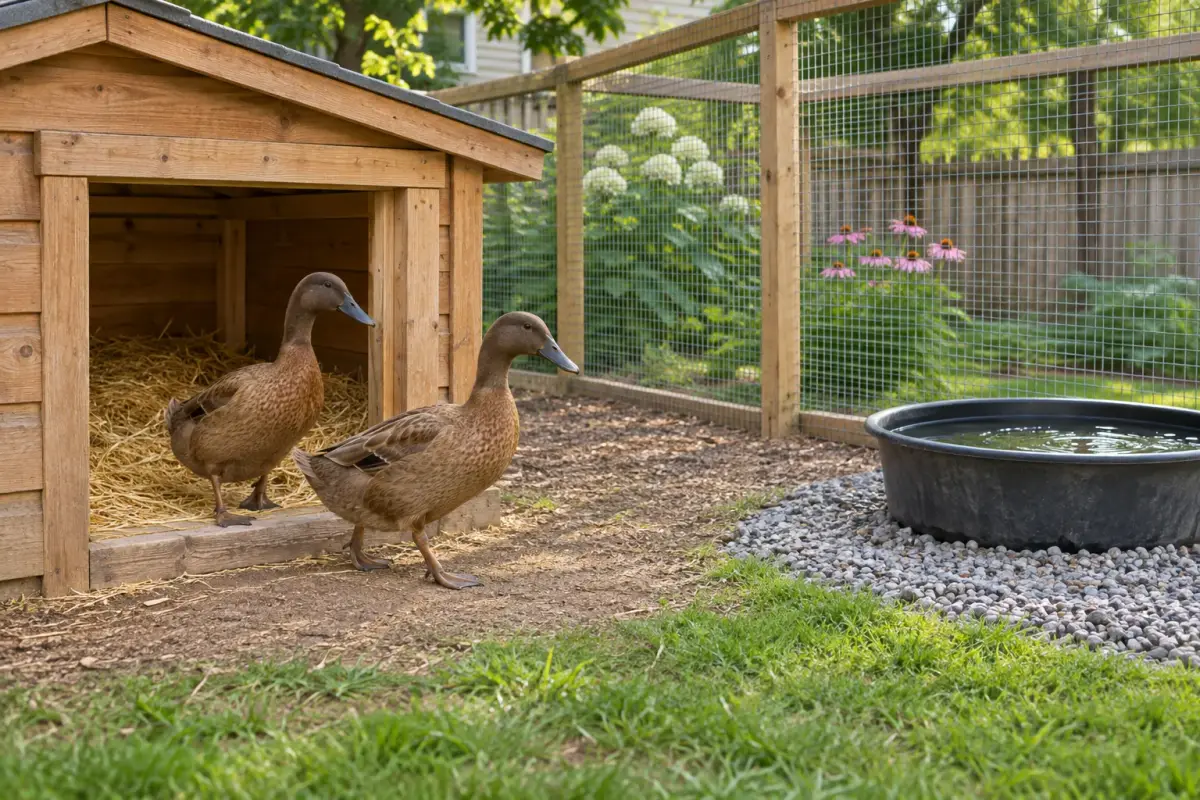
Duck houses differ from chicken coops in ways that catch new owners out. Hobby Farms advises keeping the house at ground level, skipping ramps and perches because ducks can be injured by falls, and skipping nest boxes because ducks usually lay on the floor. Muscovies are the exception, as they perch. A cute raised house with a steep ramp can therefore be a poor fit for heavy-bodied breeds.
Check the door height and threshold too. A low sill that a duck can waddle over is better than a step up. Ducks lay eggs in the house overnight or early morning, so a roof that opens, like the duck house with an openable roof and double doors, makes collecting eggs and cleaning simpler than reaching through a small hatch.
Flooring and bedding that stay dry
Ducks turn water into mess, so the floor matters. Hobby Farms says dirt floors are unsafe because digging predators can tunnel in, wood over a concrete pad is common and cheaper though wet bedding can cause mold and rot, and concrete is the best long-term option. For a prefab house, that means looking at the floor material and whether it lifts out or wipes clean.
For bedding, Hobby Farms recommends straw or wood shavings, never cedar, which is toxic to waterfowl, and changing wet bedding several times a week. Plan to clean more often than you would with chickens; our guide to chicken coop bedding and cleaning covers deep-litter routines that also suit ducks, with more frequent changes.
Predator-proofing and ventilation
Hobby Farms recommends no gaps or openings larger than half an inch, with larger openings covered in half-inch, 16-gauge hardware cloth, and says ducks should never free-range unsupervised. Penn State adds that runs should be covered against hawks and owls and that, if a run is not predator-proof, birds should be locked up before dark. Check every vent and window for welded mesh, and the door for a latch that cannot be lifted.
Ventilation is needed because ducks breathe out a lot of moisture, but vents should be covered with mesh and positioned away from where the ducks sleep. Penn State suggests keeping openings out of the direct path of the sleeping area. If a house has only a tiny window, it will likely feel damp by morning.
Water belongs in the run, not the house

Ducks need water at all times, including overnight, to drink and to clear their eyes and nostrils, according to Hobby Farms, which suggests a bucket or two inside the house plus a kiddie pool in the run. Penn State advises putting waterers in the run where possible, especially for waterfowl, so the house stays drier.
This changes what you want in a house: easy-to-wipe floors, a door wide enough to carry a water bucket through, and a covered run next to it. When you shop for a waterer in our chicken feeders and waterers, check that the opening is wide enough for a duck to dip its whole bill.
Which duck house suits which flock
For two or three ducks in a small yard, a compact wooden house such as a duck coop with an openable roof is workable, provided the floor area meets the 3 to 5 square feet figure and there is an attached run. A light gray wooden duck house with double doors offers wider access for cleaning, which pays off the first rainy week.
Anyone keeping ducks alongside chickens should read can ducks and chickens live together first, as the housing needs differ. Pair any house with a roomy run from chicken runs, checking that the mesh is predator-proof, and compare designs again at duck houses once you know your flock size.
Common questions
How big should a duck house be?
Penn State Extension lists 3 square feet per duck inside, and Hobby Farms recommends 5 square feet per duck. Using 4 to 5 square feet gives comfortable room, especially for larger breeds.
Do ducks need nest boxes?
Usually not. Hobby Farms notes that ducks and geese typically lay eggs on the floor, so a nest box is unnecessary. Some owners add a small wooden shelter corner for privacy.
Can ducks use a chicken coop?
Sometimes, with changes. Ducks need ground-level access without steep ramps, no perches for most breeds, more floor space and much more frequent bedding changes. Check these points before reusing a coop.
What bedding is best for ducks?
Straw and wood shavings are the most absorbent choices according to Hobby Farms, which warns against cedar because it is toxic to waterfowl. Change wet bedding several times a week.
Do ducks need to be locked up at night?
Yes. Penn State advises locking birds up before dark if the run is not predator-proof, and Hobby Farms says ducks should never free-range. A secure house with a latch predators cannot open is essential.
Sources we checked
This guide is general information, not veterinary advice. If your pet is unwell or injured, contact your veterinarian.


