






Buying guides
Best Dog Gate With Door: How to Choose a Walk-Through Gate
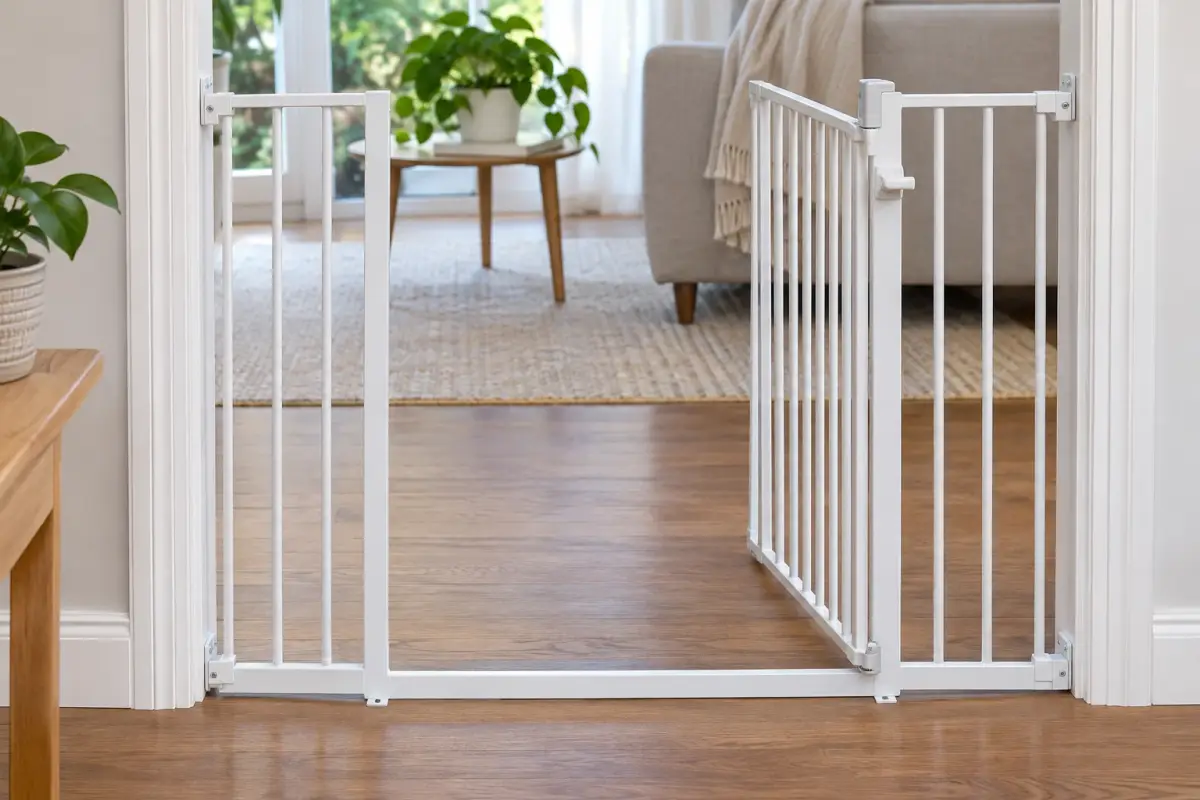
The best dog gate with a door matches your dog's jumping ability, fits your opening, and mounts securely for where it will go. For most dogs that means at least 30 inches tall for big dogs and jumpers, a latch your dog cannot nose open, and hardware mounting at the top of stairs. A walk-through door saves you from stepping over the gate.
By Matt GarnettUpdated November 13, 20264 min read2 sources
What a gate with a door adds, and what it costs
A walk-through gate has a built-in door, so you can pass without lifting the gate or stepping over it. That is a real convenience for a hallway or kitchen you cross dozens of times a day, and it is the reason gates with doors are popular for homes with an older person, a baby, or a dog that must be kept out of one room. Browse our dog gates with doors when you know your opening.
The cost is a latch and hinge, which are the weak points of any gate. A door is only as secure as its latch, so the choice comes down to how well it holds against your dog. For a general overview of gate types, our guide to the best dog gates compares the whole category before you narrow to doors.
Mounting: pressure or hardware
The AKC describes two main mounting styles. Pressure-mounted gates use rubberized tension knobs and an adjustable frame, need no tools, and suit renters and anyone who wants to move the gate around. Hardware-mounted gates are bolted or bracketed to the wall or doorway, are the most secure option, and are recommended for energetic or large dogs.
For a gate with a door, the mounting matters even more, because a swinging door puts sideways force on the frame every time it opens. A pressure-mounted gate with a door is fine across a doorway at floor level. Anywhere your dog could fall, particularly the top of a staircase, use a hardware-mounted gate. See our dog gates for stairs for that case.
Height: the first number to get right
The AKC says a 20-inch gate may work for puppies and small breeds, while bigger breeds and jumpers likely need a gate at least 30 inches high. The principle is that the gate must be tall enough that your dog cannot jump over it, so measure from the floor and think about your dog's athleticism, not only its size.
Also look around the opening. If a sofa, chair or shelf sits near the gate, a determined dog can use it as a step, which makes a gate effectively shorter. If your dog climbs, the AKC advises avoiding gates with horizontal bars that offer footholds. For tall dogs, see our tall dog gates.
Width, measuring and weight limits
Measure the doorway, hallway or opening before you buy, at the base and at the height where the gate will sit, because walls and trim are not always square. Most gates adjust within a set range, so confirm that your measurement falls inside the range given in the product specifications, and note whether extensions are needed.
Check the listed weight limit against your dog's size and how hard it pushes. A wide opening often needs an extension, and each extension adds a joint. For openings beyond the standard range, our extra-wide dog gates are built for the job. A 41-inch easy-open indoor gate type suits a standard doorway, while a taller white safety gate with extensions type suits wider openings.
Doors, latches and small pet doors
Look for a latch that needs two actions to open, such as lift-and-push, so a dog cannot open it with its nose, and a door that swings closed and latches by itself. Auto-close is useful in a busy house because a gate left open protects nothing, though a strong spring can catch a tail or a small dog.
Some walk-through gates include a smaller pet door. A walk-through gate with a small pet door lets a cat pass while a larger dog stays out, which can also protect a cat's food and litter. A pet gate with a cat door does the same. These only work if the opening is too small for your dog, so measure your dog's shoulders first.
Materials, gaps and safety
Per the AKC, metal gates are the most durable and chew-resistant, wooden gates should have pet-safe finishes, and plastic gates are lighter and cheaper but may not hold up to large or determined dogs. Gaps matter too: they should be small enough that a dog's paws or head cannot get trapped.
The ASPCA notes that a baby gate is an option for confining a dog to one room, but dogs that try to escape can injure themselves, with broken teeth, cut paws and damaged nails. If your dog panics behind a gate, do not simply buy a taller one. Talk to your vet or a trainer about whether confinement is right for that dog.
Never leave a dog behind a gate with an open top where it could climb and fall, and check the latch every few weeks, because hinges loosen with use.
Gate body materials and installation checks
| Material | Construction distinction | What to inspect |
|---|---|---|
| Metal | Metal frame and bars | Connections,gaps and latch |
| Wood | Wooden frame or panels | Surface finish and damage from chewing |
| Plastic | A lighter molded body | Flex,connections and the stated intended use |
| Door or latch assembly | A movable section within the gate | Hinges,latch closure and the opening width |
Common questions
How tall should a dog gate with a door be?
The AKC suggests around 20 inches may work for puppies and small breeds, while bigger breeds and jumpers likely need at least 30 inches. Pick a height your dog cannot clear, and watch for furniture it can climb.
Can I use a pressure-mounted gate with a door at the top of stairs?
Not recommended. The AKC advises a hardware-mounted gate at the top of stairs, because it is bolted to the wall and far more secure than a pressure-mounted frame.
What is the best dog gate for a large dog?
A tall, sturdy gate at least 30 inches high, ideally hardware-mounted, with a metal frame and a latch that needs two actions to open. Check the weight limit against your dog's size.
Will a dog gate with a cat door keep my dog out?
It can, if the small door is too narrow for your dog. Measure your dog's shoulders and chest first, and remember that determined small dogs may still squeeze through.
Are gates with doors less secure than solid gates?
The latch and hinge are the weak points, so a good locking mechanism matters. A well-built walk-through gate can hold as well as a fixed one, but check it regularly for loose parts.
Sources we checked
This guide is general information, not veterinary advice. If your pet is unwell or injured, contact your veterinarian.


