Buying guides
Best Dachshund Ramps: What Actually Matters
The best ramp for a dachshund is long enough that the slope stays gentle, has a grippy surface and is wide enough for a long body. Vets list the breed among those most prone to disc disease, so cutting out repeated jumps is a sensible habit. Browse our dachshund ramps, then use this guide to check length, surface and width.
By Matt GarnettUpdated November 14, 20265 min read2 sources
Why dachshunds get ramps
The dachshund's long back and short legs are what make the breed so recognizable, and also what make its spine vulnerable. VCA Animal Hospitals says dachshunds are among the breeds most affected by disc disease, linked to long backs and short legs, and notes that they have faster disc deterioration than other breeds. The Merck Veterinary Manual adds that discs can begin degenerating in the first few months of life.
A ramp cannot change that biology, and nobody should claim that it prevents the condition. What it can do is remove repeated jumps up to the sofa and down to the floor. VCA says repeated traumatic events in predisposed breeds may enhance the risk of disc disease, so lowering the number of hard landings is a reasonable, low-cost precaution to talk through with your vet.
Ramp length and slope
The slope is the most important feature. A short, steep ramp asks a short-legged dog to scramble, which defeats the purpose. Measure the height from the floor to the top of the bed, couch or car seat, then pick a ramp noticeably longer than that height so the incline stays shallow. If the choice is between two lengths, take the longer one and check you have the floor space.
Dachshunds have a long body but little ground clearance, so the point where the ramp meets the floor and the point where it meets the furniture both matter. Look for a smooth transition at the top, with no gap or lip a paw can catch on, and a ramp that sits firmly against the edge. Our guide to dog ramps for the bed covers height measuring in more detail.
Surface, width and stability
A ramp is only safe if the dog can grip it. Carpeted or rubberized surfaces give traction, while bare wood or plastic can be slick, especially for a dog that is hurrying. Raised side rails or a lip along the edges help keep a long body on the ramp. Check that the surface is firmly attached and not loose where a nail can catch.
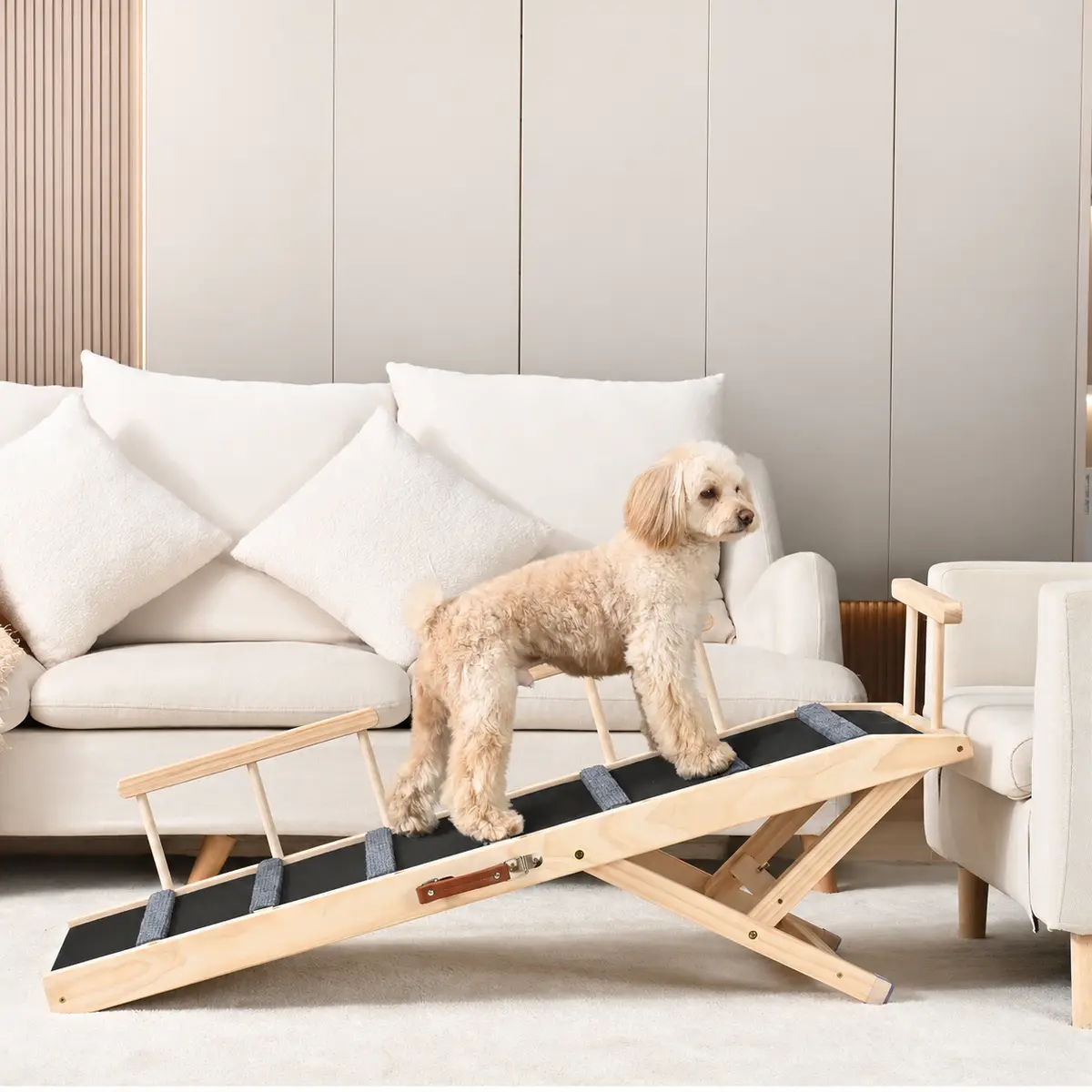
Width matters for a long dog because it needs to place all four feet in line without drifting off the side. A ramp with a carpeted surface and a flat platform at the top, like this dog ramp for a bed with a non-slip carpet and top platform, lets the dog pause before stepping onto the furniture. Whatever you choose, it must not wobble or slide on the floor.
Folding, portable and fixed designs
Foldable ramps are the practical choice if you need to move one between a car, a bed and a sofa, or store it out of the way. The trade-off is that hinges and joints are places where wobble can creep in, so check that the locking mechanism is secure and that the ramp sits flat when open. A folding wooden pet ramp with a non-slip surface is the sort of adjustable design that suits a household with more than one piece of furniture.
Fixed or semi-permanent ramps are steadier because there is nothing to fold, which suits a dog that uses the same bed every night. If the ramp is next to a sofa, a sofa-height design such as an adjustable-height dog ramp for a couch lets you match the top to your cushions. Whichever you choose, introduce it before the dog needs it.
Teaching a dachshund to use it
Most dogs need a little patience. Put the ramp on the floor first, with treats along it, and let your dog walk over it flat with no height to worry about. Raise it gradually to the furniture over a few days, rewarding each step. Never push or lift the dog onto a ramp; wait for the dog to choose it, and keep sessions short and relaxed.
Once the dog is happy, make the ramp the easy option by moving it where the dog already goes and blocking the old jump with a chair or a pillow if needed. Stairs need the same care, because running up and down stairs is another repeated impact for a long back. A baby gate at the top of the stairs is a simple way to remove the temptation.
Weight, harnesses and when to call the vet
A ramp helps most when the dog is also at a healthy weight. VCA names obesity as a risk factor for disc disease and recommends reaching and keeping a healthy weight, so ask your vet what your dachshund should weigh. Many owners also pair a ramp with a harness rather than a collar when lifting or walking, and our dachshund harnesses are cut for the long body.
Know the warning signs and act quickly. VCA lists a stiff neck, neck pain, altered walking, weakness and a lowered head, and Merck says surgery for severe signs must be prompt, because recovery chances fall if it is delayed more than 24 hours after pain perception is lost. Watch your dog's ability to urinate and defecate normally. If you see these signs, call your vet or an emergency clinic straight away.
Checklist before you buy
Measure the height of the bed, couch or car seat. Pick a ramp noticeably longer than that, with a grippy surface, side rails, a firm lock if it folds, and a width a long body can use. Check the weight limit against your dog's weight and make sure the ramp stays put on your floor.
Then compare designs for the places you will use them, starting with our dachshund ramps. If your dog already has a back problem, ask your vet which ramp, if any, is right before you buy. This page is general information, not veterinary advice, and it cannot replace an examination by the vet who knows your pet.
Common questions
Do dachshunds really need ramps?
Dachshunds are among the breeds most affected by disc disease, and repeated jumping may add to the risk in predisposed breeds. A ramp cannot prevent the condition, but it removes many hard landings.
How long should a dachshund ramp be?
Longer than the height it has to climb, so the slope stays gentle. Measure from the floor to the top of the bed or couch and choose a ramp noticeably longer than that figure.
Are stairs or ramps better for a dachshund?
Ramps with a gentle slope and grippy surface are usually easier on a long, low dog than steps, but either works if the dog does not have to jump. A gate across the stairs removes the temptation to run them.
How do I get my dachshund to use a ramp?
Start with the ramp flat on the floor, reward the dog for walking over it, then raise it by stages. Never force the dog on, and keep sessions short so the ramp stays a pleasant thing.
When should I call the vet about my dachshund's back?
Call right away if you see neck or back pain, a stiff or unsteady walk, weakness, reluctance to move or any change in urinating or defecating. Severe signs are an emergency.
Sources we checked
This guide is general information, not veterinary advice. If your pet is unwell or injured, contact your veterinarian.