






Care & how-to
How Much Should I Feed My Dog?
How much to feed a dog depends on size, age, activity and whether the dog is spayed or neutered, so the bag's chart is only a starting point. Judge the portion by your dog's body condition, measure it the same way at every meal, and adjust in small steps. Adult dogs usually eat their daily amount split across two meals, while puppies eat more often.
By Matt GarnettUpdated November 13, 20265 min read3 sources
Why the bag's chart is only a starting point
Feeding charts are a sensible place to begin, but the American Kennel Club says standard kibble-bag feeding ranges are generally too broad, and are based on active adult dogs, so they often lead to overfeeding. Two dogs of the same weight can need different amounts depending on age, build and how much they move. Our dog bowls and feeders cover the measuring and serving side once you know the amount.
Neutering matters more than many owners expect. AKC cites a veterinarian saying that spaying or neutering reduces energy requirement by 20 to 30 percent, so a neutered dog that is not very active may be overfed by that much when fed straight from the chart. Use the chart as a starting point, and let your dog's shape tell you which way to adjust.
Use body condition to set the amount
Veterinarians score body condition by sight and touch on a 1-to-5 or 1-to-9 scale, and AKC says the goal is a 3 on the 5-point scale, or 4 to 5 on the 9-point scale. At home, run flat fingers over the ribs: in a dog at a healthy weight you can feel them with light pressure under a thin layer of muscle. From above you should see a slight hourglass waist, and from the side the belly should slope up toward the hind legs.
Ribs hidden under fat, no waist and a sagging belly point to extra weight. Ribs, hip bones and spine that show clearly from a distance point to a dog that is too thin. AKC's puppy feeding guide puts the principle as watching the dog, not the dish, so check your dog's shape every few weeks and change the portion a little at a time. If you are unsure what your dog should weigh, ask your vet.
Measure the same way at every meal
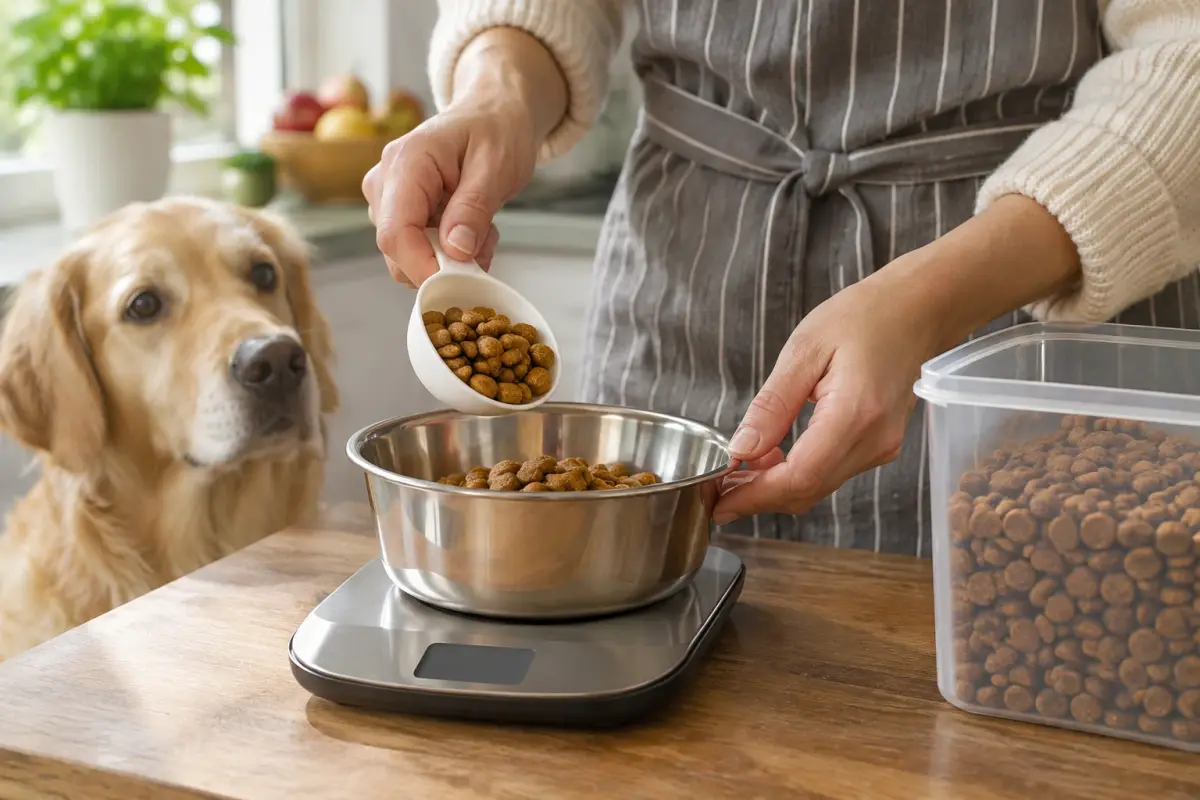
Once you have a daily amount, the practical job is making it repeatable. Scooping loosely from a bag is easy to get wrong, so use a level measuring cup, a graduated pet food measuring scoop or a kitchen scale, and write the daily amount where everyone who feeds the dog can see it.
Keeping dry food in a sealed container means you are not guessing from the bag, and a collapsible pet food storage container with scoop is one tidy option. If several people feed the dog, agree who gives which meal, since an extra meal from a second person is an easy way for portions to creep up. A dog that bolts its food may suit a slow feeder, which changes how fast the meal goes in, not how much the dog needs.
Adults and puppies: how often to feed
According to AKC, adult dogs over a year old typically eat their full daily amount split across two meals. If your schedule makes regular mealtimes hard, an automatic dog feeder can release a set portion at set times, and our guide to how often to feed a dog covers sample routines.
AKC's puppy guide says four feedings a day are usually adequate from 6 to 12 weeks, three a day from 3 to 6 months, and two a day from 6 to 12 months. Set the puppy's portion by body condition, not by how much is left in the bowl. A rounder belly can be normal before about four months, a healthy puppy should gain weight every day, and AKC suggests weighing weekly against a breed-appropriate growth chart.
Count treats and training rewards
Treats should make up no more than 10 percent of your dog's daily calories, according to AKC, and they add up quickly in a small dog. Keep them as small as possible, and when you are training with treats, reduce the mealtime portion to match instead of adding them on top.
Chews, dental sticks and food from the table count too. If your dog is gaining weight on a measured meal, look at the extras before you cut the meal, and ask your vet whether the daily amount still suits your dog.
When to ask your vet
Ask your vet for your dog's ideal weight, a daily calorie target and a safe schedule if your dog needs to lose weight. AKC notes that if weight loss stalls even when you stay within the calorie limit, a vet visit can rule out medical causes such as hypothyroidism and Cushing's syndrome. A dog that suddenly eats much more or less than usual, or loses weight without a change in food, should be seen. For bowls and routines, see our guide to the best dog bowls, or browse dog bowls and feeders.
This page is general information, not veterinary advice, and it cannot replace an examination by the vet who knows your pet.
Common questions
How many cups of food should I feed my dog?
There is no single number, because a cup of one food can hold very different calories from a cup of another. Start from the amount on your food's label for your dog's weight, then adjust by body condition and ask your vet for a daily target.
How much should I feed a puppy?
Follow the puppy food's label as a start, feed four meals a day from 6 to 12 weeks, then fewer as AKC outlines, and set portions by body condition rather than by what is left in the bowl. Weigh weekly and ask your vet if growth looks off.
How much should I feed a neutered dog?
Often less than the bag suggests. AKC cites a veterinarian saying spaying or neutering reduces energy needs by 20 to 30 percent, and bag ranges assume active adults, so watch body condition closely and ask your vet for a daily target.
Should I feed my dog once or twice a day?
AKC says adult dogs typically eat their full daily amount split across two meals. Puppies need more meals when young. If your adult dog seems unsettled on one meal a day, or you are unsure, ask your vet what suits your dog.
Sources we checked
This guide is general information, not veterinary advice. If your pet is unwell or injured, contact your veterinarian.


