






Buying guides
Best Retractable Dog Gate: Where They Work and Where They Don't
A retractable dog gate rolls out across an opening and tucks away when you do not need it, which suits wide hallways and doorways. Check the height for your dog, how it mounts and how easily the latch resists a determined dog. See our retractable dog gates, and read on for where a fixed gate is the better pick.
By Matt GarnettUpdated November 13, 20264 min read2 sources
What matters most: height, mounting and latch
The AKC says a 20-inch gate may work for puppies or small breeds, while bigger breeds and jumpers generally need at least 30 inches. Check what is next to the opening, too: furniture beside a gate can give a dog a step to climb over. Retractable gates vary in height, so read the specification and match it to your dog's jump, not just its size.
Mounting is the next question. The AKC describes pressure-mounted gates as tool-free and suited to renters, hardware-mounted gates as the more secure option, and freestanding barriers as the least secure. A retractable gate typically fixes to the wall at one side and latches or clips on the other, so look at how firmly it holds when a dog leans or pushes against it.
How retractable gates compare with fixed gates
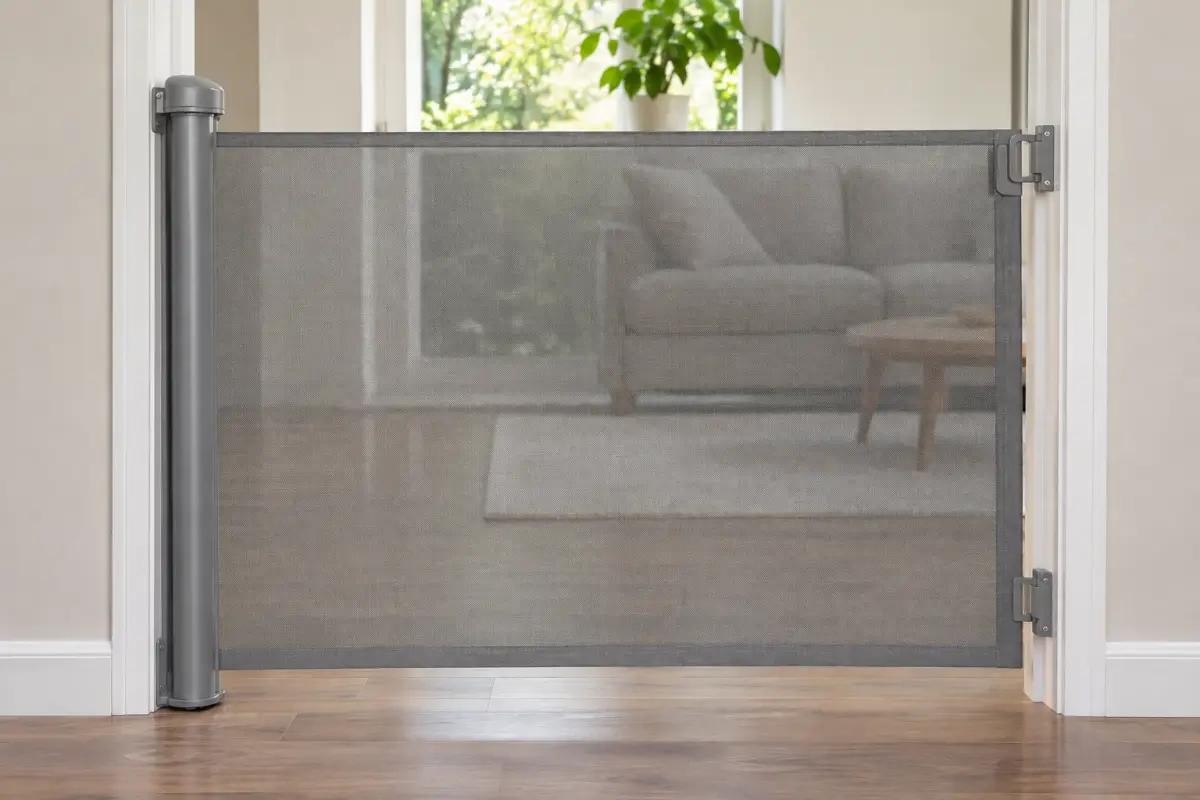
A retractable gate is a flexible mesh or fabric panel on a roller. Its strengths are that it fits a range of widths, takes up little space when open, and avoids the step-over bar at the bottom that many fixed gates have. That makes it a good match for wide hallways, kitchen entrances and open-plan spaces. A retractable stairway and hallway barrier gate shows the design.
The trade-off is stiffness. A flexible panel gives under a heavy push in a way a rigid metal gate will not. For most calm small and medium dogs, that is a fair trade; for a large dog that leans, pushes or jumps, a rigid gate is usually the safer choice.
Best type for each situation
For a wide hallway or a doorway between rooms, a retractable gate is a good fit, because you can open it fully and the opening stays clear for people. For a rental where drilling is a problem, a pressure-fit or freestanding style avoids marks on the wall, and a portable mesh option such as a mesh safety gate for stairs and doors is easy to carry between rooms.
For the top of the stairs, the AKC recommends hardware-mounted gates, so follow the maker's instructions and use bolted brackets there. For a persistent chewer, the AKC suggests metal, noting that plastic may not hold up and wood needs a pet-safe finish. Our guide to choosing a dog gate covers rigid designs in more detail.
How to measure for a gate
Measure the width of the opening at its narrowest and widest points, and check that the result sits inside the gate's stated range. Measure the wall or post where the roller will mount: it needs to be solid and flat, not a thin trim or a loose door frame. Measure the height you need, using the AKC's guideline above as a start.
Check the weight limit and the manufacturer's instructions for stairs, and test the gate before you trust it: push on it, lean on it and watch how your dog responds in the first few days. Keep the latch height and release easy for you to use with one hand while carrying something.
Safety and what to avoid
The AKC advises openings small enough that a dog's paws or head cannot become trapped, and a latch people can operate easily but dogs find hard to open. With mesh panels, check for loose threads or gaps at the edges. Avoid horizontal bars on a gate for a climbing dog, since they can serve as footholds, and avoid any gate a puppy can squeeze under.
A dog gate is a management tool, not a safety device for infants or a substitute for supervision, and baby and dog safety is a separate topic to raise with your vet. If your dog panics behind a gate or tries to climb it, stop and ask your vet or a trainer for help.
Care and lifespan
Wipe the mesh with mild soap and water, and let it dry fully before it retracts. Check the roller and latch every few weeks for wear, and take the gate off the wall if the mounting loosens. A retractable gate that sticks or no longer locks should be replaced rather than patched.
Chewing, claws and sun all age flexible panels, so expect a shorter life than a metal gate. When you need a fixed option, browse our dog gates too.
Retractable and rigid barrier construction
| Construction | Open arrangement | Check before installation |
|---|---|---|
| Retractable mesh | Panel rolls into a housing | Actual span,fixings and permitted location |
| Rigid gate | A fixed panel or hinged door remains in the opening | Mounting,width and any threshold bar |
Common questions
Are retractable dog gates good for large dogs?
They suit calm large dogs in hallways, but a flexible panel gives when a big dog pushes or leans. For jumpers, pushers or the top of stairs, a rigid, hardware-mounted metal gate is generally the safer choice.
How tall should a retractable dog gate be?
The AKC says about 20 inches may suit puppies or small breeds, and at least 30 inches for bigger breeds or jumpers. Check for furniture nearby that a dog could use to climb over.
Can I use a retractable gate at the top of stairs?
The AKC recommends hardware-mounted gates at the top of stairs. If a retractable gate is made for stairs, follow its instructions exactly and bolt it in place; never rely on a gate that moves when pushed.
Will a retractable gate stop a dog that chews?
Not reliably. The AKC suggests metal for persistent chewers, noting that plastic may not hold up. For a chewer, choose a rigid metal gate and work on exercise and chew toys.
Sources we checked
This guide is general information, not veterinary advice. If your pet is unwell or injured, contact your veterinarian.


