






Buying guides
Best Escape-Proof Dog Harnesses: Fit Matters More Than the Label
No harness is truly escape-proof, but the right design, fitted correctly, makes slipping out much harder. Look for a three-point harness with neck, chest and belly straps, measure your dog's chest and neck, and check the fit while the dog stands and moves. Compare options in our escape-proof dog harnesses after reading the fit checks below.
By Matt GarnettUpdated November 14, 20264 min read2 sources
Why dogs slip out of harnesses
A harness fails for a handful of reasons: it is the wrong size, it is adjusted too loosely, or it has too few points of contact for the way the dog is built. A dog that pulls back, twists or backs away can work a loose strap over its head or shoulders in a second, and a frightened dog can do it before you notice.
The American Kennel Club notes that broad-necked or narrow-headed dogs are less likely to slip out of a well-fitting harness than a collar, which is why a harness is usually the safer choice. The key phrase is well-fitting. A harness sold as escape-resistant still depends on you measuring, adjusting and checking it.
Three-point harnesses and what they add
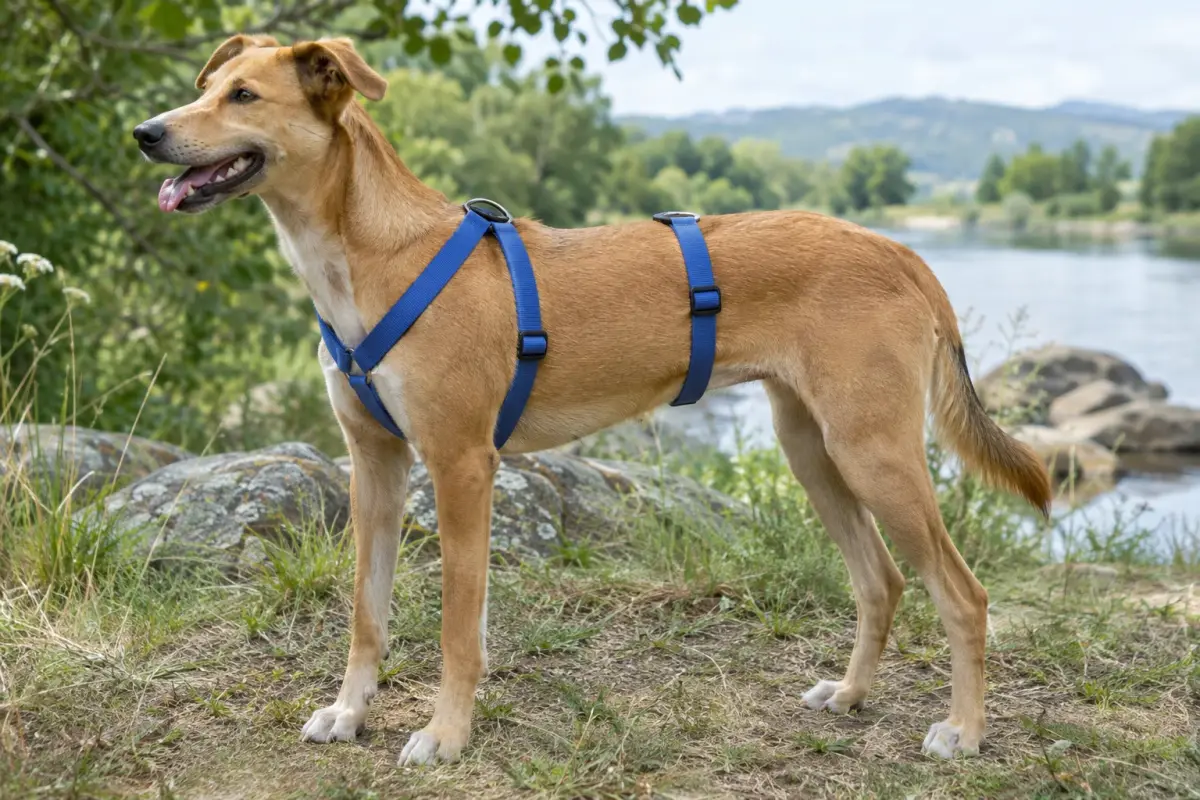
The AKC recommends three-point harnesses, with neck, chest and belly straps, for escape artists. Each strap is another place the harness is anchored, so there is no single loop that can be pulled forward over the head. Compare that with a simple vest that closes at the neck and relies on one strap.
Look at how the straps adjust. Several adjustment points let you tune the neck, chest and belly separately, which helps with deep-chested and narrow-waisted shapes. A no-pull anti-escape harness and a reflective harness and lead set are two designs sold for this purpose, and our general guide to choosing a dog harness explains the other types.
Measure before you buy
The AKC advises using a flexible tape, or a string you then lay against a ruler. Have your dog stand with the spine aligned and weight even, keep the tape snug but not tight, and leave room for two fingers. For a harness, chest girth is one of the two most important measurements: measure around the widest part of the rib cage, usually just behind the front legs.
Neck girth is the other. Measure around the base of the neck, and for long-necked breeds measure lower, between the withers and where a standard collar would sit. Some harnesses are sized by your dog's measurements and others by the harness's own dimensions, so check the product details. If your dog falls between sizes, the AKC suggests choosing an adjustable option.
The fit check that matters
The AKC says you should be able to fit two fingers under the straps, with the harness neither tight nor pinching anywhere when the dog is standing or sitting. The girth strap should not sit behind the rib cage toward the stomach or press into the back of the front legs, and the neck opening should sit near the top of the breastbone, not around the throat.
Your dog should also be able to reach the front legs forward and out to the side without restriction. Check the fit with the dog standing, sitting and walking, and recheck it after any change in weight. Fleece-lined styles suit thin-coated breeds such as Greyhounds, but a harness that is too thick can change how it fits.
Getting a nervous dog to accept a harness
Never force a harness over a nervous dog's head. The AKC suggests choosing a harness with a neck strap you can unclasp before putting it on, then rewarding the dog for voluntary head-in behavior, building up from sniffing the harness to putting the head through.
Over-tightening a harness will not fix a dog that dislikes wearing one. If your dog panics on the leash, a qualified trainer can help, and your vet can rule out pain as a reason for the behavior.
What to avoid, and the backup plan
Avoid very loose adjustment, a single point of closure, and thin straps on a strong dog. Never rely on a harness label alone, and never leave a harness on an unsupervised dog. Use the front attachment where the AKC advises it, and a double-ended lead helps keep the dog balanced.
For a dog that has escaped before, use the harness together with a collar and a properly attached ID tag, and keep a hand on the leash near roads. Browse our dog harnesses, no-pull dog harnesses and small dog harnesses to compare sizes, and see the escape-proof dog harnesses when you are ready.
Common questions
What is the best harness for a dog that escapes?
A well-fitted three-point harness with neck, chest and belly straps is what the AKC recommends for escape artists. No harness is truly escape-proof, so fit and adjustment matter most.
How tight should a dog harness be?
You should be able to fit two fingers under the straps, with the harness not tight or pinching when the dog stands or sits. It should not restrict the legs or ride behind the rib cage.
How do I measure my dog for a harness?
Measure chest girth around the widest part of the rib cage behind the front legs, and neck girth at the base of the neck. Use a snug tape with room for two fingers, then check the size chart.
Can a dog slip out of a harness?
Yes, if it is too loose or has too few straps for the dog's shape. A harness is usually harder to slip than a collar for broad-necked or narrow-headed dogs when it fits well.
Sources we checked
This guide is general information, not veterinary advice. If your pet is unwell or injured, contact your veterinarian.


