






Buying guides
Best Dog Agility Equipment: What to Buy First and What to Skip
The best dog agility equipment for most homes is simple, low and adjustable: a tunnel, a few low jumps with poles that fall if hit, and a wobble board, with ramps and seesaws added only once your dog is confident. Footing, adjustable height and a calm pace matter more than owning a full course. Browse our dog agility equipment, then check each piece against the criteria below.
By Matt GarnettUpdated November 13, 20265 min read2 sources
What matters most: low, adjustable and stable
The American Kennel Club advises beginners to use lowered equipment and positive training methods, and says full-size equipment should wait until a dog is comfortable and has mastered the basics. That makes adjustability the first thing to look for. Jumps should start at the lowest setting, and for a growing puppy they stay at walking height. As the AKC puts it, what a dog can jump and what a dog should jump are two different things.
Stability and footing come next. A jump pole should fall if your dog hits it, so a bar that locks rigidly into its stands is the wrong design for a beginner. Practice surfaces should not be slippery, because slick ground is where jumping injuries happen. If you are choosing between a big set and a few well-made pieces, the few well-made pieces teach more and cost less to get wrong. Our dog agility equipment range is organized by piece for that reason.
The main pieces and what each one teaches
A full agility course uses jumps, tire jumps, open tunnels, weave poles, seesaws (teeters), dog walks and A-frames, and the AKC says a course usually runs 14 to 20 obstacles. You do not need all of them. Jumps teach timing and collection, tunnels teach confidence and speed, weave poles teach focus, and the ramp-style pieces teach balance and body awareness.
The ramp, seesaw, dog walk and A-frame are called contact obstacles because they have contact zones, usually painted bright yellow, which a dog must touch with at least one toenail on the way down. If you buy one, look for a clearly marked zone and a non-slip surface. A standalone dog agility ramp is the simplest contact-style piece for teaching a dog to walk confidently up and down a sloped board.
Tunnels and jumps: the sensible first purchase
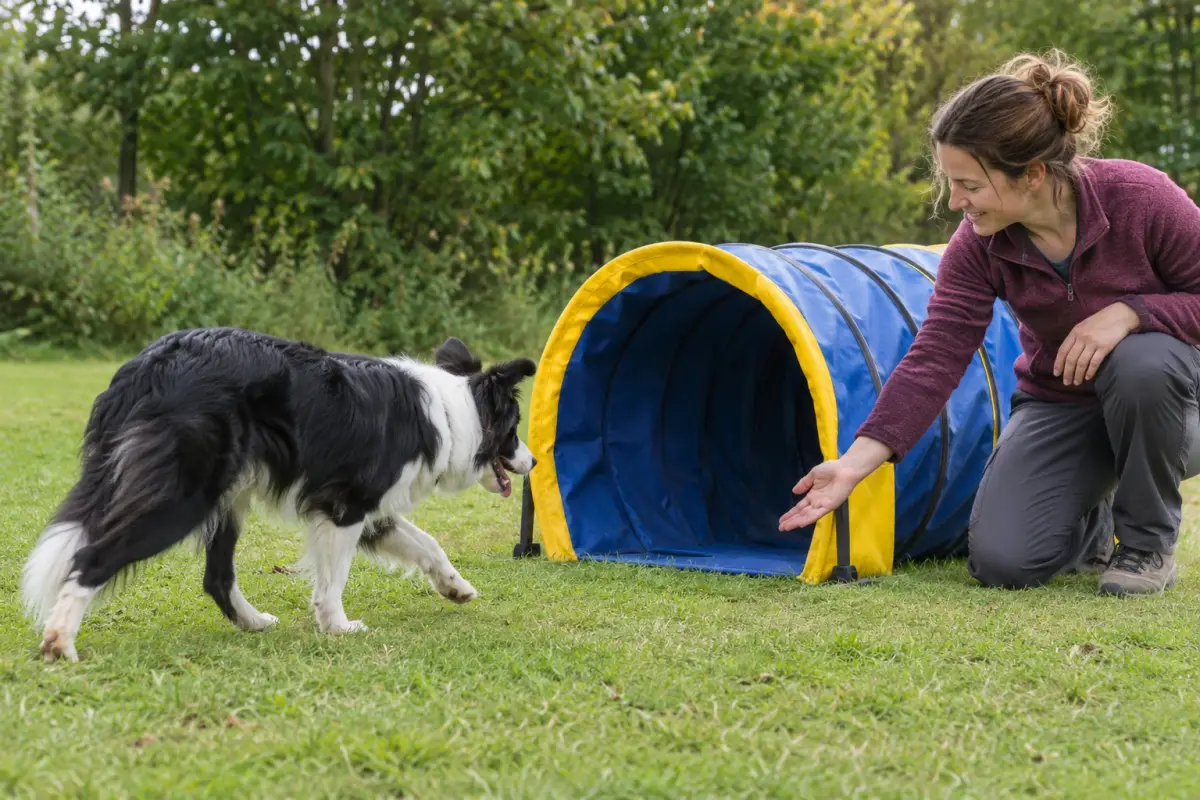
A tunnel is the easiest first piece for most dogs, but many are intimidated by the dark opening. Start with it scrunched short so your dog can see the exit, lure or encourage from the far end, and never push a dog through. If you are not sure your dog will like it, the AKC notes a blanket draped over chairs or a large open cardboard box works as a trial run before you spend anything.
Jumps are where sloppy setups cause injuries, so choose a design with adjustable height and a bar that drops. The AKC points out that agility is not a high-jump contest, so keep heights low in training and raise them gradually. If you want several pieces in one purchase, read a combined listing such as dog agility training equipment closely for which obstacles it includes and whether each height adjusts.
Seesaws, ramps and weave poles: the harder pieces
The AKC calls the teeter one of the scariest obstacles for a novice dog because it seems stable until the dog starts to climb, then drops. It suggests practicing first on lower objects that move, such as a wobble board made from plywood at least two feet square with something small underneath. A teeter-style piece such as a wooden dog agility seesaw is a later purchase, introduced slowly and, ideally, with an instructor.
Weave poles are the hardest to teach at home, and the AKC recommends expert guidance for them. A full set has six to 12 poles in a straight line, and the AKC's home-practice article uses stakes spaced 24 inches apart. Treat weave poles as an upgrade for a dog that already loves tunnels and jumps, not as a starter item.
Which setup suits which dog
Puppies can learn foundation skills, but the AKC says full-height jumps and strenuous obstacles are generally delayed until their bodies are developed, and a vet and qualified instructor can help set the timing. For a puppy, a tunnel, a flat ladder on the ground and a wobble board are plenty. Small dogs and large dogs do not jump the same height, since standard jump height in competition is based on the dog's own height.
Older dogs are welcome if they are up to it, and the AKC suggests checking with your vet first. Many handlers of older dogs use the lower Preferred jump height. A nervous dog does best with open tunnels and low obstacles. Keep sessions short, no more than five or 10 minutes at a time, so the equipment stays fun. Pair your obstacles with a dog treat pouch and a dog training clicker so rewards are instant.
What to avoid, and when to ask your vet
Avoid jump bars that cannot fall, equipment that wobbles when it should not, slippery grass or polished floors, and any set that only offers one fixed height. Avoid forcing a dog onto a contact piece or through a tunnel; a dog that panics once may refuse the piece for months. Avoid rushing height, because puppies and older dogs both need gradual progress.
Ask your vet whether agility suits your dog before you begin, especially for a puppy, a senior, a heavy dog or a dog with joint trouble. Stop and call the vet if your dog limps, yelps, or is stiff the next day. When you are ready to choose, browse our dog agility equipment and start with the lowest, simplest piece. This page is general information, not veterinary advice, and it cannot replace an examination by the vet who knows your pet.
Common questions
What agility equipment should a beginner buy first?
A short tunnel and a few low, adjustable jumps with bars that fall easily are the usual starting point, plus a wobble board for balance. Leave seesaws and weave poles until the basics are solid.
Can I practice dog agility at home without buying equipment?
Yes. The AKC suggests a blanket over chairs or a cardboard box as a tunnel, a broomstick balanced on low supports as a jump, and a plywood wobble board at least two feet square for balance work.
Is agility safe for puppies?
Foundation skills are fine, but full-height jumps and strenuous obstacles are generally delayed until the body has developed. Keep jumps at walking height and ask your vet and an instructor about timing.
How many obstacles are on a full agility course?
The AKC says a course usually has 14 to 20 obstacles, depending on class and level. At home you only need two or three pieces to teach confidence, timing and balance.
Sources we checked
This guide is general information, not veterinary advice. If your pet is unwell or injured, contact your veterinarian.


