






Buying guides
Best Breakaway Cat Collars: What Actually Matters
The best breakaway cat collar is one that releases when snagged, fits snugly without choking and carries a legible tag. Vets advise that any collar a cat wears should be a breakaway type so it cannot trap her. Browse our breakaway cat collars, then use this guide to check the buckle, the fit and the identification.
By Matt GarnettUpdated November 13, 20265 min read3 sources
Why a cat's collar must break away
Cats climb, squeeze through gaps and groom with their back feet, which means a fixed collar can catch on a branch, a fence, furniture or even the cat's own jaw. VCA Animal Hospitals says that if a cat wears a collar, it should be a breakaway type so that it does not get caught on anything and cause an injury. The ASPCA gives the same reasoning when it recommends a safety collar with an elastic panel that lets the cat break loose.
That makes the release mechanism the single most important feature. A plain buckle collar that never opens is the wrong tool for a cat, however good it looks. Whatever else you compare, whether color, material or tag, begin by confirming that the collar is designed to open under pressure and that this is stated plainly on the product page.
Breakaway buckles and elastic panels compared
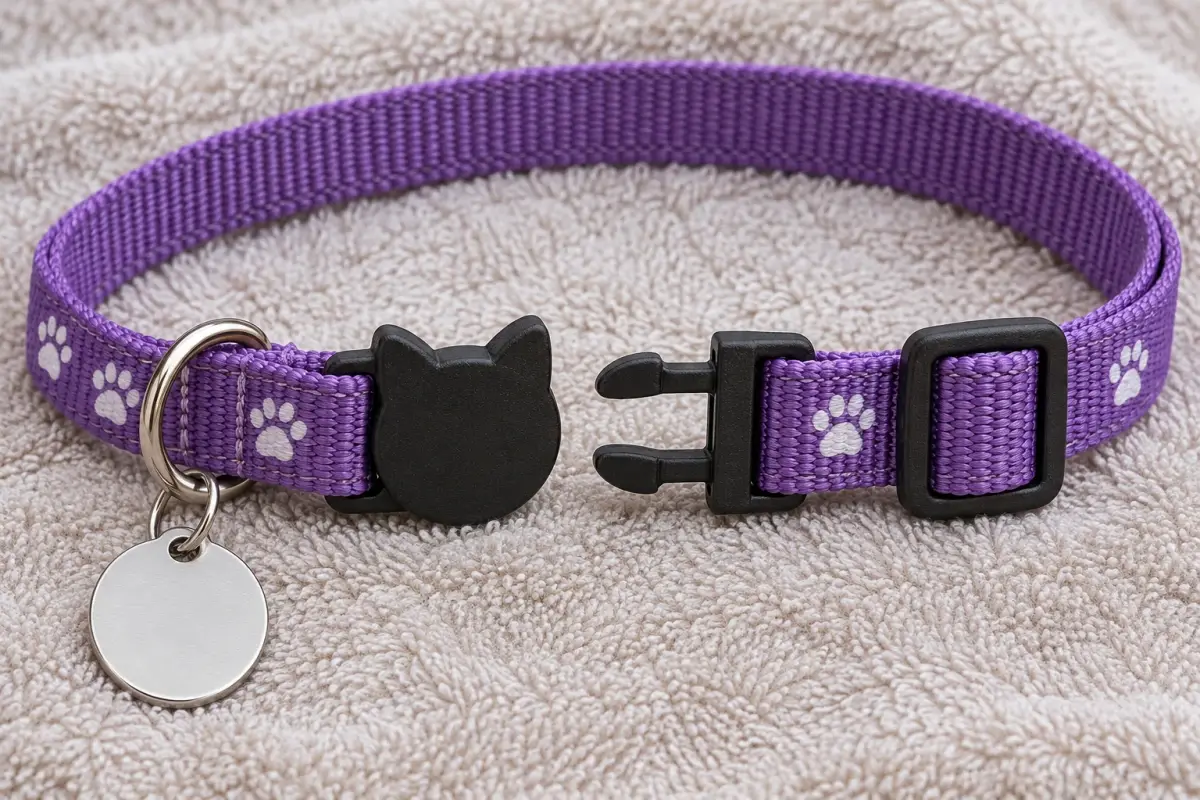
Most cat collars use a plastic quick-release buckle that snaps open when pulled hard enough. These are light, easy to replace and available in nylon webbing, which is why they are the usual choice. The other design, mentioned by the ASPCA, is a collar with an elastic panel that stretches so the cat can pull free if it catches on something.
Neither design is perfect. A buckle can pop open at the wrong moment and leave the cat without a collar, while an elastic panel can wear out and lose its stretch. If you choose a personalized breakaway collar with an ID tag, check the release by hand once a week. Treat the collar as something you replace when it frays rather than something that lasts for years.
Getting the fit right
A collar that is too loose can slip over the head or let a back leg through, and one that is too tight is uncomfortable and unsafe. The common guidance is to fit two fingers between the collar and the neck, and adjustable collars let you check this easily. Check again as a kitten grows or a cat gains or loses weight, because the right fit changes.
Look at how much loose strap is left after fitting. A long tail of webbing is something a paw can snag on, so tuck it into the keeper loop or trim it to a sensible length where the design allows. Watch your cat for the first day or two for scratching at the neck, rubbing or hair loss, and take the collar off and ask your vet if the skin looks irritated.
A collar is not enough on its own
Collars come off, by design. VCA notes that a collar can accidentally fall off or be intentionally removed, and that it is not a permanent form of identification. A breakaway collar makes that even more likely, because the same feature that frees a snagged cat can free a cat that never gets caught at all.
That is why vets recommend a microchip as well as a tag. A chip is permanent and lets a shelter or clinic identify your cat if the collar is gone, but only if the number is registered and your contact details are current. PetMD's vet writer puts it bluntly: without registration, a microchip is useless. A chip is also not a GPS tracker, so it cannot find a cat that is missing.
Who needs which kind of collar
An indoor-only cat benefits from a collar and tag too, because indoor cats slip out through open doors and a finder cannot tell a lost cat from a neighbor's. A light breakaway collar with a clear tag is enough. An outdoor cat needs the same safety release, a tag that is easy to read, and a closer watch on how the collar wears and fits.
Kittens need a narrow, lightweight collar and frequent checks as they grow, and senior cats may prefer a soft one that does not rub thin skin. If your cat has a neck wound, skin problem or has never worn anything, ask your vet before starting. For harness walking, a cat harness is a separate piece of kit, and a breakaway collar stays on alongside it for ID.
Checklist before you buy
Run through a short list. Is it a breakaway design, and does it say so? Is it adjustable so you can fit two fingers under it? Is there a clear place for a tag? Is the webbing smooth with no sharp hardware? Is there a spare you can fit if one goes missing? Check these before looking at style.
Then browse our breakaway cat collars, or look at the wider range of cat collars if you want other styles. This page is general information, not veterinary advice, and it cannot replace an examination by the vet who knows your pet.
Release buckle and elastic-panel construction
| Design | Release arrangement described | Wear point to inspect |
|---|---|---|
| Breakaway buckle | A buckle is designed to separate under force | The exact release mechanism and maker’s instructions |
| Elastic panel | A section stretches within the collar | Elastic condition and loss of stretch |
Common questions
Are breakaway collars safe for cats?
Vets advise that a collar on a cat should be a breakaway type so it does not trap her if it catches on something. A breakaway collar can still come off, so pair it with a microchip.
How tight should a cat collar be?
Tight enough that it will not slip over the head, loose enough to fit two fingers between the collar and the neck. Recheck as kittens grow or when weight changes, and trim or tuck any long strap.
Does my indoor cat need a collar?
A tag helps even an indoor cat, because cats slip out through open doors and a finder can see the tag straight away. Use a breakaway collar and a microchip together for the best chance of getting her home.
Do I still need a microchip if my cat wears a collar?
Yes. Collars can fall off or be removed and tags wear out, while a chip is permanent. The chip only works if it is registered and your contact details are kept up to date.
Should a cat collar have a bell?
It is optional. A bell tells you where your cat is but some cats dislike it. If you use one, make sure it is secure and small, and watch for any sign it bothers her.
Sources we checked
This guide is general information, not veterinary advice. If your pet is unwell or injured, contact your veterinarian.


