






Care & how-to
Mental Stimulation for Dogs and Puppies: Brain Games to Try
Mental stimulation for dogs means giving their brains a job: sniffing out food, solving a puzzle toy, learning a trick or working out a game. The AKC notes that mental exercise can tire many dogs as much as physical exercise, which makes it ideal for puppies, rainy days and dogs on rest. Ten to fifteen minutes of brain games a day, alongside walks, goes a long way toward a calmer, happier dog.
By Matt GarnettUpdated November 14, 20264 min read4 sources
Why brain games matter
Many breeds were developed to do a job, such as herding, retrieving, guarding or hunting by scent, and most pet dogs now get their food and fun without working for it. The AKC links boredom to too little mental challenge as well as too little exercise, and lists chewing, digging, barking and restlessness among the results. Some toys for bored dogs and dog puzzle toys can supply part of that challenge between games.
Mental work burns energy in a different way from running. A dog who has spent fifteen minutes sniffing out hidden treats often settles more deeply than one who has chased a ball for the same time. The AKC also notes that problem-solving activities may help slow cognitive aging in senior dogs, so brain games matter at every age.
Scent games: the easiest place to start
Sniffing is the most natural brain work a dog can do. For a muffin tin puzzle, the AKC suggests putting treats in a few cups of a muffin tin, covering every cup with a tennis ball, and letting your dog move the balls to find the food. Change which cups hold treats each time you play, and supervise so no one chews the balls.
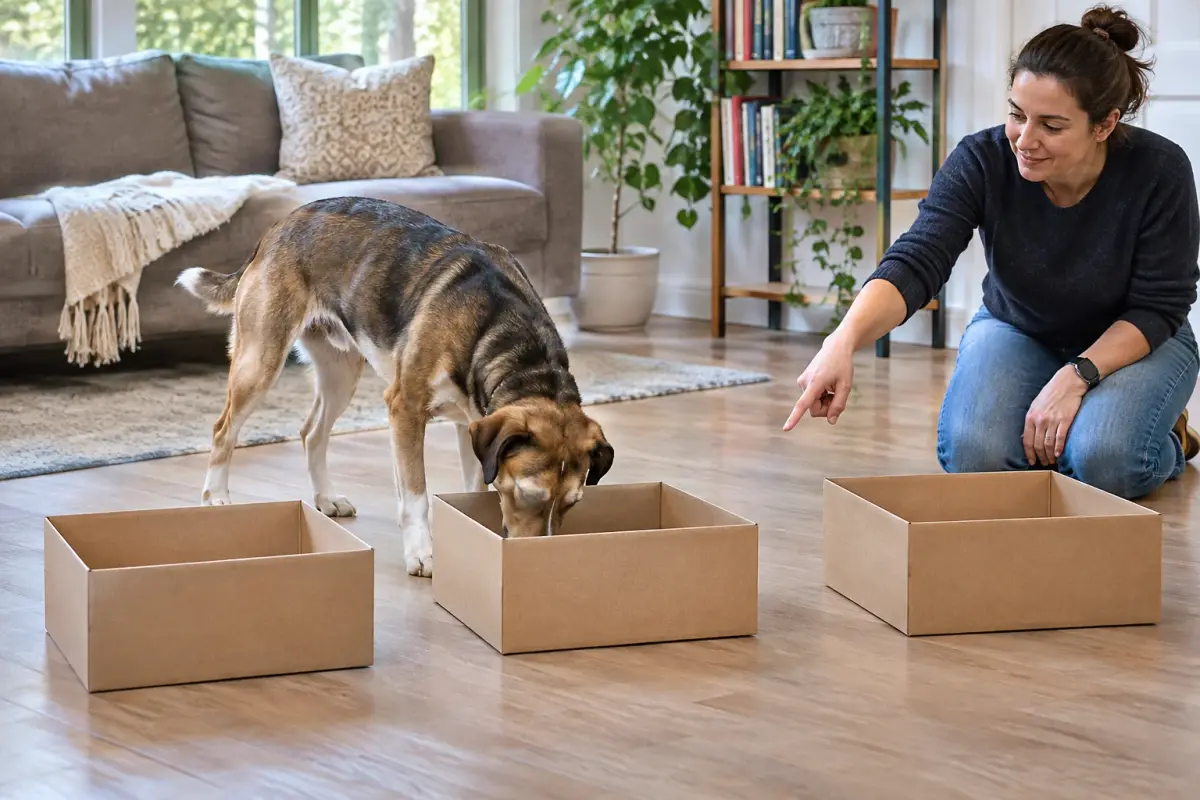
For a box search, put several empty boxes on the floor while your dog waits in another room, drop treats in one or two, then let your dog search. Praise each find. When the game is over, lure your dog away with one last treat so they do not keep hunting. Use your dog's normal kibble if they need to watch their weight.
The cup game and other thinking games
Step 1: Put a treat under a cup while your dog watches, and reward them when they nose or paw it. Step 2: Add a second, empty cup. Step 3: When your dog picks the right one, lift it and let them have the treat. Step 4: If they choose the empty cup, show them it is empty and reset. Step 5: Add more cups and shuffle them, so your dog has to use their nose rather than their memory, as the AKC describes.
Hide-and-seek works for any dog that knows a sit and stay: ask your dog to wait, hide in another room, then call. A short game of finding a named toy, such as asking your dog to bring the rope rather than the ball, adds another layer of thinking once they know the names.
Puzzle toys and food toys
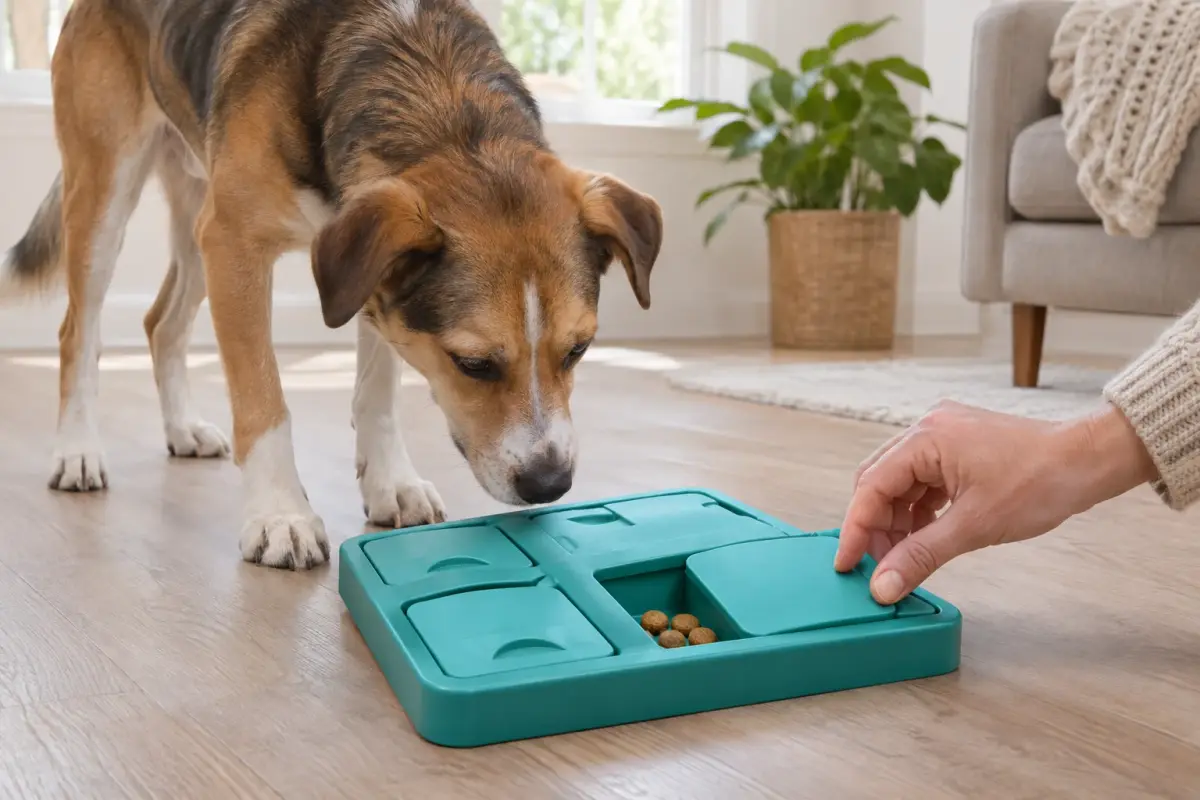
Puzzle toys hold food that your dog has to work out. The AKC describes hollow rubber toys stuffed with soft food and frozen, hard plastic toys with mazes or compartments for kibble, and pull-apart toys with hidden pockets. Snuffle mats let dogs forage for scattered kibble in fabric strips, and slow feeder bowls turn mealtimes into a small puzzle. A treat-leaking food ball is another easy starting point, and our dog treat balls range has more.
Match the toy to your dog. The AKC advises checking that a toy's size and toughness suit your dog's jaw, and some training toys are not meant to be left alone with a dog at all. Start with easy puzzles so your dog wins quickly, then make them harder. Count food from toys as part of the daily ration.
Mental stimulation for puppies
Puppies tire quickly and learn fast, so short sessions work best. The AKC suggests food puzzles, learning a new skill, and scavenger boxes made from an egg carton, a rolled dish towel or crumpled paper with treats hidden inside. A sniffari, where you toss kibble across the yard for your puppy to find, is a great alternative to a long walk for a young dog.
Keep training to a few minutes at a time, use rewards, and stop while your puppy is still keen. Mental games are especially useful because the AKC warns against too much sustained hard exercise for growing puppies, which can strain developing joints. A puppy that has had a sniff and a puzzle usually naps well afterward.
Training as a brain workout, and when to ask your vet
Every new trick is a puzzle for your dog. The AKC recommends trick training at any age and lower-impact sports such as Rally or scent work for older dogs. Five minutes practicing a new cue, a spin, a paw or a bow, uses as much brainpower as many toys. Positive reinforcement keeps it fun.
If your dog suddenly loses interest in games they loved, seems confused or forgets familiar routines, mention it to your vet, especially in an older dog, because changes in thinking can have medical causes.
This page is general information, not veterinary advice, and it cannot replace an examination by the vet who knows your pet.
Common questions
How much mental stimulation does a dog need?
There is no fixed amount, but ten to fifteen minutes of brain games a day on top of walks suits most dogs. High-energy working breeds and young dogs often need more, and puppies do best with several short sessions.
What are good brain games for dogs at home?
Try a muffin tin puzzle, a box search, the cup game, hide-and-seek, puzzle feeders, snuffle mats and learning a new trick. All of them need little space and work well on bad-weather days.
Does mental stimulation tire a dog out?
Yes. The AKC notes that mental exercise can be as tiring as physical activity for many dogs. A short scent game or training session often leaves a dog more settled than a walk alone.
Sources we checked
This guide is general information, not veterinary advice. If your pet is unwell or injured, contact your veterinarian.


