






Care & how-to
How to Play With a Cat: Games That Copy the Hunt
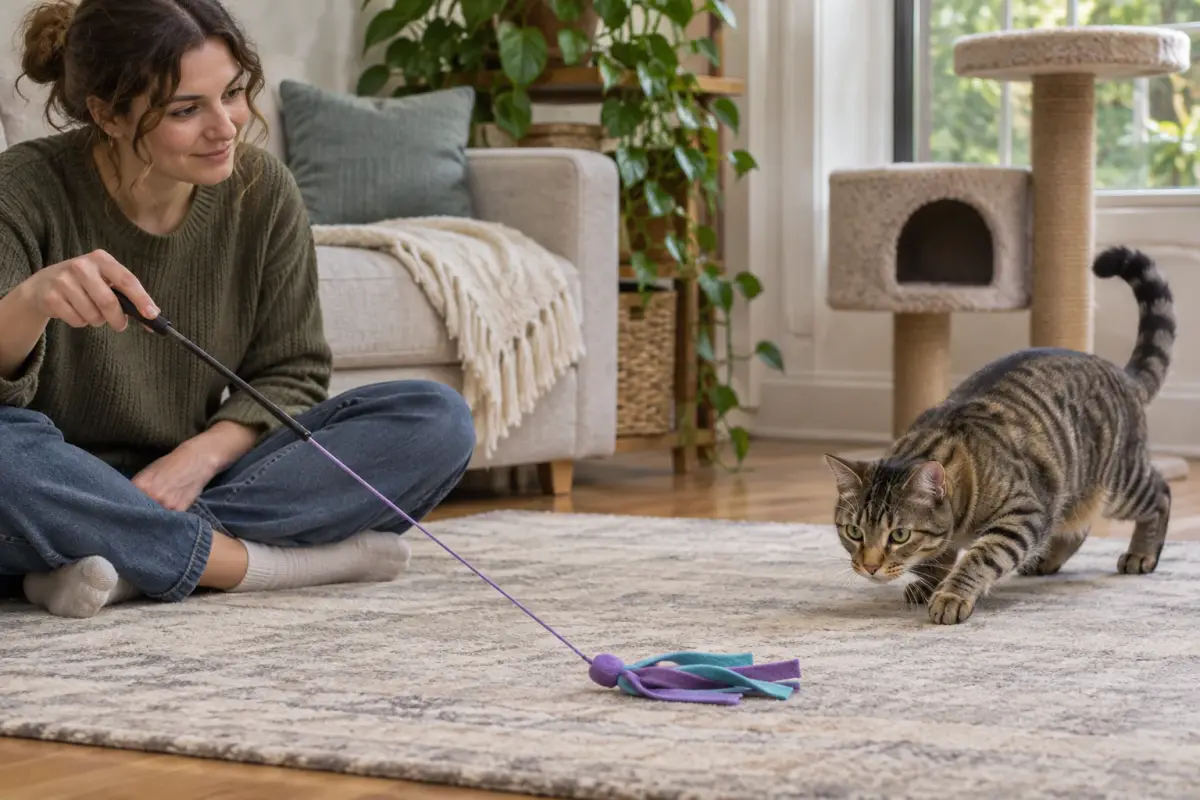
Play with a cat by copying a hunt. Move a wand toy or small toy like prey, letting it hide, freeze and dart away, let your cat stalk and pounce, let it catch the toy at the end, then offer a treat or meal. Keep hands out of it, aim for several short sessions a day, and time them for dawn and dusk when cats are naturally most active.
By Matt GarnettUpdated November 9, 20264 min read3 sources
Why play matters, at every age
Play is how cats practice hunting, and it is not just for kittens. VCA points out that adult cats keep their hunting drive and benefit from regular play. Cornell Feline Health Center adds that toys and play provide exercise and mental stimulation that can help prevent obesity and behavior problems such as destructive scratching and house soiling.
Cats play in short bursts and then rest, so a cat that loses interest after a few minutes is not bored with you. VCA notes that short bursts followed by rest are normal play.
Step-by-step: a good play session
Step 1: Pick a wand or fishing-pole toy with a feather, fabric or mouse on the end, such as a feather teaser wand from our cat toys. Step 2: Move it like prey: across the floor, behind a chair, pausing, twitching, then darting away. Avoid waving it in your cat's face. Step 3: Let your cat stalk and pounce, and let it catch the toy regularly; VCA says cats need to succeed or they lose interest.
Step 4: After 5 to 10 minutes, slow the toy down like tired prey and let your cat make a final catch. Step 5: Give a treat or serve a meal straight after. This hunt, catch, eat routine is what satisfies a cat and often leads to grooming and a nap.
How often and when to play
VCA recommends several 10-minute sessions a day, adjusted to your cat's interest, and suggests morning and evening, since predatory activity peaks around dawn and dusk. Its enrichment guidance aims for at least three short sessions daily.
Start a session just before your cat's usual wild time, such as the evening zoomies or the 5 a.m. wake-up call. VCA describes this as beating the cat to the punch, so energy goes into a toy rather than your ankles.
How to play with a kitten
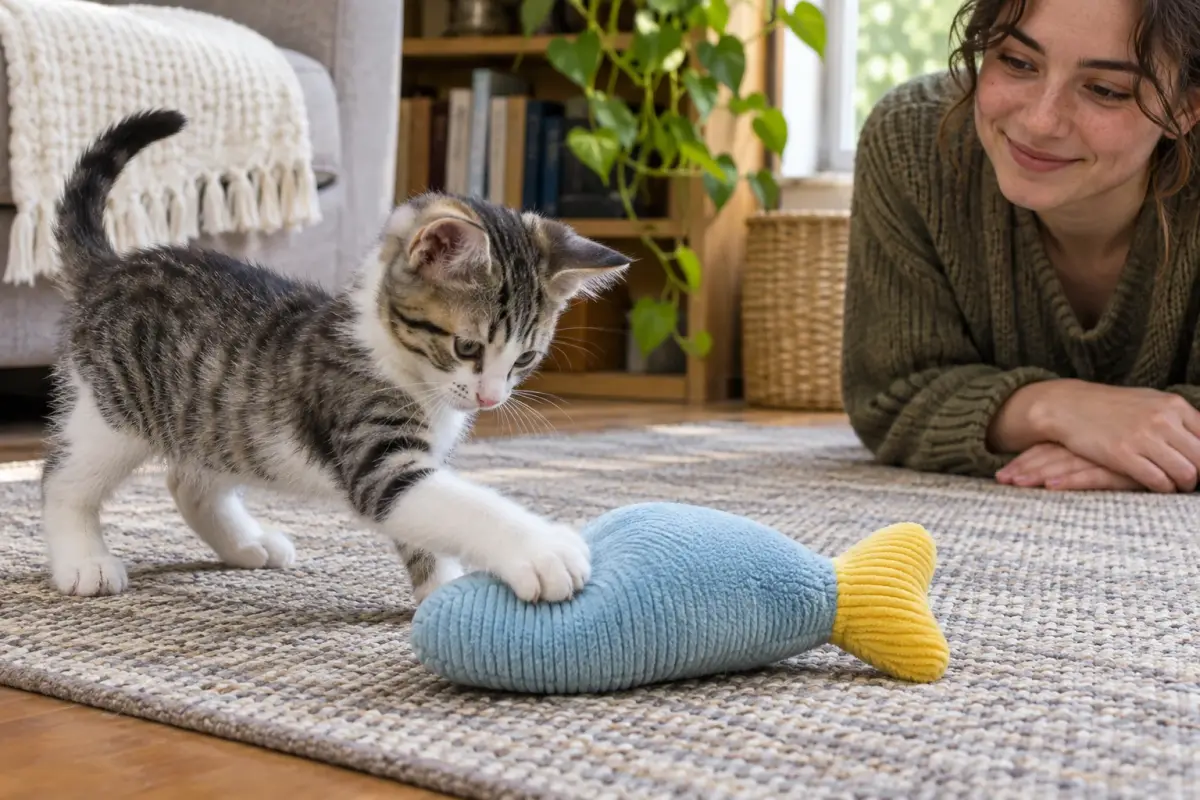
Kittens play hard: stalking, pouncing, biting and clawing are all normal. VCA warns against using fingers or toes as prey, even with tiny kittens, because the habit becomes painful as they grow and small bites can become infected. Keep a wand toy or kick toy handy to redirect instantly.
Offer small toys a kitten can bat and carry, such as soft mice, crinkle balls and ping-pong balls, plus cardboard boxes and paper bags, never plastic. VCA recommends never leaving string, ribbon or wand toys out unsupervised, since swallowed string can cause serious intestinal injury.
How cats play with each other, and with dogs
Cats that play together take turns chasing and being chased, wrestle with soft paws and closed or gentle mouths, and pause often. Ears forward or relaxed, no hissing or growling, and both cats coming back for more are good signs. Flattened ears, puffed fur, yowling or one cat always fleeing and hiding means it is not play; separate them calmly and talk to your vet if it keeps happening.
Cats and dogs can play well together when the dog is gentle and the cat has an escape route. Watch for a dog that fixates, chases hard or pins the cat. Give your cat high perches, such as cat trees or a window perch, and dog-free rooms, and supervise until you are sure both enjoy it.
Mistakes to avoid, and when to call your vet
Do not use hands or feet as toys, do not end a game abruptly while your cat is still in hunt mode, and do not rely only on laser pointers, which never let your cat catch anything. Rotate toys weekly; VCA suggests offering only four or five at a time from a larger collection. A wand set with spare feather refills from our cat toys makes it easy to swap the head.
Call your vet if a playful cat suddenly loses interest in play, seems stiff, pants after a short session or hides. Reduced play can be an early sign of pain or illness.
This page is general information, not veterinary advice, and it cannot replace an examination by the vet who knows your pet.
Common questions
How do I get my cat to play?
Try a wand toy at dawn or dusk, move it slowly and secretively like prey rather than waving it, and let it disappear behind furniture. Some cats prefer small toys on the floor; experiment and keep sessions short.
Why does my cat bite me during play?
Usually because hands became part of the game. Stop using hands as toys, switch to a wand toy, and end the session calmly if your cat bites. Regular play outlets reduce ankle attacks.
Is it normal for cats to play rough with each other?
Play can look rough, but it should be quiet and balanced, with both cats taking turns. Hissing, yowling, flattened ears or one cat hiding means a fight, so separate them.
Do older cats still need to play?
Yes. Senior cats keep their hunting drive and benefit from gentle play. Use slower movements, keep toys low, and let them win often, as long as they show no sign of pain.
Sources we checked
This guide is general information, not veterinary advice. If your pet is unwell or injured, contact your veterinarian.


