






Breeds
Great Dane vs Mastiff: Living With a Giant Dog
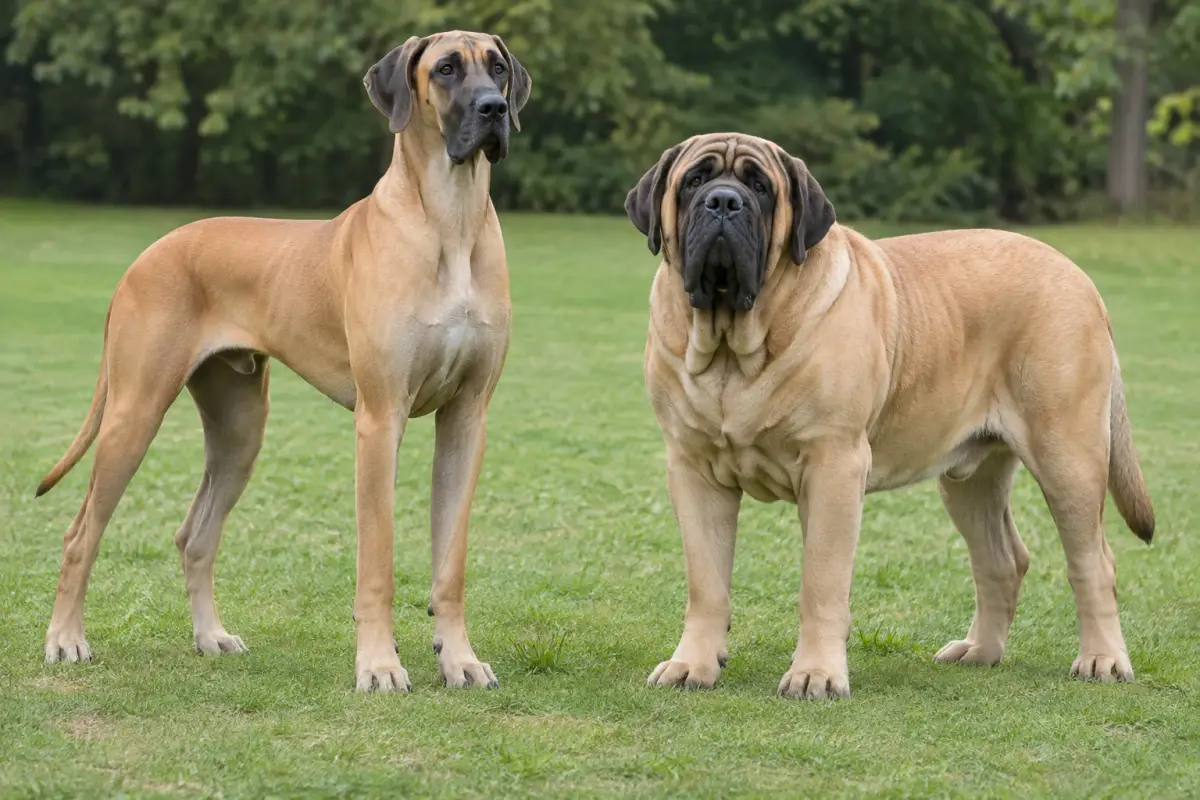
The Great Dane is the taller, more leggy giant, while the Mastiff has a particularly heavy, substantial build. Both can be calm companions, but neither is a small commitment just because it relaxes indoors. Here, Mastiff means the breed named Mastiff, not every breed with mastiff ancestry. Plan for adult size, training, transport, and veterinary care before choosing either.
By Matt GarnettUpdated November 14, 20263 min read4 sources
Compare the giant breeds side by side
VCA lists Great Danes at roughly 110–175 pounds and describes a tall, long-legged frame. Its Mastiff profile gives about 175–190 pounds, illustrating the heavier build. Lifespan guides are about 7–10 years for the Dane and 9–11 for the Mastiff; individual outcomes can differ.
Exercise: both need daily activity rather than endurance work by default. Grooming: both have short coats with routine brushing needs, and drool belongs in the practical comparison. Training: early, reward-based work matters for safe handling. Best fit: a household prepared to accommodate and manage a giant adult dog, which includes a roomy crate such as those in our XXL dog crates.
Measure the home against the adult dog
The AKC emphasizes that a Great Dane’s size, weight, and strength deserve serious consideration. Apply the same practical exercise to a Mastiff. Walk through doorways, resting spaces, and the vehicle you would use for routine appointments. Decide how the dog will move through busy areas without people having to squeeze past it.
Consider who could help if the dog became unable to move comfortably. Planning transport and access while the dog is healthy is easier than improvising during a problem. An attractive puppy may fit every current arrangement; the adult dog is the one those arrangements must ultimately accommodate. A heavy-duty crate on lockable wheels is one type to compare, so check each crate's interior dimensions against your dog's measured length and height.
Teach manageable behavior while the dog is young
VCA stresses early training and socialization for Great Danes and notes that Mastiffs can resist forceful methods. Use patient, reward-based teaching rather than trying to overpower a large dog. Set clear household expectations for greetings, leash walking, resting, and cooperative handling from the start.
Meet an adult dog and ask about behavior around strangers, children, and other animals. A calm breed description does not make supervision unnecessary. At this size, ordinary enthusiasm or moving through a crowded room can present practical challenges even without any intention to cause harm.
Separate appropriate exercise from athletic ambition
VCA recommends controlled activity for Great Danes, particularly during growth, to protect developing joints. The Mastiff also needs a moderate daily exercise routine. Ask your veterinarian what suits the dog’s age, condition, and mobility rather than choosing an activity because you think all large dogs need hard running.
Short coats make brushing relatively straightforward, but care still includes nails, ears, skin, and dental hygiene. VCA also notes drooling in the Mastiff. Ask how the individual dog tolerates handling and build a cooperative routine that you can continue when it reaches adult strength. A bed made for giant breeds gives a heavy dog a supported place to rest, a harness sized for a Great Dane can help with leash walking, and toys for Great Danes give a young dog something suitable to chew.
Include veterinary care in the choice
VCA highlights gastric dilatation-volvulus and orthopedic concerns for Great Danes. Before choosing either giant breed, discuss screening records, growth, and emergency planning with a veterinarian. Breed size is a reason to prepare carefully, not a reason to assume that a particular dog already has a disease.
Seek veterinary attention for new pain, weakness, difficulty breathing, or a substantial change in activity. Ask for individual advice if exercise becomes uncomfortable. The best choice is the dog whose physical and behavioral needs your household can support, including during later life.
This page is general information, not veterinary advice, and it cannot replace an examination by the vet who knows your pet.
Common questions
Does Mastiff mean the same thing as any mastiff-type dog?
No. This comparison uses Mastiff as the specific breed name. Other mastiff-type breeds have their own sizes, temperaments, and care needs, so their profiles should not be substituted for this one.
Is a Great Dane easier to handle because it is lighter?
Not automatically. Height, strength, training, health, and individual behavior all affect handling. Meet the dog and consider transport, leash walking, and household access rather than relying only on a weight range.
Do Great Danes and Mastiffs need hard exercise?
Do not assume that giant size calls for intense exercise. Both need suitable daily activity, while growing dogs require particular care. Ask your veterinarian what is appropriate for the individual dog.
Sources we checked
This guide is general information, not veterinary advice. If your pet is unwell or injured, contact your veterinarian.


