






Buying guides
Best Dog Water Bowl for Messy Drinkers: No-Spill Designs Compared
The best water bowl for a messy drinker is a no-spill design that limits how much water your dog can scoop at once: a floating disc bowl for dogs that gulp and splash, or an inward-curved rim for dogs that slosh water out. Choose a heavy or non-slip base, enough capacity for a day's water and parts you can take apart to clean. A mat underneath catches the rest.
By Matt GarnettUpdated November 10, 20264 min read2 sources
What matters most: less splash without less water
A no-spill bowl should change how water reaches your dog's mouth without making drinking hard. The AKC's general guide is that dogs need about an ounce of water per pound of body weight daily, varying with weather and activity, so the bowl must still hold enough and let your dog drink comfortably. A design that frustrates your dog into drinking less is worse than a wet floor.
Stability comes next. A heavy base or rubber feet stop the bowl sliding when your dog pushes into it. Cleanability is the third: no-spill bowls have more parts and corners, and the AKC's bowl guidance favors materials such as stainless steel that stay hygienic.
The main designs compared
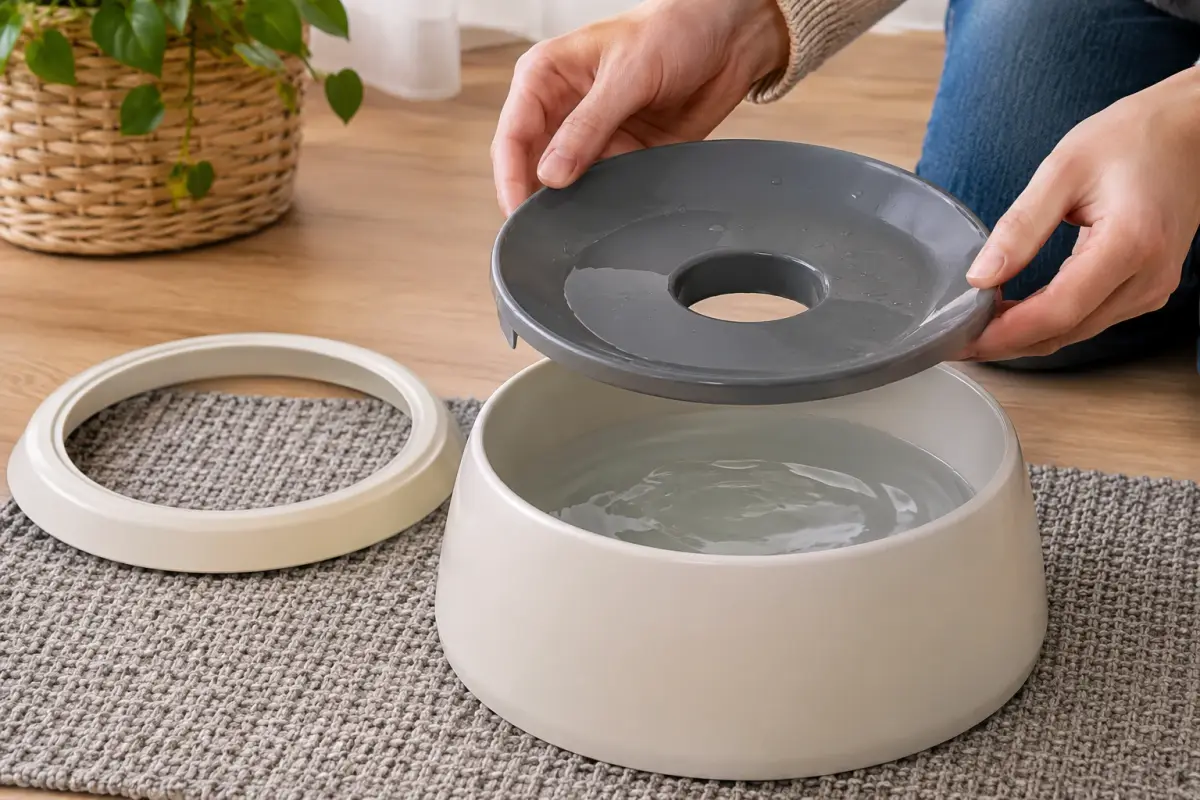
Floating disc bowls have a perforated plate resting on the water. As the dog presses with its tongue, a little water rises through the center, which slows gulping and reduces splashing and dripping beards. Inward-rim or splash-guard bowls have a lip that curves inward, so water sloshes back into the bowl instead of over the edge, which suits dogs that bump or paw the bowl and suits cars.
Slow-drinking bowls with a shallow ring or maze reduce the volume available at once. Travel no-spill bowls seal or limit water during car journeys. Gravity waterers refill as the dog drinks but do not reduce splashing on their own.
Best design for each dog
For dogs that gulp and then drip or vomit water, a floating disc bowl slows each mouthful. For bearded and long-eared breeds such as Schnauzers, doodles and spaniels, a floating disc or a narrow-topped bowl keeps more water off the face. For large, enthusiastic drinkers, a heavy stainless steel bowl or splash-guard bowl with a wide base.
For car travel, a sealed or inward-rim travel bowl. For flat-faced breeds, a shallow, wide bowl with a modest splash guard, since deep or narrow designs can be hard to drink from. For puppies, a simple, stable bowl at first; introduce a disc bowl once your puppy drinks confidently.
What to avoid
Avoid designs your dog will not drink from; offer a normal bowl alongside a new one for a few days and watch how much it drinks. Avoid thin plastic for chewers and any bowl with deep, unreachable crevices. Avoid no-spill designs for dogs on medication or diets where your vet wants you to monitor water intake closely, unless your vet agrees.
A sudden change in how much your dog drinks, much more or much less, is worth raising with your vet; the AKC's guidance on excessive thirst says a clear change from your dog's normal pattern should be checked.
How to size and place a no-spill bowl
Choose a capacity at least equal to your dog's daily water need of roughly an ounce per pound, and more in summer. A 60-pound dog needs a bowl holding well over half a gallon or a refill during the day. For floating disc bowls, check that the disc suits your dog's muzzle size.
Place the bowl on an absorbent or rubber mat, away from walkways, and keep a second bowl in another room for large homes. Refill with fresh water daily even if the bowl still has water in it.
Cleaning and lifespan
Take no-spill bowls apart every day or two and wash all parts in hot soapy water or the dishwasher; the disc and rim trap slime. A slippery film is biofilm, the sign a bowl needs scrubbing.
Stainless steel parts last years. Replace plastic parts when scratched and any bowl with a cracked base. Keep a spare so one is always clean.
Floating discs and inner rims are the parts that wear first, and many makers sell replacements, which keeps the base in use for longer.
Water-surface and refill mechanisms
| Format | Physical arrangement | Inspect before choosing |
|---|---|---|
| Floating plate | A plate rests on the water surface | Plate removal and drinking opening |
| Inward rim | A lip curves over the bowl edge | Rim opening and cleaning access |
| Channel or ring | A restricted drinking area | Channel dimensions and accessible parts |
| Travel closure | A stated lid or flow-limiting arrangement | Actual sealing and transport instructions |
| Gravity reservoir | Stored water feeds a basin | Reservoir and basin connection |
Common questions
Do no-spill dog bowls work?
Yes, for most messy drinkers. Floating disc bowls slow gulping and splashing; inward-rim bowls stop water sloshing out. Check your dog still drinks normally. Offer a normal bowl alongside at first.
What is the best water bowl for a dog with a beard?
A floating disc bowl or a narrow-topped bowl keeps more water off the beard. Wipe the beard after drinking to keep it clean and dry.
Is a slow water bowl good for dogs that drink too fast?
It can help dogs that gulp and then drip or bring water back up. Watch that your dog still drinks enough, and see your vet if drinking changes suddenly.
How do I stop my dog splashing water everywhere?
Use a no-spill or splash-guard bowl, a heavy non-slip base and an absorbent mat underneath. Place the bowl away from walkways. Wiping a wet beard after drinking also helps.
Sources we checked
This guide is general information, not veterinary advice. If your pet is unwell or injured, contact your veterinarian.


