






Breeds
German Shepherd vs Belgian Malinois: Which Working Dog Suits You?
The German Shepherd and the Belgian Malinois look alike but live very differently. The Malinois is lighter, leaner and more intense, a dog that VCA says lives to work and does not see itself as a pet; the German Shepherd is larger and heavier-boned, still a serious working breed but better suited to active family life. The AKC ranks the German Shepherd 4th in popularity and the Malinois 33rd. Neither suits a first-time, low-activity home.
By Matt GarnettUpdated November 13, 20265 min read4 sources
Side by side
Size: the AKC lists German Shepherd males at 24 to 26 inches and 65 to 90 pounds, females at 22 to 24 inches and 50 to 70. Belgian Malinois males stand 24 to 26 inches at 60 to 80 pounds, females 22 to 24 inches at 40 to 60. Lifespan: AKC gives 12 to 14 years for the German Shepherd and 14 to 16 for the Malinois. Coat: the Shepherd has a double coat that sheds heavily; the Malinois has a short coat in fawn to mahogany with a black mask and ears.
Energy: VCA rates German Shepherds high and says Malinois need daily, strenuous exercise. Training: both are highly intelligent and trainable, and both need consistent, positive methods. Temperament: Shepherds are loyal, confident and protective; Malinois are intense and sensitive. Experience: VCA rates the Shepherd best for committed or experienced owners, and the Malinois is more demanding still. Best for: Shepherds suit active, experienced families; Malinois suit owners who train or work dogs seriously.
How to tell them apart
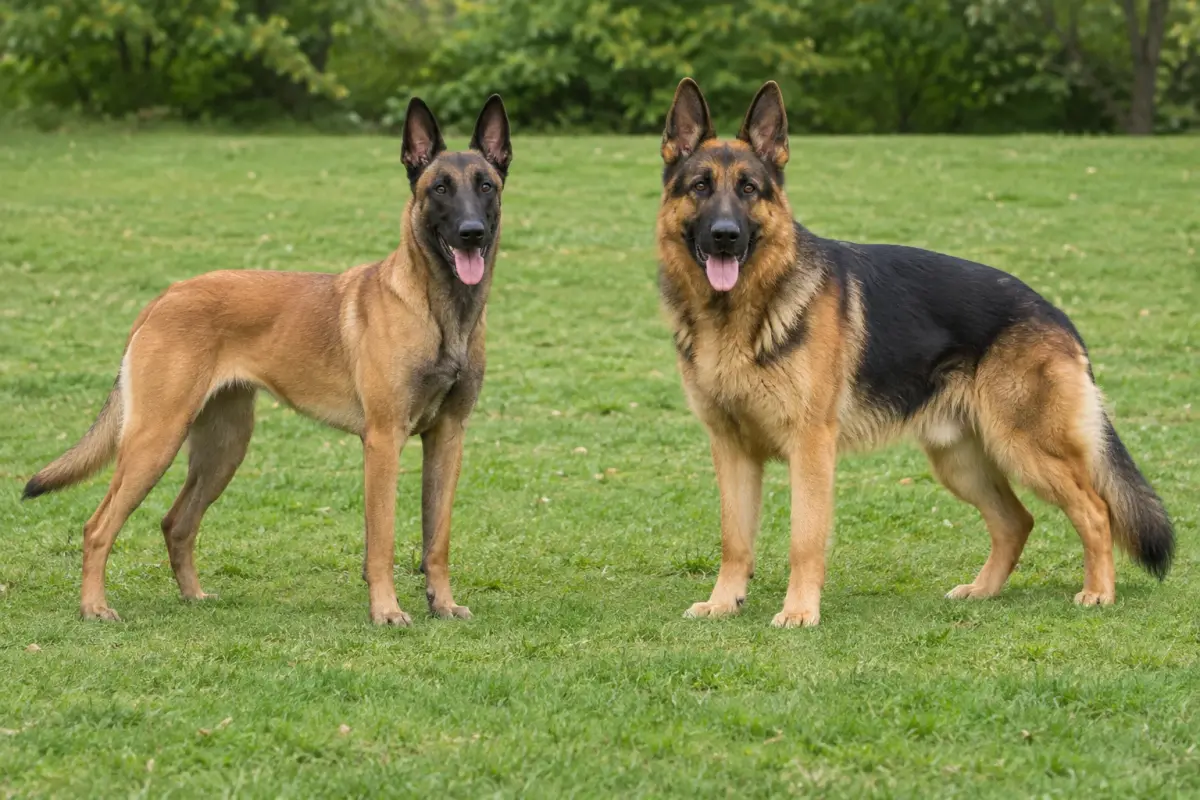
VCA points out the subtle differences: the Malinois has a shorter back and smaller ears than a German Shepherd and is lighter in body and bone. Its coat is short and fawn to mahogany, and every Malinois has a black mask and black ears. The German Shepherd carries a longer, often black-and-tan, sable or solid black double coat, a sloped topline and a deep chest.
In practice, a Malinois looks squarer, lighter on its feet and almost springy, while a German Shepherd looks longer and more substantial. Shepherds also shed far more, so a house with a Shepherd usually has more hair on the floor. If you are adopting a dog of uncertain background, ask the shelter what they know about its history and energy.
Origins
The Belgian Malinois traces to 1891, when, per VCA, a veterinary professor gathered shepherd-type dogs near Brussels and concluded that a true Belgian Shepherd existed in several coat varieties. The AKC registered them together as Belgian Shepherds by 1912 and split them into three breeds, including the Malinois, in 1959. Today the AKC calls the Malinois a world-class worker that forges an unbreakable bond with its partner.
The German Shepherd Dog was developed for herding and protection, according to VCA, and is now used in everything from service work to companionship. The AKC calls it generally considered dogkind's finest all-purpose worker, describing a large, agile, muscular dog of noble character and high intelligence. VCA notes that the Malinois excels in law enforcement work, while the Shepherd is used for service work and companionship alike.
Temperament and training
VCA describes the German Shepherd as loyal and strongly bonded to family, confident and protective, especially in unfamiliar situations, and very trainable with consistent leadership. Without dedicated training, it warns, Shepherds may become overprotective or reactive. Mental stimulation matters as much as exercise for this highly intelligent breed.
The Malinois is intense and sensitive, dedicated to its work and its person, and VCA says it will not do well with a life of solitude. Some are reserved with strangers and others friendlier, so socialization in puppyhood and throughout life is crucial to avoid fearfulness. VCA notes the Malinois sees itself as a partner rather than a pet. Short, varied, reward-based sessions every day work best for both breeds.
Exercise and daily life
German Shepherds need significant daily exercise, such as long walks, running and structured training, and VCA warns that without it they may become anxious or destructive. Malinois need even more: VCA says daily strenuous exercise is what makes them mellow indoors, and they excel at tracking, agility, herding and search-and-rescue. A walk around the block will not satisfy either breed.
Think about your week honestly. A Malinois in a home without a job often turns its energy on furniture, fences and the people in it. If you want a dog for jogging, hiking and obedience classes with family time in between, a German Shepherd is usually the more livable choice. Both need secure fencing and a sturdy leash.
Grooming, health and which to choose
VCA calls the Malinois a wash-and-wear dog that needs a couple of brushings a week, while German Shepherds need frequent brushing, especially through heavy seasonal sheds. VCA lists hip dysplasia, progressive retinal atrophy, cataracts, hypothyroidism and epilepsy among Malinois concerns, and hip and elbow dysplasia, degenerative myelopathy, exocrine pancreatic insufficiency, perianal fistula and pannus among Shepherd concerns. Ask breeders for hip and eye clearances, and ask your vet what to monitor.
Choose a German Shepherd if you are an experienced owner who wants a loyal, trainable, protective family dog and can give it daily exercise and training. Choose a Belgian Malinois only if you are committed to working, training or sport every day and want a partner more than a pet.
This page is general information, not veterinary advice, and it cannot replace an examination by the vet who knows your pet.
Common questions
Is a Belgian Malinois bigger than a German Shepherd?
No, usually smaller and lighter. The AKC lists Malinois males at 60 to 80 pounds and German Shepherd males at 65 to 90 pounds, at similar heights. VCA notes the Malinois is less heavy in body and bone.
Is a Malinois a good family dog?
For most families, no. VCA describes the Malinois as an intense working partner that needs daily strenuous exercise and a job. In experienced, very active homes it can be devoted, but it is not a casual pet.
Why do police use Malinois instead of German Shepherds?
VCA notes the Malinois excels in law enforcement, tracking and search-and-rescue. Its intensity, lighter frame and drive to work with a handler suit those jobs, while German Shepherds remain widely used working dogs too.
Which sheds more, a German Shepherd or a Malinois?
The German Shepherd. Its double coat sheds heavily year-round and more in seasonal sheds, while VCA says a couple of brushings a week control the Malinois's short coat.
Sources we checked
This guide is general information, not veterinary advice. If your pet is unwell or injured, contact your veterinarian.


