






Buying guides
Orthopedic Dog Beds for Large Dogs: How to Choose
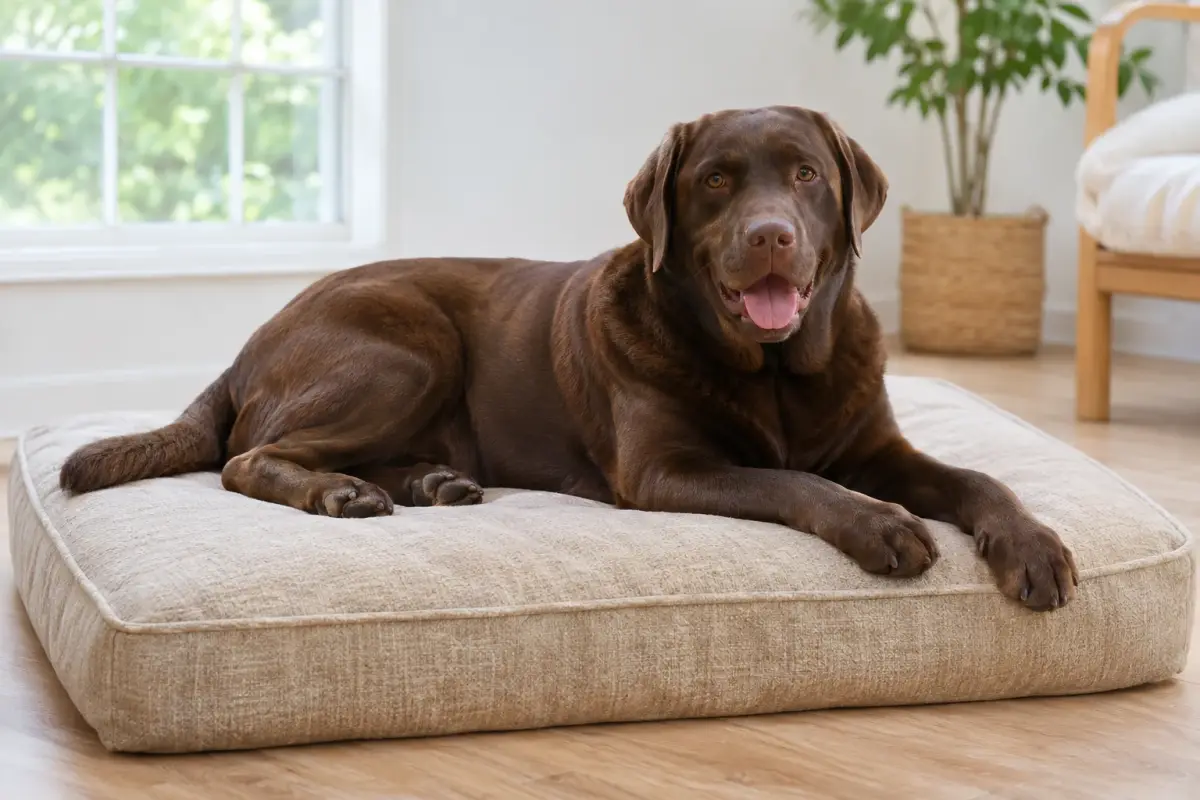
The best orthopedic dog bed for a large dog is a thick, solid slab of memory foam or high-density foam that does not flatten under the dog's hips and shoulders, sized so the dog can lie fully stretched out. Add a low entry, a non-slip base and a washable, waterproof cover. For dogs over 50 lb, thickness and foam quality matter far more than stuffing, bolsters or looks.
By Matt GarnettUpdated November 13, 20265 min read3 sources
What makes a bed orthopedic for a big dog
An orthopedic bed spreads a dog's weight evenly so the bony points, hips, elbows and shoulders, do not press through to the floor. The AKC advises looking for a thick, solid piece of polyurethane foam or memory foam, because high-quality thick foam distributes weight evenly and gives firm support. Shredded foam, fiberfill and pillow beds can be comfortable, but under a heavy dog they shift and pack down, leaving the joints on a thin layer.
Large dogs test this harder than small ones, simply because there is more weight on the same points. That is why the label "orthopedic" means little on its own; what counts is the foam inside and how thick it is. Our orthopedic dog beds for large dogs are the place to compare foam type, thickness and size side by side once you know what to look for.
Which large dogs benefit most
Joint support is not only for old dogs. VCA notes that osteoarthritis is the most common chronic disease in dogs, affecting an estimated one in four, and that obese dogs are more likely to develop degenerative joint disease because of the extra mechanical stress on their joints. Large and giant breeds carry that stress every time they lie down and get up, and the AKC points out that orthopedic beds can offer preventive comfort to younger dogs as well as relief to seniors.
The dogs that gain most are seniors, dogs recovering from surgery, heavy-framed breeds such as Labradors, retrievers, shepherds and mastiffs, and any dog that is slow to stand, hesitates before lying down, or shifts weight when rising. Those signs are worth mentioning to your vet, because a bed adds comfort but does not treat the cause.
Foam types and construction compared
Memory foam molds to the dog's shape and spreads pressure well, which suits stiff, bony or senior dogs. It can feel warm, so some versions add a cooling gel layer. High-density polyurethane support foam is firmer and springs back faster, which makes standing up easier for a heavy dog. The most supportive beds combine the two: a firm support base with a softer memory foam layer on top.
Egg-crate foam, which the AKC also mentions, is a lighter, cheaper option with ridges that help airflow, but it compresses faster under a big dog. Avoid judging by weight of the bed or by fluffiness. Press the center firmly with a fist: if you can feel the floor, a large dog's hips will too. For heavy dogs, a solid foam base of several inches is the minimum worth considering.
The best type for each large dog
A senior or arthritic dog needs a flat or low-sided mattress-style bed it can step onto without climbing, with memory foam on a supportive base. A waterproof orthopedic crate mattress suits a dog that sleeps in its crate and may have the occasional accident. A dog that sprawls on its side needs a long rectangular bed rather than a round one.
Very large dogs, and owners who like to lie beside them, often do well on a human-size floor bed. An oversized human dog bed of about 71 by 45 inches or a washable faux fur human dog bed with orthopedic support gives a giant breed room to stretch fully. Hot sleepers may prefer an elevated or cooling bed alongside the main one.
What to avoid
Avoid tall beds and deep bolsters for dogs that struggle to step up; the edge becomes an obstacle. VCA suggests making every surface a stiff dog walks on non-slip, so choose a bed with a grippy base and place it on a rug rather than bare hardwood, where it can skid as the dog stands. Avoid beds whose foam is sewn into a cover you cannot remove, because large dogs bring in mud and hair and the foam must stay dry.
Avoid beds sized by the dog's breed name alone. Two dogs of the same breed can differ by 30 lb, and a bed that is too small makes a big dog curl tightly, which defeats the point of support. Also avoid placing the bed in a cold, drafty spot, since stiff joints are often worse in the cold.
How to measure, care and replace
Measure your dog lying stretched out on its side, from nose to the base of the tail, and add 8 to 12 inches; that is the minimum bed length. Measure the height from the floor to the shoulder too, to help judge the width a sprawling dog needs. Check the bed's weight rating where one is given, and choose the larger size when your dog falls between two.
Wash the outer cover often and keep a waterproof liner between it and the foam. Replace the bed when the foam stays dented where your dog lies, or when the dog starts choosing the floor instead. To compare sizes and foam types, browse orthopedic dog beds for large dogs, and for other shapes and materials see our wider dog beds for large dogs.
This page is general information, not veterinary advice, and it cannot replace an examination by the vet who knows your pet.
Foam arrangement and layer information
| Construction | Physical arrangement | What to verify |
|---|---|---|
| Memory foam | A continuous memory-foam layer | Exact material and usable thickness |
| Support foam | A firmer continuous base | Material declaration and compression |
| Layered combination | Softer layer above a support base | Material and thickness of each layer |
| Egg-crate | Ridged foam surface | Ridge height and underlying base |
| Gel-added version | Additional gel content or layer | What component actually contains the gel |
Common questions
What type of bed is best for a large dog with arthritis?
A flat, low-entry bed with a solid memory foam layer over a firm support foam base, a non-slip bottom and a removable, washable cover. Ask your vet about pain relief too, since a bed only adds comfort.
How thick should an orthopedic dog bed be for a large dog?
Thick enough that a fist pressed into the middle cannot feel the floor. For dogs over 50 lb, that usually means several inches of solid foam, with heavier dogs needing more than lighter ones.
Is memory foam good for large dogs?
Yes, when it sits on a firmer support base. Memory foam spreads pressure on hips and elbows, while the base stops a heavy dog sinking through. Very soft memory foam alone can make standing harder.
What size bed does my large dog need?
Measure your dog stretched out from nose to the base of the tail and add 8 to 12 inches. Choose the larger size if your dog falls between two, especially if they sleep on their side.
Are elevated beds good for large dogs with joint problems?
Elevated cot beds keep dogs cool and off cold floors, and the AKC notes they can help support joints. They are less cushioned than foam, so stiff dogs often do best with a foam bed as their main bed.
Sources we checked
This guide is general information, not veterinary advice. If your pet is unwell or injured, contact your veterinarian.


