






Buying guides
Best Long Line Dog Leash: What Actually Matters
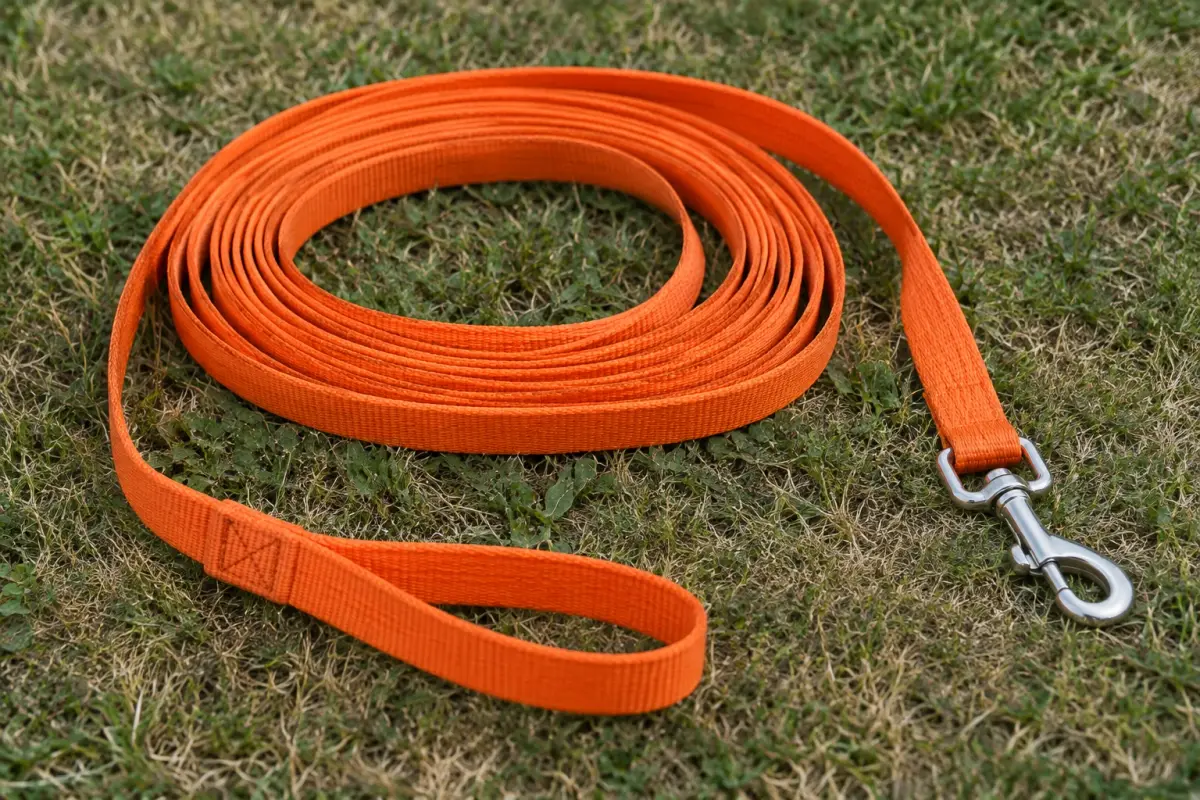
A good long line is light, smooth in your hands, 15 to 20 feet for most park training, and clipped to a well-fitted harness, never yanked. Choose material and length by where you will use it. Browse our long line dog leashes after you read how to compare length, material and clip, and how to use the line safely.
By Matt GarnettUpdated November 13, 20264 min read3 sources
What a long line is for
The American Kennel Club describes a long line as a leash that gives your dog more room while you keep control. Unlike a retractable, it does not extend on its own: you let the line out and gather it back yourself. That is the point. You decide how much freedom the dog gets and you can stop it instantly.
AKC suggests saving a long line for larger, more distracting places such as parks, after you have practiced recall somewhere quiet. It is a training and safety tool, not permission to stop paying attention. Leash laws can apply even in your own yard, and parks have their own rules, so check local requirements before you let the line out.
Length: pick for the place you will use it
AKC's recall guidance suggests a long line of 15 to 20 feet for parks. A leash of about 15 feet is long enough to feel like freedom to a dog but still short enough to manage. Anything longer is harder to handle, snags more often and tends to tangle around legs. A shorter line is better for a small yard or a cluttered trail.
Compare the length to your space, not just to the number on the label. A leash of around 4.5 to 5 meters (roughly 15 to 16 feet) suits most open-field training. A 4.5 meter dog leash and a 5 meter dog leash fall into this range. Standard leashes, by AKC's measure, are 4 to 6 feet, so a long line is a different tool and should not replace the one you use for walking near traffic.
Material, weight and handling
Pick a material that is light enough for your dog to drag a little without being weighed down and easy on your hands. Flat nylon webbing is common and is waterproof and easy to clean, according to AKC's leash guide, and it can be washed in a mesh bag or scrubbed with a little dog shampoo and air dried. Wet or muddy lines are heavier, so a quick-drying material is worth having if you train in damp fields.
Avoid thin cords for any leash handled bare-handed. AKC warns about rope burn and hand injuries from fast-moving cord on retractable leashes, and the same logic applies to a thin long line that slides through your fingers when a dog bolts. Look for a flat or round line with a smooth finish, a comfortable handle, and consider gloves for strong or fast dogs. A geometric-pattern training lead is an example of a flat-style option.
Clips, handles and visibility
Choose a sturdy metal clip that attaches securely, which is the standard AKC safety check for any leash. A clip that is too heavy for a small dog will weigh the harness down, so match the hardware to your dog's size. A padded or looped handle helps with comfort and gives you somewhere to hold the line without wrapping it around your hand.
Long lines are hard for drivers and other people to see at dusk, and a dog dragging one through tall grass can lose it. A long reflective training lead adds visibility, and AKC recommends reflective leashes for night walks near roads. Even so, long lines are not for roads or for crowded places where the line can trip people.
Attach it to a harness, and never reel the dog in
For a long line, attach to a well-fitted harness instead of a collar, so a sudden sprint to the end of the line does not strain the neck. AKC's harness guide says to measure the base of the neck and the widest part of the chest, start loose and tighten gradually, and check that you can fit about two fingers under the straps. Back-clip harnesses are quick to attach and suit trained dogs, while front-clip styles help with pulling. See our dog harness guide.
Use the line to control a situation, not to reel the dog in. If the dog ignores you, stop, and let it come to you, because hauling the dog back teaches nothing. Practice recall in a quiet area first, and see our recall training guide. Even the best-trained dog will not be perfect, so keep the line on near wildlife or traffic.
When to ask for help
If your dog bolts, pulls hard, or ignores recall despite practice, a qualified trainer can show you handling skills that no leash can replace. When you are ready to shop, browse our long line dog leashes by length and material. If your dog is injured by the line, such as a burn on the leg or neck pain after a hard stop, see your veterinarian.
This page is general information, not veterinary advice, and it cannot replace an examination by the vet who knows your pet.
Common questions
How long should a long line dog leash be?
AKC suggests 15 to 20 feet for training in parks. Shorter lines are easier to handle in small spaces, while longer lines tend to tangle and are harder to control.
Should I attach a long line to a collar or a harness?
A harness is usually the better choice, because a sudden run to the end of the line puts pressure on the chest instead of the neck. Make sure the harness is fitted correctly.
Is a long line the same as a retractable leash?
No. A long line does not extend automatically, so you control how much line is out. AKC notes retractables need careful handling and can cause rope burn.
Can I use a long line near roads?
No. A long line is for open, low-traffic areas. Near roads or in crowded places, use a standard 4 to 6 foot leash so you keep close control.
Sources we checked
This guide is general information, not veterinary advice. If your pet is unwell or injured, contact your veterinarian.


