






Buying guides
Best Dog Nail Grinder: How to Choose One for Your Dog
The best dog nail grinder for your dog has enough power for the thickness of its nails, runs quietly enough not to frighten it, and has a guard that limits how much nail touches the grinding band. Small dogs need little power; large dogs with thick black nails need a stronger, two-speed motor. A grinder is not automatically safer than clippers, but it lets you take nail off gradually.
By Matt GarnettUpdated November 9, 20264 min read2 sources
What matters most: power, noise and control
Power decides whether the grinder can handle your dog. Thin nails on a toy breed need only a gentle, low-speed grinder, while a 70 lb dog with thick nails needs a stronger motor and ideally two or more speeds, so you can use low speed to get started and higher speed to shape. An underpowered grinder heats the nail before it shortens it.
Noise and vibration decide whether your dog will tolerate it. Quieter motors and lighter bodies are easier for nervous dogs. Control comes from a slim body you can hold like a pencil, plus a guard or port that exposes only the tip of the nail; the AKC suggests holding the grinder higher up for better control and grinding only a small amount at a time.
The main types compared
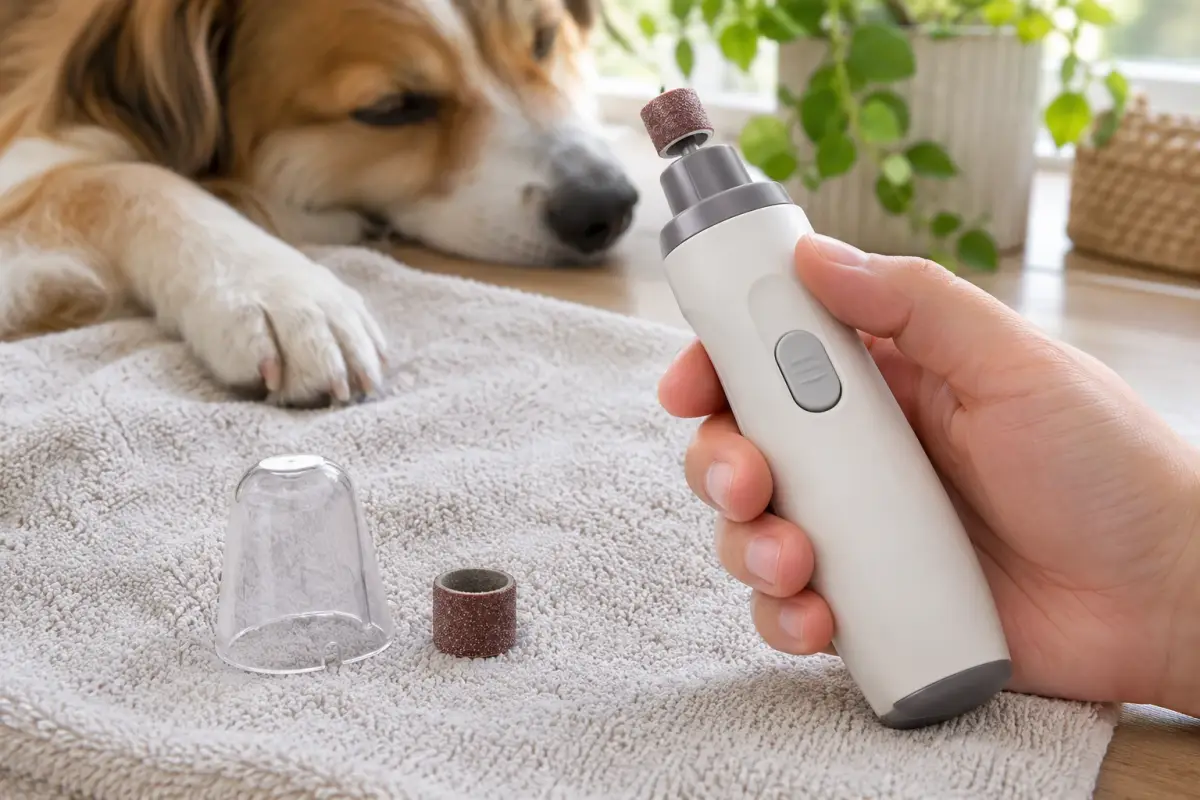
Pet-specific grinders are cordless, rechargeable, and usually include a guard with ports sized for small, medium and large nails. They are the easiest starting point. Some have LED lights that help you see the quick on light-colored nails, which matters more than most extras.
Rotary multi-tools, often sold with a pet attachment, are more powerful and have more speed settings, which suits big dogs and owners who groom often. They are heavier and louder, and the power that makes them fast also makes it easier to take off too much. Corded models never run out of charge but limit where you can work.
Best type for each dog
For small dogs and puppies, choose a light, quiet, single-speed pet grinder with a guard; the smaller grinding drum fits tiny nails. For large and giant breeds, choose a two-speed or variable-speed grinder or a rotary tool with a coarse band, since thick nails take time at low power.
For anxious dogs, quiet matters most, so choose a low-noise model and plan short sessions. For dogs with dark nails, choose a grinder with a light and work in very thin passes, because the quick is hard to see. For dogs with long feathering on the feet, choose a guard that keeps fur away from the drum.
Grinding without hitting the quick
The quick is the living part of the nail with blood vessels and nerves. The AKC advises against going past the curve of the nail, and on dark nails to watch for a chalky white ring or solid dark dot that signals you are getting close. Grind across the bottom of the nail, then in from the tip, in passes of a second or two.
Hold the toe firmly but gently, and keep fur clear of the spinning drum. Keep styptic powder on hand; if you nick the quick, apply it and stay calm, and if the bleeding does not stop, call your vet. Most dogs need trimming every three to four weeks, per the AKC.
What to avoid
Avoid holding the grinder on one nail for more than a few seconds, as friction heats the nail and hurts. Avoid worn or clogged grinding bands, which heat up more and cut less. Avoid starting with the full process on a dog that has never seen the tool.
Instead, introduce it over several days: let the dog sniff it while switched off, then switched on at a distance, then touched briefly to a nail, rewarding each step. If your dog panics, struggles hard or has painful, cracked or bleeding nails, stop and ask your vet or a groomer to help.
Care and lifespan
Replace sanding bands or drums when they look smooth or clogged; on large dogs this can be every few sessions. Brush nail dust out of the guard and vents after each use, and wear a mask if you are sensitive to dust. Charge cordless models fully before you start so the motor does not slow halfway through a paw.
A good pet nail grinder lasts years with regular band changes. If the motor starts to labor, gets hot in the hand, or rattles, it is time to replace it, since a weak grinder heats nails rather than shortening them.
This page is general information, not veterinary advice, and it cannot replace an examination by the vet who knows your pet.
Grinder power and head arrangements
| Feature | Physical arrangement | Verify on the exact tool |
|---|---|---|
| Rechargeable | A battery powers the motor | Charging input and stated runtime |
| Corded | A cable powers the motor | US input and cable arrangement |
| Guarded head | A cover provides working openings | Opening sizes and guard removal |
| Rotary tool attachment | A separate abrasive attachment on a compatible tool | Exact attachment compatibility and controls |
| LED feature | Light near the working area | Position and controls |
Common questions
Are nail grinders better than clippers for dogs?
Neither is better for every dog. The AKC notes some dogs tolerate grinders better while others prefer clippers. Grinders take nail off gradually and smooth the edges; clippers are faster and quieter. Many owners clip first and grind to finish.
What is the best nail grinder for large dogs?
A grinder with a strong motor and at least two speeds, or a rotary tool with a pet attachment, handles thick nails best. Use a coarse band, keep passes short, and let the nail cool between passes.
Can I use a Dremel on my dog's nails?
Rotary tools with a pet attachment or guard are commonly used. Use a low speed to start, a sanding band, short passes, and keep fur clear of the spinning drum. Do not use cutting or grinding stone attachments.
Do nail grinders with quick sensors work?
Lights and sensors can help you see where to stop on light nails, but they do not replace careful, thin passes. On dark nails, watch for the chalky ring or dark dot near the quick and stop there.
Sources we checked
This guide is general information, not veterinary advice. If your pet is unwell or injured, contact your veterinarian.


