






Breeds
British Shorthair vs Russian Blue
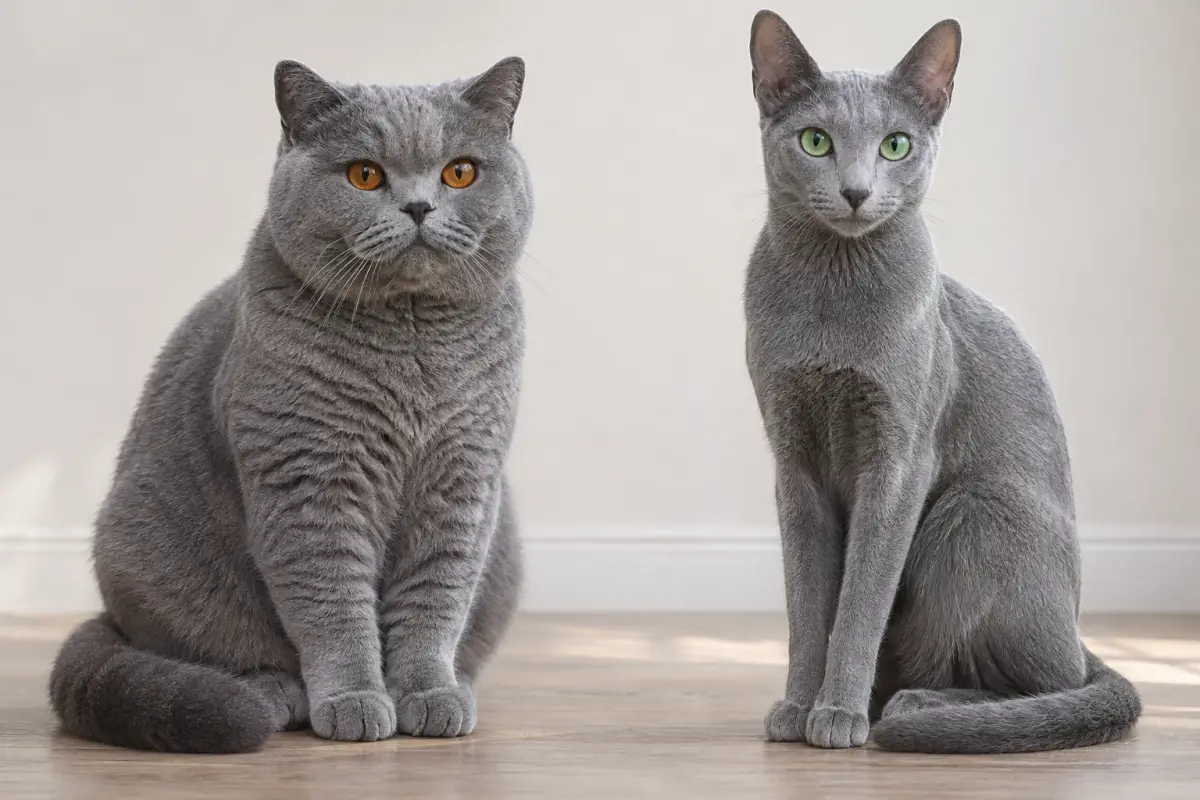
The British Shorthair is the stockier, more rounded cat, while the Russian Blue has a more graceful, fine-boned outline. Both can be quiet, affectionate companions, but their preferences around play, visitors, and handling deserve attention. A blue coat does not make the breeds interchangeable, and neither description replaces meeting the individual cat.
By Matt GarnettUpdated November 14, 20263 min read4 sources
The differences side by side
Build: CFA describes the British Shorthair as sturdy and muscular and the Russian Blue as medium-sized and graceful. Coat: both are short and dense, but the Russian Blue has its distinctive silver-tipped blue color, while British Shorthairs come in many colors. Grooming is generally manageable for both, with regular combing.
Activity: CFA describes the Russian as playful and the British Shorthair as calm. Training and household adjustment depend on the individual. VCA lists broad lifespan guides of 15–20 years for British Shorthairs and 12–15 for Russian Blues; these should not be treated as a prediction for either cat.
Choose the kind of interaction you enjoy
CFA notes that British Shorthairs enjoy people but may dislike being carried and may withdraw during loud activity. If your idea of companionship is having a cat nearby while you go about your day, discuss that expectation when meeting a prospective cat.
The Russian Blue may initially be shy with visitors before becoming affectionate once comfortable. Give a cat the opportunity to approach rather than interpreting hesitation as a defect. Ask how the individual responds to new people and which familiar activities bring out its playful side.
Make coat care a routine, not a color decision
Both breeds have dense coats that deserve regular attention. CFA recommends routine combing or brushing for British Shorthairs and occasional combing for Russian Blues to manage shedding. Ask which tools work for the particular coat and whether the cat is comfortable being groomed.
The coat is only part of handling. Check how the cat responds to paw care and gentle examination. If you are considering a kitten, ask about the routines it already knows. For an adult, a clear account of handling preferences can help you choose a realistic care arrangement.
Both dense coats are easy to keep in good order with a weekly session using a soft cat brush, and a deshedding brush helps in shedding season.
Think about visitors and the home environment
A quiet household may suit either cat, but the details matter. CFA describes Russian Blues as often preferring quieter surroundings while acknowledging that individuals can do well in busier homes. A breed tendency is not a guarantee that every cat will respond the same way to guests or other animals.
Ask about the exact household the cat has known, including children and existing pets. Prepare resting places and allow time for adjustment. Choose the cat whose observed behavior and history fit your circumstances, rather than selecting one because a breed description makes it sound universally adaptable.
Review the cat’s health and future care
Have your veterinarian review available records and discuss appropriate preventive care. The cited lifespan ranges are broad guides, not reasons to rank one cat as a better long-term investment. Current health, age, ancestry, and care all belong in an individual discussion.
Seek veterinary advice for unexplained appetite changes, pain, new hiding, or a notable change in activity. A quiet cat should not be expected to hide illness behind its usual reserve. Choose a companion whose day-to-day care you are ready to maintain as it gets older.
This page is general information, not veterinary advice, and it cannot replace an examination by the vet who knows your pet.
Common questions
Is a Russian Blue the same as a blue British Shorthair?
No. They are separate breeds with different body shapes and breed histories. British Shorthairs can have blue coats, but coat color alone does not establish that a cat is a Russian Blue.
Which breed is more playful?
CFA describes Russian Blues as playful and British Shorthairs as calm and quiet, but individuals vary. Ask about the actual cat’s favorite activities and how it behaves in a familiar environment.
Do both cats need grooming?
Yes. Their short coats still benefit from appropriate combing or brushing to manage loose hair. Ask about the individual coat and handling routine, and build care around the cat’s comfort.
Sources we checked
This guide is general information, not veterinary advice. If your pet is unwell or injured, contact your veterinarian.