






Buying guides
Best Snake Enclosures: What Actually Matters
The best snake enclosure is escape-proof, large enough for the species and its adult length, ventilated, and able to hold a warm end and a cool end. Choose the lock and the size first, then check how you will heat it, keep humidity right and clean it. Browse our snake enclosures once you know the species you are keeping.
By Matt GarnettUpdated November 13, 20265 min read2 sources
Start with the species and its adult size
No single enclosure suits every snake, because ball pythons, corn snakes, boas and tree-dwelling species need different shapes. VCA Animal Hospitals advises giving the largest cage possible, and says smaller species and juveniles often do well in a 10 to 20 gallon aquarium or a plastic container with holes in the top, then move to a larger enclosure as the snake grows.
The Merck Veterinary Manual gives minimums by length for the species it lists: boas and pythons need about 0.6 square meters of floor per meter of snake, which works out to roughly 2 square feet of floor per foot of snake. Arboreal snakes need height rather than floor, and it advises matching the enclosure type to the species. Find out the adult length before you buy, not the length of the baby.
Escape-proofing comes first
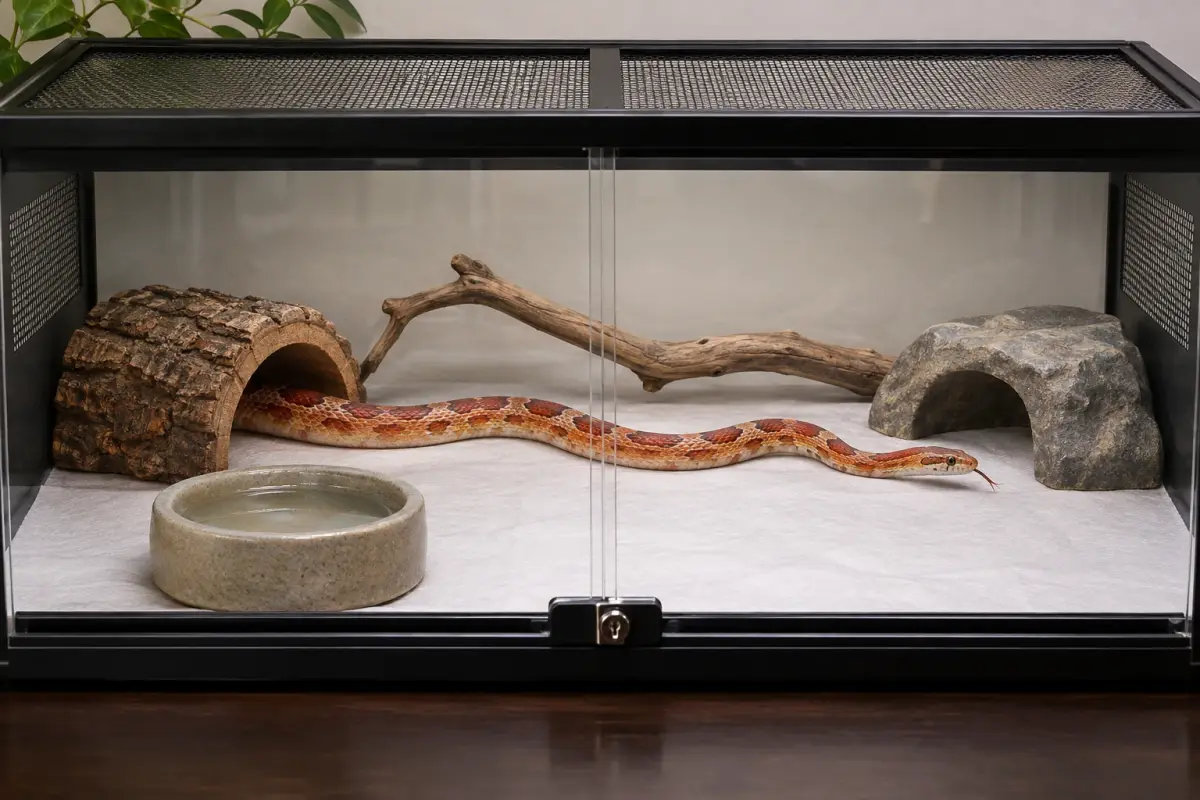
VCA says a snake cage should be escape-proof, with sealed seams and a secure top that locks. Snakes are strong, patient and good at finding gaps, and a lid that merely sits on top or a sliding door without a lock is a risk. Check every door, vent and cable hole, and look for a latch that a snake cannot push open.
A lost snake is stressful for the snake and for the household, and it can be hurt by a closing door or a pet. The Merck Veterinary Manual also says to keep only one species per enclosure, since group-housed snakes risk feeding trauma. Choose a lock you can operate with one hand while holding the snake.
Ventilation, humidity and temperature
Merck warns that ventilation can be severely hampered even when the whole top is covered with mesh, and that reducing ventilation to hold heat or humidity frequently causes skin and respiratory disease. A good enclosure moves air without losing all its warmth. Humidity needs vary: VCA says many snakes do well at 40 to 70 percent and desert species need less, and Merck lists ball pythons at 50 to 80 percent.
Provide a gradient so the snake can move between warm and cool. VCA gives the cool end as 70 to 75 degrees Fahrenheit and the warm end as 90 to 95 degrees, with night temperatures of 65 to 70 degrees, and says to use two thermometers, one at each end. Merck lists boa constrictors at 82 to 88 degrees and ball pythons at 77 to 86 degrees. Species differ, so check the figures for yours.
Heating safely
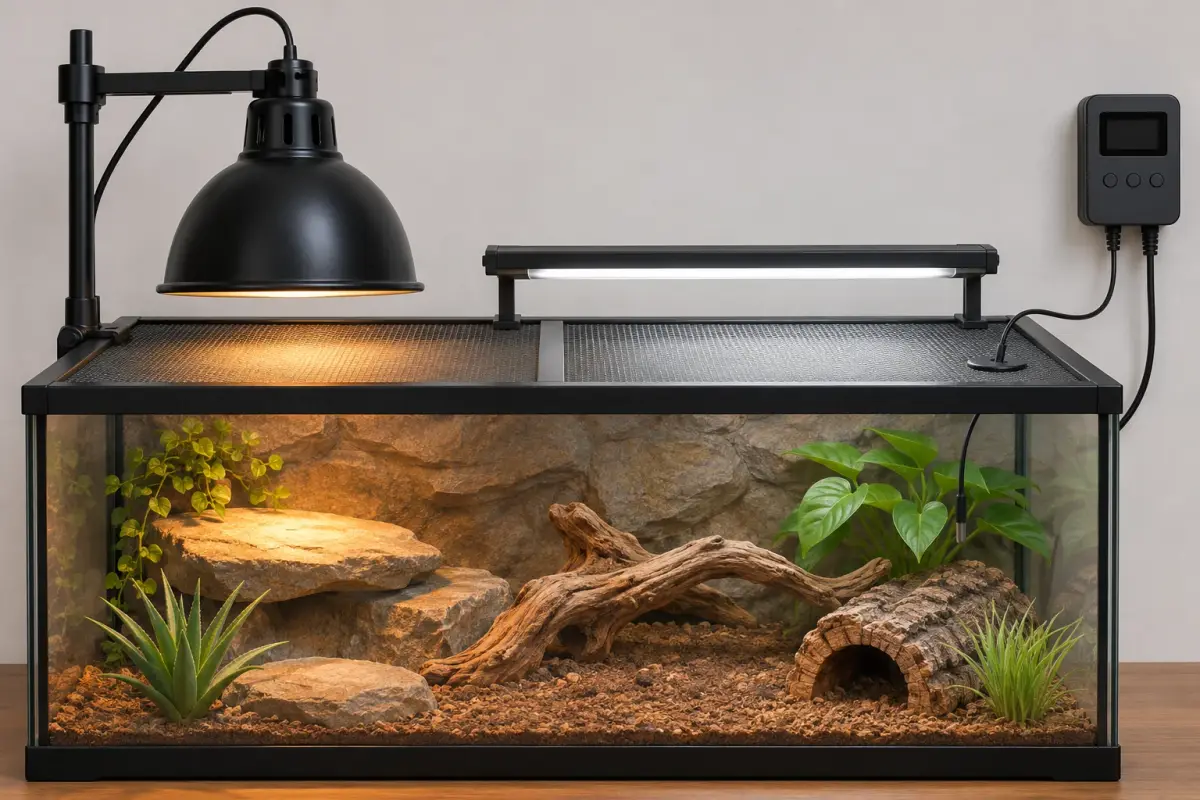
VCA recommends placing the heat source outside the cage, covered with a screen, and at least 4 to 6 inches from the highest point the snake can reach. Both VCA and Merck say to avoid hot rocks, because they cause burns and are ineffective. Merck adds that heaters should be thermostat-controlled and screened from the animal.
Heating decides how easy an enclosure is to set up. A tank with a mesh top on part of the lid leaves room for an overhead heat source, while a fully sealed box needs an external heater. Plan the heat before you buy, and check that a thermostat can be fitted without leaving a gap for escape.
Materials: glass, plastic and wood
VCA lists Plexiglas, glass, fiberglass and untreated wood as options, and says wooden cages are very difficult to clean and fully disinfect. Merck says glass aquaria are common but poor insulators, causing greater heat loss and dramatic temperature swings, and that visibility through glass may stress the animal. It describes wood, plastic and fiberglass as more versatile but more expensive.
For most keepers, a plastic or fiberglass enclosure is easier to wipe clean and handles heat better than glass. A glass tank works if you add a locking top, a heat source and a covered background. Whichever you choose, plan how you will wash it, because soap and water are generally enough, and Merck says bleach is acceptable if rinsed thoroughly while phenolic disinfectants are toxic.
Inside the enclosure: hides, substrate and cleaning
VCA says to provide a secure hiding place, such as an upside-down box, a hollow log, curved bark or a commercial reptile cave, and a large, heavy water bowl that resists spilling. Use newspaper, butcher paper, towels or artificial turf for substrate, and avoid sand, gravel, wood shavings, corncob, walnut shells and cat litter, which can cause intestinal impaction. VCA also says to avoid cedar shavings, which are toxic to reptiles.
Remove feces and dried urates every 24 to 72 hours, clean the water dish at the same interval and wash the cage weekly. If your snake stops eating, has skin or breathing problems, see a vet who treats reptiles promptly. When you are ready, compare the options in our snake enclosures collection, or see our reptile terrariums for wider setups. This page is general information, not veterinary advice, and it cannot replace an examination by the vet who knows your pet.
Common questions
What size enclosure does a snake need?
It depends on the species and adult length. VCA says smaller species and juveniles do well in a 10 to 20 gallon tank, and that you should move up as the snake grows.
What temperature should a snake enclosure be?
VCA gives a cool end of 70 to 75 degrees Fahrenheit and a warm end of 90 to 95 degrees, with 65 to 70 at night. Check your species, since some need less heat.
Is a glass tank good for a snake?
It can work with a locking top, but Merck notes glass is a poor insulator and loses heat. Some animals are also stressed by being seen from all sides, so cover part of it.
Can I use a wooden enclosure for a snake?
It is possible, but VCA says wooden cages are very difficult to clean and fully disinfect. Plastic, fiberglass or glass are easier to keep clean and hygienic.
What substrate is safe in a snake enclosure?
VCA suggests newspaper, butcher paper, towels or artificial turf. Avoid sand, gravel, wood shavings, corncob, walnut shells and cat litter, and never use cedar, which is toxic to reptiles.
Sources we checked
This guide is general information, not veterinary advice. If your pet is unwell or injured, contact your veterinarian.


