






Buying guides
Best Dog Whistles: What Actually Matters
The best dog whistle is the one you can blow the same way every time, that carries over the distance you work at, and that your dog has been taught to respond to. A whistle is a cue, not a control. Choose the type by where you train, then teach it with treats. Start with our dog whistles and use the checks below.
By Matt GarnettUpdated November 13, 20264 min read2 sources
What a whistle can and cannot do
The American Kennel Club describes a whistle as a communication tool, a cue you pair with a behavior in the same way you would a word or a hand signal. It is not magic: a dog has to be trained to respond, and a whistle will not make a dog come, or stop barking, on its own. AKC notes that dogs tend to get used to a whistle used against barking, so buying one for that job is likely to disappoint.
What a whistle does well is carry. AKC says dogs can hear up to 45,000 Hz while adult humans stop at about 20,000 Hz, and the high pitch carries over distance and cuts through background noise. It also sounds the same every time, regardless of how frustrated or excited you are, which is why handlers use it for recall and for stays at a distance.
Main whistle types compared
AKC lists several designs. Standard single-pitch whistles are the most common and the simplest. Two-tone whistles give you two pitches, handy if you want separate cues, or if two dogs need different signals. Shepherd's lip or pealess whistles produce a range of tones and are popular in herding, but they take more practice to control. A pea whistle contains a small ball that vibrates inside, and AKC says these work better in cold weather because they will not freeze.
For most pet owners starting out, a single-pitch or two-tone model is enough. If you have never used a whistle, a variable-tone design is more frustrating than helpful, because an inconsistent signal is the opposite of what makes a whistle useful. Buy a design you can blow the same way on the first try.
Audible versus ultrasonic whistles
Silent whistles are ultrasonic, meaning too high for people to hear but still audible to dogs, according to AKC. They will not bother neighbors, which suits dense areas. The trade-off is that you cannot hear what the dog is hearing, and AKC says they can be harder to use for multiple cues.
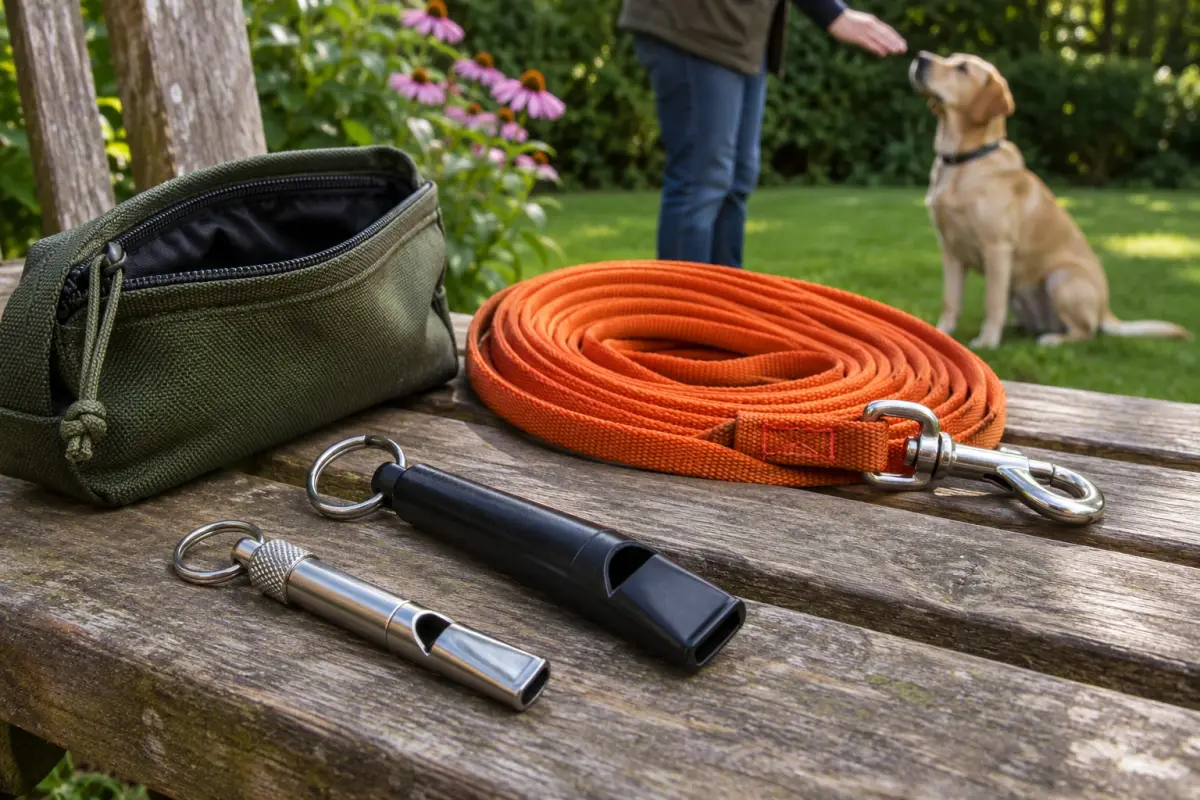
An audible whistle lets you check that your signal is consistent, and a pattern of toots can mean different things; AKC's examples are three toots for recall and one long toot for sit. The drawback is that audible whistles can draw stares or complaints. If you choose an ultrasonic design such as this ultrasonic training whistle, practice at home to settle on a blowing pattern before you rely on it outdoors.
Why the recall comes first, and the whistle second
A whistle works only on top of a recall that already works. AKC's recall guidance starts indoors on a leash with high-value rewards, then adds distance and distractions slowly, moving outdoors on a 6-foot leash before a 20-foot or 30-foot long line. It warns that indoor reliability does not transfer outdoors, and that sounding angry or boring makes a dog less interested in coming back.
That is why a long line is the natural companion to a whistle. A long dog leash lets you practice distance safely until the response is dependable. Our step-by-step guide on how to use a dog whistle walks through the process from the first treat to the first outdoor recall.
Using a whistle safely and considerately
AKC cautions that your dog hears the whistle much louder than you do, so it does not need to be blown at full force, and it should never be blown directly into your dog's ears because that is painful. Pick a tone or pattern that is distinct from other owners' whistles, since another person's whistle in the park can trigger your dog.
Keep your cue consistent: the same pattern for the same behavior every time. Start with a quiet room, blow once while your dog is looking at you, and give treats, as AKC describes. If your dog shows signs of ear discomfort or you worry about its hearing, talk to your vet before using any whistle.
Which whistle suits which owner
If you hike or work your dog at distance, a loud audible whistle with a clear pattern is practical and lets you hear what you are sending. In a crowded neighborhood, an ultrasonic one avoids complaints, provided you practice consistently. In cold climates, a pealess design avoids the freezing problem AKC mentions for pea whistles, though it needs more skill.
If you are new to training, start with one cue and one pattern, and resist the urge to add more until the first one is reliable. When you are ready to compare designs, browse dog whistles and pair one with a long line for outdoor practice.
Whistle pitch controls
| Type | Physical or sound-control feature | What to try before choosing |
|---|---|---|
| Single pitch | One principal signal from the body | Repeatability of the intended cue |
| Two tone | Separate pitches available | Access to each pitch |
| Variable tone | The handler varies the signal | Consistent control of the chosen cue |
| Pea design | A small internal ball affects the sound | Exact body construction and care instructions |
Common questions
Do dog whistles stop barking?
Not reliably. AKC says dogs tend to get used to the sound, so a whistle used against barking loses effect. A whistle is a cue the dog must be taught to respond to, such as for recall.
Can dogs hear silent whistles?
Yes. AKC says dogs can hear up to 45,000 Hz, while adult humans hear up to about 20,000 Hz. Silent whistles are ultrasonic, too high for people but within a dog's hearing range.
Which dog whistle is best for recall?
Any whistle you can blow consistently works, provided the dog has been taught what it means. AKC suggests a standard or two-tone whistle for beginners and a distinct pattern, such as three toots for recall.
Is a dog whistle harmful to dogs' ears?
AKC warns that dogs hear whistles much louder than people do, so you should not blow at full force or directly into a dog's ears. Ask your vet if you have concerns about your dog's hearing.
How do I start training with a whistle?
In a quiet room, blow the whistle while your dog is looking at you, then give five treats one at a time, as AKC describes. Repeat after several minutes, then pair it with a known cue.
Sources we checked
This guide is general information, not veterinary advice. If your pet is unwell or injured, contact your veterinarian.

