






Buying guides
Best Dog Coat With a Harness Hole: What Actually Matters
The best dog coat with a harness hole fits snugly without restricting movement, has an opening that lines up with your dog's harness ring, and suits the weather and coat of your dog. Measure back length, chest girth and neck first, decide between a built-in harness and a leash opening, and never leave a coat on an unsupervised dog.
By Matt GarnettUpdated November 14, 20264 min read2 sources
Does your dog need a coat at all?
Not every dog does. The AKC says small dogs, especially toy breeds, and dogs without thick fur get cold easily, along with lean short-haired breeds such as Whippets and Greyhounds, hairless breeds, dogs with shaved fur, young puppies and senior dogs. Healthy large dogs with thick coats generally do not need sweaters and could overheat in them.
If your dog is in the first group, a coat with a harness opening solves a practical problem: you can keep the dog warm and still clip the leash on without removing layers. If your dog is a thick-coated husky type, save the money and ask your vet if you are unsure. When you are ready to compare styles, browse our dog coats with a harness hole.
Harness hole, built-in harness or coat over harness
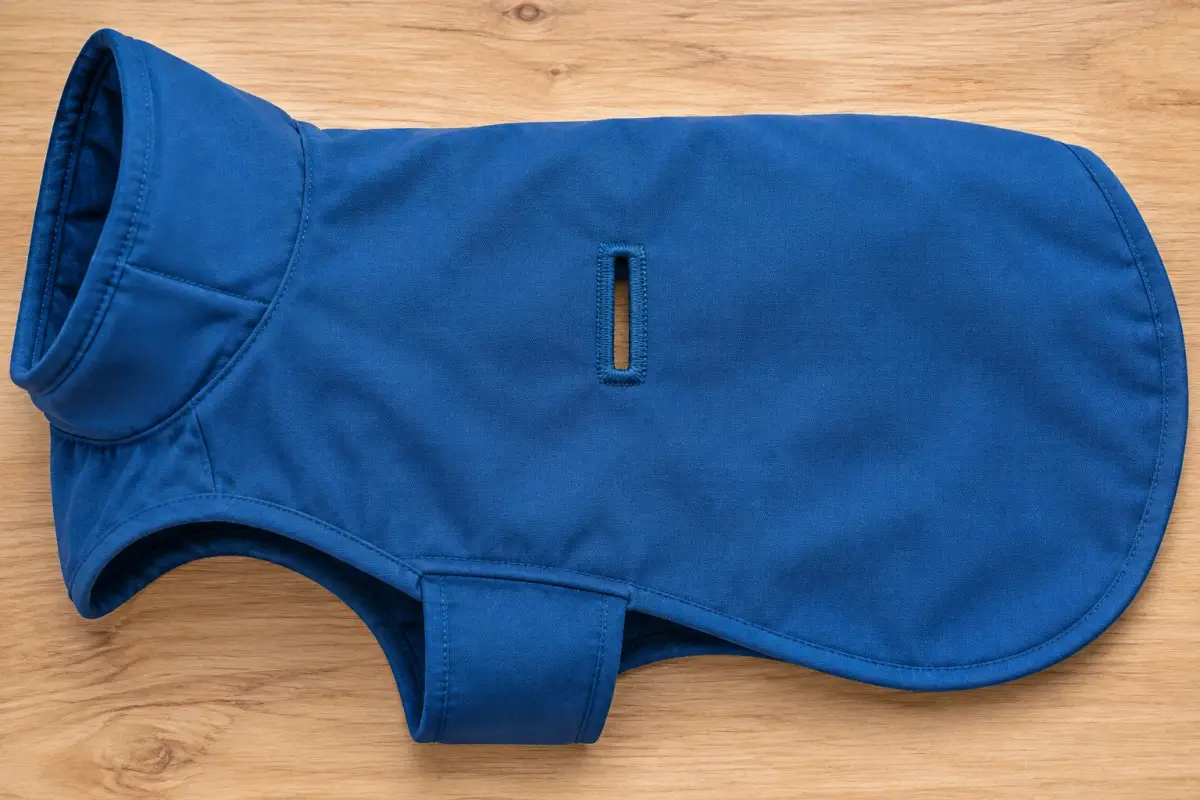
There are three common designs. The first is a coat with an opening on the back, so the coat goes over your dog's own harness and the leash clips to the harness ring through the hole. The AKC notes that a built-in hole for a leash or harness attachment lets the sweater sit over the harness. The second is a coat with a harness built in, such as this padded dog coat with a built-in harness, which puts the leash attachment on the garment itself. The third is a coat designed to go under a harness, which leaves the harness fully visible.
The trade-off is simple. A hole over your own harness keeps a harness you already trust and fits, but the opening has to line up with the ring. A built-in harness is one less piece to put on, but you rely on the garment for the leash connection, so check how it is stitched and how it adjusts. An under-harness coat is the easiest to swap between harnesses, though the harness can bunch the fabric.
How to measure for a good fit
The AKC says a properly fitting dog sweater fits without being too big or too tight: baggy garments can tangle or trip a dog, and tight ones restrict movement. Measure with a soft tape: back length from the base of the neck to the base of the tail, chest girth at the widest part behind the front legs, and neck size. Sizing varies by brand, so compare your numbers with the maker's chart rather than ordering by weight or breed alone.
If your dog wears a harness, measure with the harness on, since the extra layer adds bulk at the chest and shoulders. Check that the opening sits where the harness ring sits when your dog stands, not only when it sits or lies down, and that straps and belly fasteners do not hang loose where they could catch a leg.
Which style suits which dog
For a short-haired small dog on city walks, a padded or fleece coat such as this padded winter dog coat with a built-in harness covers the back and chest where heat is lost. For an energetic dog that runs and plays, a lighter coat or outdoor jacket with a built-in harness is less likely to overheat. Coats with leg sleeves cover more of the body and insulate more in very cold weather, according to the AKC.
For puppies and seniors, choose soft, easy-on styles and avoid anything that pulls on joints. For a chest-strap design like the chest strap jacket padded coat, check that the strap sits flat and cannot rub under the front legs. If your dog dislikes pulling a coat over the head, look for a coat that fastens along the back or belly.
What to avoid
Avoid coats that are loose enough to snag, designs with hanging straps, and any garment that restricts how your dog walks or lifts its legs. The AKC advises supervising your dog whenever it wears clothes and removing them before crating or leaving the dog alone, since loose items can snag or become a choking hazard.
Avoid putting a thick coat on a dog that does not need one. Overheating is possible, especially indoors or during exercise. If your dog scratches at the coat, freezes or seems stressed, take it off and go back to a slower introduction.
Introducing and caring for the coat
The AKC suggests introducing clothing gradually: let your dog sniff the coat, reward calm behavior, then put it on briefly with treats and build up wearing time indoors before a walk. Keep sessions short and positive, and stop if your dog seems stressed.
Wash coats regularly, since oils and dirt can cause odor and skin irritation, and follow the care label to avoid shrinking. Check straps, fasteners and the harness opening for wear every few weeks. You can compare more styles in our dog coats with a harness hole collection.
Common questions
Do you put a dog coat over or under the harness?
It depends on the design. A coat with a harness hole goes over your dog's harness so the leash clips to the harness ring through the opening. Other coats are made to sit under the harness.
Can a dog wear a coat all day?
It is better not to. The AKC advises supervising your dog while it wears clothes and removing them before crating or leaving the dog alone, since garments can snag or become a choking hazard.
How do I know a coat fits my dog?
It should be snug without being tight: your dog should walk, sit and lift its legs freely and the coat should not shift or hang loose. Measure back length, chest girth and neck, and use the maker's chart.
Does my large dog need a coat?
Healthy large dogs with thick coats generally do not, and they can overheat in one. Short-haired, small, senior, very young or hairless dogs are the ones most likely to benefit. Ask your vet if you are unsure.
Sources we checked
This guide is general information, not veterinary advice. If your pet is unwell or injured, contact your veterinarian.


