






Buying guides
Best Cat Exercise Wheel: Is One Right for Your Cat?
A good cat exercise wheel has a large enough diameter that your cat runs with a straight back, around 40 inches or more for most adult cats and larger for big breeds, a textured, quiet running track, and a stable base with a brake or stopper. Wheels suit high-energy indoor cats that will train to them; many cats never use one.
By Matt GarnettUpdated November 14, 20263 min read2 sources
Is a wheel right for your cat?
A cat exercise wheel suits young, high-energy indoor cats, often active breeds such as Bengals and Abyssinians, that run laps around the house at night. The Ohio State Indoor Pet Initiative stresses that indoor cats need ways to be active and play (see how to exercise an indoor cat), and a wheel is one option among many, alongside climbing, interactive play and puzzle feeders.
Be realistic: many cats ignore a wheel, and most need training with a wand toy or treats to start. Older, overweight or arthritic cats may find it hard and are better served by gentle play; ask your vet before encouraging a cat with joint or heart problems to run.
What matters most
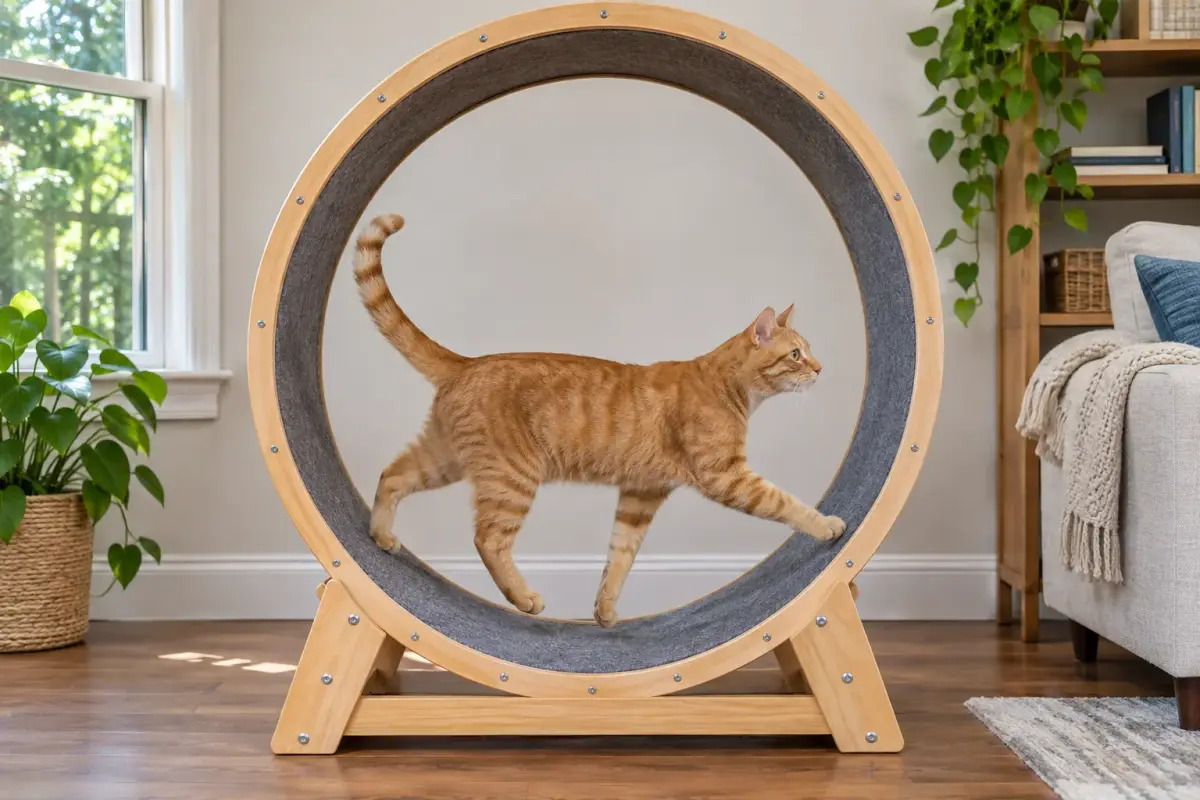
Diameter comes first. A wheel that is too small forces the cat to arch its back. Most adult cats need a wheel of roughly 40 inches or more, and large breeds such as Maine Coons need bigger, like this 52-inch wooden wheel. Check the track width too, so the cat can run without its feet catching the edges.
Then surface, noise and stability. A carpeted or textured track gives grip; a smooth plastic one can be slippery. Quiet bearings matter in apartments and at night. The base should be wide and stable so the wheel does not rock, and a brake or stopper lets you lock it when the cat jumps on.
Wheel types compared
Open-frame wheels, a circular track on a stand, are the most common and easiest for a cat to see into. Enclosed or drum wheels feel more secure to some cats but can be harder to train. Flat cat treadmills exist, but a cat cannot control the speed of a motorized one, so non-powered designs that the cat drives are the safer choice.
Most wheels, including a wooden cat exercise wheel, take a sizeable footprint, often over 4 feet tall, so measure floor space and ceiling clearance. Some come with scratching surfaces or platforms; those add value only if your cat uses them.
Training a cat to use a wheel
Start by letting your cat explore the wheel while it is locked. Toss treats onto the track. Unlock it and use a wand toy or laser dot, moving it along the track just ahead of the cat so a few steps move the wheel. Reward any movement. Keep sessions short and stop before the cat gets bored.
Many cats take days or weeks to run on their own. Ohio State suggests ending laser play with something the cat can catch, so finish with a toy or treat. Never force a cat onto the wheel or spin it with the cat on board.
Safety, care and lifespan
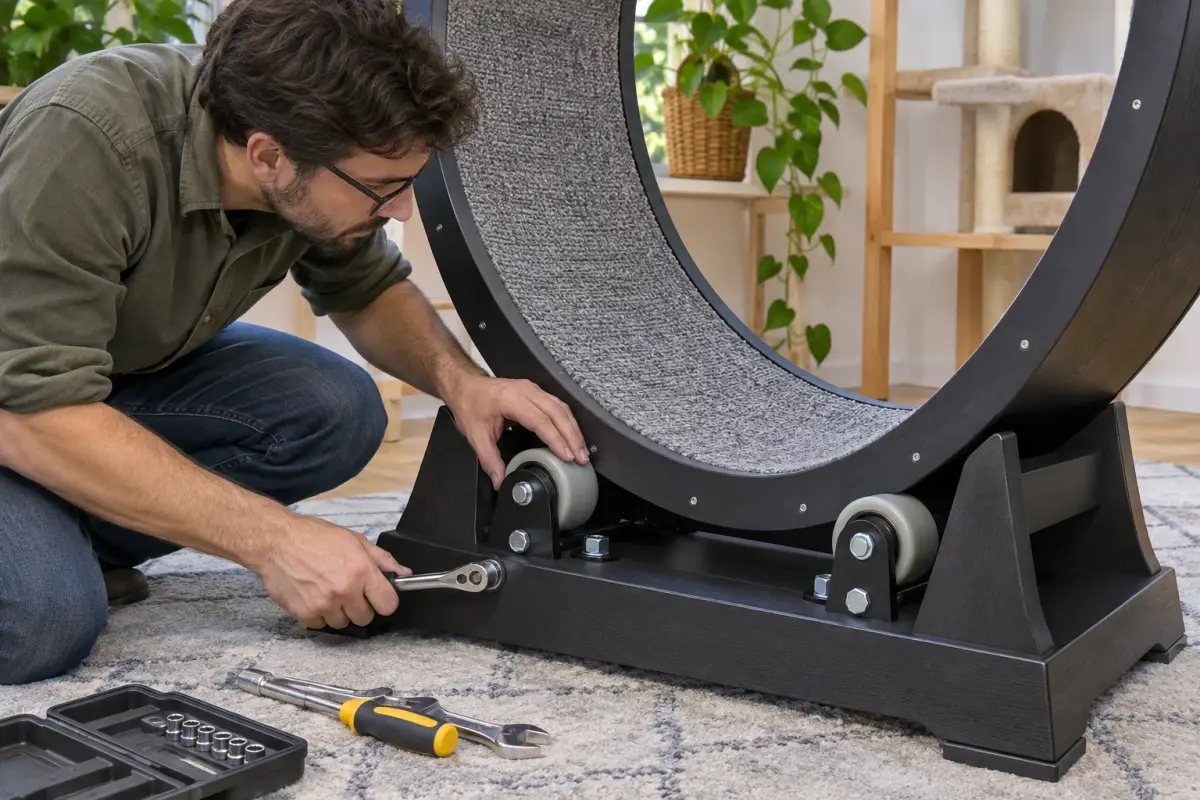
Supervise until your cat uses the wheel confidently, keep tails and paws of other pets and children clear of moving parts, and lock it when not in use if you have kittens or small pets. Check bolts and the track regularly, and vacuum hair from carpeted surfaces.
Watch for limping, heavy panting or reluctance after exercise and ask your vet if you see these. A well-built wheel lasts many years, but replace worn tracks or noisy bearings. Browse all cat exercise wheels or more cat toys.
Wheel enclosure and accessory choices
| Format | Physical difference | Measure or inspect |
|---|---|---|
| Open-frame wheel | An exposed circular running track on a stand | Inner diameter,track width and base |
| Drum or enclosed wheel | Additional sides around the running area | Entry opening and access for cleaning |
| Wheel with platforms | A wheel combined with resting or scratching parts | Complete footprint and each fixed attachment |
Common questions
Do cats actually use exercise wheels?
Some do, especially young, high-energy cats, but many need training with toys and treats, and some never take to it. A wheel works best as one of several ways to keep an indoor cat active.
What size cat wheel do I need?
Most adult cats need a wheel around 40 inches in diameter or larger, and big breeds need more, so they can run with a straight back. Check the track width too.
What is the best cat wheel for large cats?
One with a larger diameter, a wide track, a sturdy base rated for heavier cats and a textured running surface. Measure your floor and ceiling space before choosing.
Is a cat treadmill safe?
A non-powered wheel the cat drives itself is the safer choice. A motorized treadmill sets the speed for the cat, which can cause falls and stress, so avoid using one.
Sources we checked
This guide is general information, not veterinary advice. If your pet is unwell or injured, contact your veterinarian.


