






Breeds
Maine Coon vs Norwegian Forest Cat: How to Tell Them Apart
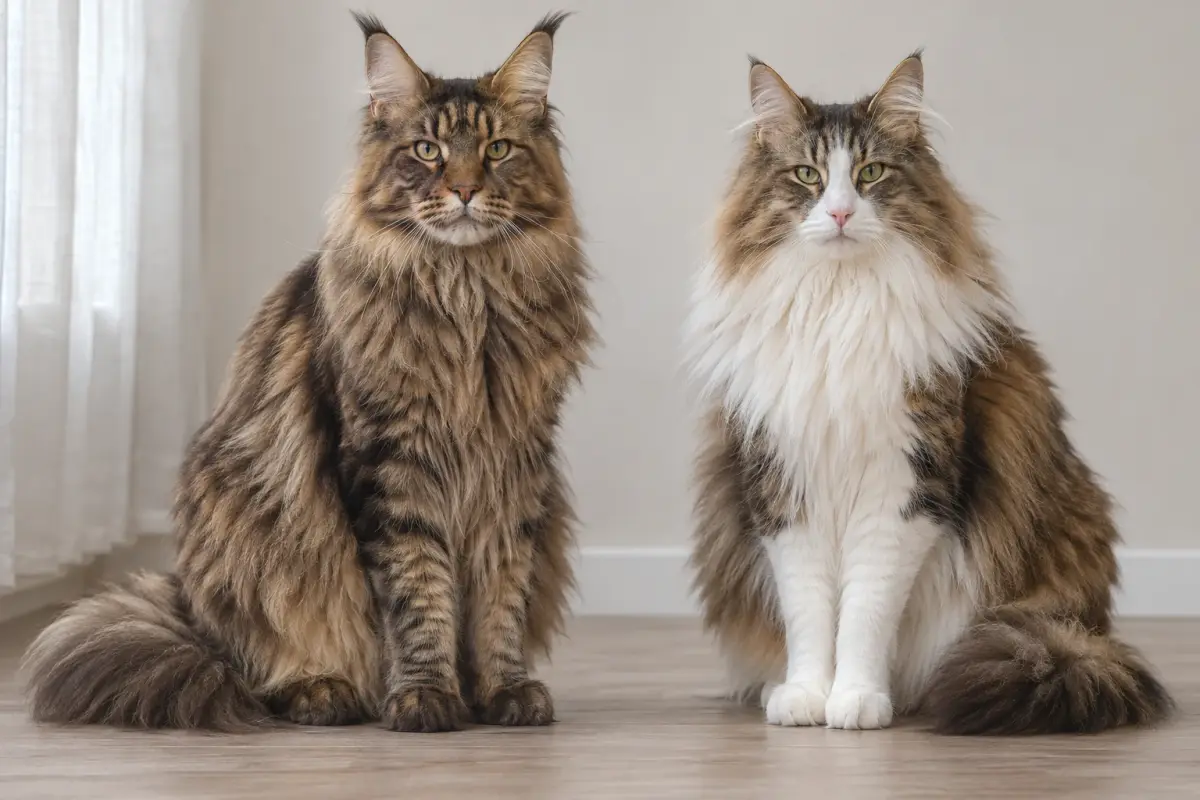
The Maine Coon and the Norwegian Forest Cat are both big, long-haired, cold-climate cats, and both are gentle and sociable. The Maine Coon is usually the larger and longer of the two, with a squarer muzzle and a chirping voice; the Norwegian has a triangular head, a straight profile and a heavier seasonal shed. VCA lists Maine Coons at 8 to 20 pounds and Norwegians at 12 to 22, and both take years to finish growing.
By Matt GarnettUpdated November 14, 20265 min read4 sources
Side by side
Size: VCA gives Maine Coons 8 to 20 pounds, with males up to about 8 pounds heavier than females and bodies up to 40 inches long; the CFA says mature males often reach or exceed 20 pounds. VCA gives Norwegian Forest Cats 12 to 22 pounds, while the CFA puts males at 12 to 16 and females at 9 to 12. Lifespan: VCA lists 12 to 15 years for the Maine Coon and 15 to 20 for the Norwegian. Maturity: up to 3 to 4 years for the Maine Coon and up to 5 for the Norwegian.
Coat: both have long, water-resistant coats; VCA rates Norwegian shedding 5 out of 5 and Maine Coon shedding 4. Grooming: VCA suggests a weekly comb for the Maine Coon and brushing at least twice a week for the Norwegian. Temperament: both are friendly and good with children and dogs. Voice: Maine Coons chirp and trill; Norwegians are quiet purrers. Best for: Maine Coons suit busy family homes; Norwegians suit homes with plenty of climbing space.
Origins
The Maine Coon is an all-American breed from New England, especially Maine, where farmers valued it as a mouser in the 1800s. The CFA calls it perhaps the most popular breed born in America and the largest of all pedigreed cats, with a documented history back to the 1850s. Its heavy coat and broad, tufted paws suit snowy northeastern winters, and it is the official state cat of Maine.
The Norwegian Forest Cat, or Skogkatt in Norway, is thought to descend from cats that reached Norway long ago and adapted to harsh Scandinavian winters. VCA notes it sailed with the Vikings to keep grain stores free of mice, and the CFA says it was named the official cat of Norway. It reached CFA championship status in 1993.
How to tell them apart
Look at the head first. VCA describes the Maine Coon's head as large and square, with big, wide-set eyes, tufted ears and a full mane, and the CFA standard asks for a squareness to the muzzle. The Norwegian Forest Cat has a triangular head with a straight nose, almond-shaped eyes and ears that tilt forward, giving a sweeter, more equilateral face.
The body helps too. A Maine Coon is long and rectangular with a barrel chest, with a shaggy, weatherproof coat. The Norwegian has a double coat with a water-repellent overcoat and long guard hairs, plus a bushy tail that can reach 12 inches. Norwegians are also notable climbers and like to watch the world from high perches.
Temperament
VCA describes the Maine Coon as super mellow and affectionate with people, cats and dogs, an ideal cat for a busy household. Maine Coons show affection with chirps, trills and head butts, often play with water, and can be clicker trained. The CFA notes they get along well with children and other animals, though both may be wary of a Maine Coon's size at first.
VCA calls the Norwegian Forest Cat a friendly, affectionate cat that is not overly demonstrative, welcomes children, cats and dogs, and is mellow and adaptable. It is fairly quiet but purrs steadily when content. Both breeds are clever: Norwegians are skilled hunters, and Maine Coons famously scoop food and water with their paws.
Grooming and shedding
The Maine Coon's coat mats less easily than many long-haired breeds, and VCA suggests a weekly metal comb, though the CFA notes breeders recommend combing two or three times a week to control shedding and hairballs. Check behind the ears, under the legs and on the belly, where tangles start.
The Norwegian's coat needs brushing at least twice a week, and VCA warns that during the seasonal shed it drops so much undercoat that it looks like a smaller cat. Plan on daily brushing during spring and fall. For both, a wide-toothed comb and an undercoat brush are the most useful tools, and our guide to the best cat brushes covers how to choose them.
Which to choose
Choose a Maine Coon if you want the biggest, most dog-like companion of the two: sociable, chatty in its own chirping way, playful with water and happy at the center of family life. Choose a Norwegian Forest Cat if you want a slightly more independent but still affectionate cat that loves to climb and is quieter around the house.
Both need a sturdy, tall cat tree with a wide base, a large litter box and a carrier sized for a 15 to 20 pound adult. Both mature slowly, so a two-year-old may still be filling out. Ask breeders about heart and hip screening and keep up yearly vet visits, where your vet can also advise on a healthy weight for a big frame.
This page is general information, not veterinary advice, and it cannot replace an examination by the vet who knows your pet.
Common questions
Which is bigger, a Maine Coon or a Norwegian Forest Cat?
Usually the Maine Coon. The CFA calls it the largest pedigreed breed and says mature males often exceed 20 pounds, while it puts Norwegian males at 12 to 16 pounds. Individual cats overlap.
How can I tell a Maine Coon from a Norwegian Forest Cat?
Look at the head. A Maine Coon's head is large and square with a square muzzle, while a Norwegian has a triangular head with a straight nose and almond-shaped eyes. Maine Coons are also longer-bodied.
Which sheds more?
The Norwegian Forest Cat, especially seasonally. VCA rates its shedding 5 out of 5 and warns it sheds so much undercoat it looks smaller. The Maine Coon is rated 4 out of 5.
Are Maine Coons and Norwegian Forest Cats good with kids?
Both are. VCA rates both 5 out of 5 for being good with children, and describes both as friendly with dogs and other cats. Supervise young kids so they handle these big cats gently.
Sources we checked
This guide is general information, not veterinary advice. If your pet is unwell or injured, contact your veterinarian.