

Buying guides
Comparing Dog Back Wrap Measurements
A torso wrap has to match more than a dog’s back length. Neck, chest, rear circumference and the length of the panel can each affect whether the garment closes in its intended position. Use this guide to compare a specific measurement chart and closure layout, without treating the equipment as a diagnosis or treatment.
By Giddy Pets EditorialUpdated November 14, 20263 min read2 sources
Identify the garment before choosing a chart
A back wrap, a knee sleeve and a walking harness cover different parts of the body. Start by identifying the panel and straps in the actual product images. Note whether the garment has front-leg openings, a rear strap or a separate neck section. These details help you find the correct chart for that design.
Use the maker’s instructions for the exact wrap. WiggleLess’ measuring page, for example, provides its own measuring demonstrations. Such instructions belong to that product family; they are not permission to borrow its size boundaries or fitting method for another brand. Keep model names and diagrams attached to their own measurements.
Read all the measurement columns
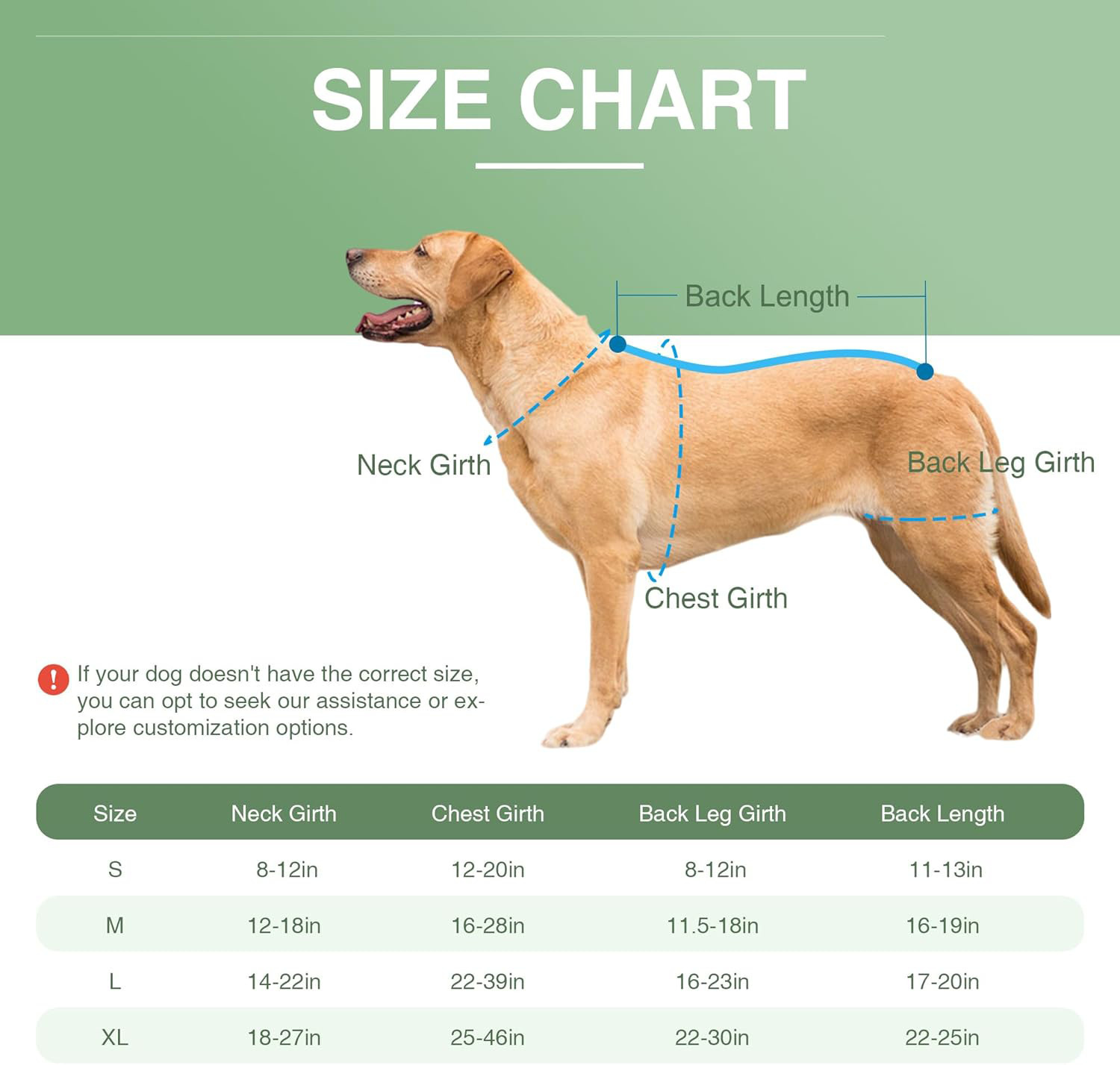
The black polyester back wrap with strap closures has four columns in its size chart: neck girth, chest girth, rear-leg-area girth and back length. Check every column rather than choosing by the most familiar one. A size may match the chest while its panel length or another opening differs.
The diagram places the neck reference around the lower neck, the chest behind the front legs and the rear reference around the lower torso ahead of the hind legs. Back length is a separate line along the upper body. These are chart references for this garment, not a universal clinical bracing protocol or a way to decide whether support is needed.
Keep inches and centimeters together
Record the original unit before converting. Multiply inches by 2.54 to obtain centimeters, and keep a consistent rounding rule across the chart. A decimal such as 11.5 inches is different from 11 inches; preserve it during conversion. Range endpoints also matter, so do not simplify a range to its midpoint.
In the example wrap, Small has a neck reference of 8–12 inches, chest of 12–20 inches, rear reference of 8–12 inches and back length of 11–13 inches. Other sizes have their own ranges. Those figures demonstrate why a letter size alone is not enough. Compare the actual chart rather than applying a blanket instruction to size up.
Inspect closures and usable panel coverage
Follow each strap to its fastening point. Check where it passes through a loop, where the free end sits and whether the closure can be inspected without removing another section. Look at both the outside and inside views. A close-up of a fastening is useful, but it does not show the entire path around the body.
Ask which measurements describe the closed garment and which describe adjustment limits. Establish whether the diagram includes edge binding or projecting straps. Do not assume that tightening a closure changes the length of the panel. Keep requests about material, seams and fasteners separate from questions about clinical support; a photograph cannot establish both.
Collect the instructions needed before use
Keep the full chart with the actual model, size and material information. Ask for the maker’s fitting, cleaning and inspection instructions, including restrictions concerning closures or detachable components. A product weight is a handling detail rather than a fit measurement or an instruction about how long the garment can be worn.
An individual veterinarian should decide whether this equipment is appropriate and provide any clinical fitting or wearing plan. This guide does not prescribe tension, duration or recovery use. For equipment comparison, record what is confirmed and request missing details before ordering. No second comparable back-wrap model is included here, and knee products are not substitutes.
Common questions
Should I automatically choose the larger size?
No. Compare all four ranges and get model-specific guidance when they do not align.
Does the rear column mean the same thing as chest girth?
No. Follow the separate rear reference shown in the exact diagram.
Can this guide tell me how tightly to fasten a medical support?
No. Clinical suitability, fitting and wearing instructions need individual professional guidance.
Sources we checked
This guide is general information, not veterinary advice. If your pet is unwell or injured, contact your veterinarian.