






Breeds
Bengal vs Savannah Cat: Ancestry and Care Needs
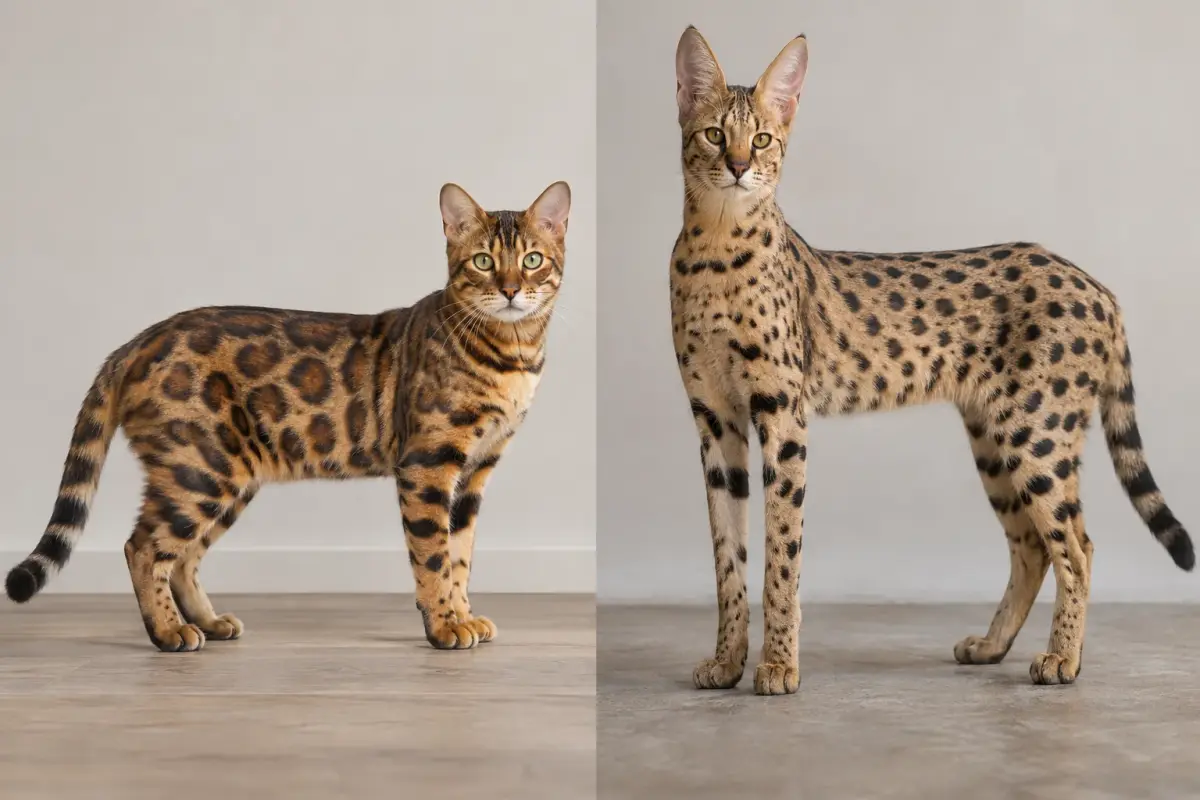
Bengals trace their development to domestic cats crossed with Asian leopard cats, while Savannah ancestry involves a serval. Generation and the individual cat matter, so neither name alone establishes size, temperament, or household fit. Compare documented ancestry, behavior, and care needs rather than treating a striking coat as a reason to choose a cat with needs you may struggle to meet.
By Matt GarnettUpdated November 14, 20263 min read3 sources
Start with ancestry rather than a simple size chart
CFA describes the modern Bengal as a breed developed over many generations from a wild ancestor and requires documented domestic ancestry for its registered cats. Savannahs originate from crosses between domestic cats and the serval, and the generation number describes how far back the wild ancestor sits. Ask what is actually documented for the cat being considered.
VCA gives Bengals a broad 6–12-pound weight guide and 12–15-year lifespan guide. These are not predictions, and this page does not substitute a guessed universal Savannah range. Size, energy, grooming, learning, and best household fit need an individual discussion. A generation label alone cannot supply a complete profile of behavior or future health.
Take activity and household needs seriously
CFA describes Bengals as curious and athletic; VCA emphasizes activity and interaction. If you are considering an existing Bengal companion, ask about its daily behavior and how its needs have been met. What play does it enjoy, where does it rest, and which arrangements make routine care comfortable?
For a Savannah or any cat with recent wild ancestry, ask for experienced advice before assuming ordinary household arrangements will suffice. The ASPCA opposes breeding and keeping wild-domestic hybrid cats as family pets, citing both humane and safety concerns. An appealing photograph cannot show the space, engagement, handling, or management an individual needs. Consider whether a domestic cat with a known, compatible routine is a better fit for your circumstances.
Either cat will need vertical space and exercise outlets, such as a tall cat tree or a cat exercise wheel.
Understand why welfare guidance differs from an appearance ranking
ASPCA opposes breeding and keeping wild-domestic hybrids as family pets because of safety and welfare concerns. That position deserves consideration alongside breed descriptions, especially when a cat has recent wild ancestry. It is not a reason to invent behavior predictions about every later-generation individual.
Ask a veterinarian familiar with the cat and an experienced welfare organization to help you understand the actual situation. Discuss documented ancestry, existing behavior, household animals, and comfortable care. Do not decide that a spotted coat establishes either danger or suitability. The question is what this animal needs and whether those needs can be met humanely in the proposed home.
Compare grooming and handling with direct information
A relatively short coat does not make the whole care commitment simple. Ask which grooming tasks the individual accepts and what happens during transportation, paw care, or an examination. Discuss any handling difficulties before taking responsibility for the animal rather than hoping affection will resolve them.
Ask about secure arrangements, other pets, and how the cat responds to unfamiliar people. Wild ancestry can bring complex care needs even beyond the first generation. Choose advice based on actual history and qualified assessment. Do not use an online comparison as a substitute for a plan that addresses the individual cat’s welfare and everyday management.
Make the decision with records and qualified help
Review available medical and behavior information with your veterinarian. Ask what is known about future care and what remains uncertain, including expected adult size for a growing cat. A broad lifespan guide or a generation label does not guarantee health, predictable training, or compatibility with children.
If you already care for one of these cats, seek experienced support for problems rather than trying to force behavior that conflicts with its needs. Report unexplained changes in appetite, movement, comfort, or behavior. If choosing a new companion, prioritize an individual whose needs can be met well over time rather than the most exotic appearance.
This page is general information, not veterinary advice, and it cannot replace an examination by the vet who knows your pet.
Common questions
Are Bengals and Savannahs the same type of cat?
No. Their wild ancestry differs: Bengals developed from Asian leopard cat crosses, while Savannahs involve serval ancestry. The individual and documented generation matter when assessing behavior, size, and care needs.
Does a later generation guarantee an easy household companion?
No generation label can guarantee temperament or suitability. Ask about the individual’s documented history, handling, social needs, and welfare requirements, and seek qualified advice before making a care commitment.
Is a spotted coat enough to identify ancestry or suitability?
No. Appearance alone cannot establish the full ancestry, behavior, or care needs of an individual. Use records and experienced assessment rather than choosing on looks or assigning a profile from a photograph.
Sources we checked
This guide is general information, not veterinary advice. If your pet is unwell or injured, contact your veterinarian.